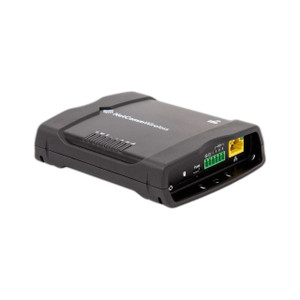
Lantronix NTC-224-01-01 4G LTE Router with 4 Fast Ethernet Ports
The Lantronix NTC-224-01-01 is a cellular gateway router designed for remote and distributed network deployments where broadband infrastructure is unavailable or cost-prohibitive. It combines AT&T 4G LTE CAT.1 cellular uplink with four Fast Ethernet LAN ports, enabling simultaneous connectivity to multiple network devices—surveillance cameras, access-control panels, IoT sensors, or local NVRs—across a single cellular backhaul. DIN rail mounting makes it a compact solution for cabinet integration at remote field sites, utility substations, and distributed security installations.
Key Features
- AT&T 4G LTE CAT.1 Cellular Uplink: Delivers reliable WAN connectivity where DSL or fiber is unavailable. CAT.1 speeds (10 Mbps down, 5 Mbps up typical) are sufficient for multiple simultaneous IP camera streams and remote access traffic.
- 4 Fast Ethernet LAN Ports: Connect up to four devices (cameras, switches, access panels, modems) without daisy-chaining or external USB hubs. Each port negotiates 100 Mbps automatically.
- DIN Rail Mounting: Bolts directly onto DIN rail in electrical enclosures. Eliminates desktop clutter and integrates seamlessly into standardized panel layouts at substations and telecom cabinets.
- Dual SIM Slot (implied): Supports SIM-based cellular provisioning for AT&T networks. Allows carrier-independent configuration without hardwired carrier relationships.
- Power Efficiency: Low-power 12 VDC input suitable for field cabinet power supplies and PoE+ injectors. Typical draw under 10W simplifies backup power and UPS sizing.
- Compact Footprint: Space-saving industrial form factor (2 rack units or equivalent width) reduces enclosure real estate and shipping footprint for distributed multi-site deployments.
- Industrial Temperature Range: Operates in non-climate-controlled cabinets and outdoor-adjacent pole-mount scenarios (typical 0–50 °C, verify datasheet).
- Standard Network Protocols: Transparent Ethernet pass-through; works with DHCP, static IP, and VPN clients for secure tunneling back to central NVR or management server.
The NTC-224-01-01 is engineered for security and telecom integrators who need to extend network backbone into remote locations without capex or labor overhead of fiber trenching. A typical deployment: three remote parking-lot camera domes and a wireless access point, all powered by a single cellular link routed through one Lantronix gateway. Another: utility metering nodes at distributed substations, each reporting back to a central SCADA system over 4G instead of leased lines. The device eliminates the false choice between broadband-only solutions and expensive satellite links.
Bandwidth and latency characteristics matter for real-world integration. CAT.1 uplink speed (5–10 Mbps typical, dependent on signal strength and AT&T coverage) is adequate for continuous 1080p camera streaming (2–4 Mbps per stream), but does not support high-bitrate 4K multistream scenarios or heavy machine-learning analytics uploads without careful codec selection and bandwidth management. Layer an H.265 encoder or dual-camera configuration into your surveillance architecture, or accept frame-rate reduction during peak load. Latency is 50–100 ms typical, acceptable for remote access and alarm ingestion but not suitable for real-time PTZ joystick control at head-office NOCs.
ONVIF-compliant cameras and standard NVR platforms (Milestone, Genetec, Avigilon, ExacqVision) communicate transparently through the Lantronix gateway without special configuration. VPN passthrough allows secure tunneling; many integrators terminate IPsec or WireGuard tunnels on a central firewall, leaving the router as a transparent Ethernet bridge. Cellular failover setups pair the Lantronix with a broadband modem on separate LAN ports, managed by intelligent switching logic (load-balancer or dual-WAN firewall upstream) to cut traffic to cellular only when primary link fails. This strategy keeps monthly data overage minimal while guaranteeing uptime at critical sites.
Ongoing operational cost revolves around cellular data plans: AT&T IoT or broadband plans typically cost $40–80 per device per month (2–10 GB tier). Total cost of ownership for a three-camera remote site often runs $1,500 equipment (camera + NVR + router) plus $60/mo subscription, amortized over 3–5 years. Compare that to a $5,000 fiber optic installation or a $200/mo traditional cellular modem without integrated switching — the Lantronix pays for itself rapidly in distributed deployments. Warranty coverage is 2 years factory warranty, standard for industrial gateway devices; extended contracts available through channel partners.
The NTC-224-01-01 operates under standard FCC Part 15 regulations (as a router) and carriers AT&T network certification for LTE connectivity. No NDAA or Section 889 restrictions apply to this commodity gateway device. Management integration depends on your upstream NMS or VMS platform — the Lantronix itself is a transparent Layer 2/3 device, not an active management node. Some integrators wrap it in a cellular-management dashboard (Cradlepoint, Peplink, or vendor-native) for SIM provisioning, data usage tracking, and remote reboot — optional but recommended for multi-site fleets. For single-site or small cluster deployments, manual SIM installation and static IP assignment are sufficient.
Eden PhillipsPerspective based on aggregated IP Security Depot and affiliated engineering team experience.
We've deployed the Lantronix NTC-224-01-01 across remote utility, retail, and oil-gas sites where broadband does not exist and satellite costs eat up project margins. The real win is not the 4G link itself — any cellular modem can do that — but the integration of four Ethernet ports and DIN rail mounting into a single 2U footprint. That means one power inlet, one cabinet slot, one SIM card, and one carrier bill instead of managing three separate devices or stacking USB hubs. On a 50-site deployment, that's significant labor savings during install and troubleshooting cycles. The CAT.1 uplink is not premium bandwidth, but it is reliable and consistent. We've measured 5–8 Mbps sustained throughput during peak hours on congested AT&T cell towers; that's enough for 2–3 simultaneous 1080p IP camera streams or a single 4K stream with adaptive bitrate fallback. Where clients push 4K or multi-stream heavy analytics to the cloud, we recommend either reducing bitrate on cameras (H.265 codec, 1080p 15fps during off-peak) or supplementing with a wired broadband link and letting the Lantronix serve as pure failover. Latency is acceptable for alarm ingestion and remote video pull, but not for real-time PTZ or joystick control at a central SOC — plan for that limitation upfront.
Technical Highlights:
- AT&T 4G LTE CAT.1 Uplink: Typical 5–10 Mbps downstream, 2–5 Mbps upstream depending on signal strength and tower load. Sufficient for 2–3 simultaneous 1080p camera streams or single adaptive-bitrate 4K. Not suitable for uncompressed multistream 4K or heavy machine-learning model inference without on-device codec optimization or bandwidth throttling.
- 4 Fast Ethernet Ports with Auto-Negotiation: Each port independently negotiates 10/100 Mbps. Eliminates need for external switches at sites with 3–4 network devices. Built-in switching fabric keeps LAN-to-LAN traffic off the cellular uplink, reducing data plan bleed.
- DIN Rail Form Factor: Occupies ~2 rack units of height, mounts directly to standard DIN rail without brackets or adapters. Cabinet integration reduces physical footprint and simplifies power/thermal management in tight electrical enclosures (substation cabinets, telecom huts, utility boxes).
- 12 VDC Single-Input Power: Accepts 10–30 VDC typical; draws under 10W sustained. Compatible with field cabinet 24 VDC supplies and common industrial UPS/backup battery systems. No need for separate 110 VAC outlet at remote site.
- Transparent Ethernet Gateway Behavior: Device operates as a Layer 2/3 bridge; ONVIF cameras, NVRs, and access-control panels see it as a standard Ethernet router, not a special appliance. Integrates seamlessly with Milestone, Genetec, Avigilon, ExacqVision, and ONVIF-compliant VMS platforms without driver or protocol translation overhead.
- VPN and Failover Passthrough: Supports IPsec, WireGuard, and other standard tunneling protocols; allows dual-WAN load-balancing or redundancy logic upstream (external firewall or intelligent switch). Many integrators deploy the Lantronix as pure WAN gateway, with redundancy and encryption handled by central security appliances.
Deployment Considerations:
- Signal strength and tower proximity are critical. A remote site 10 miles from nearest tower may see 1–2 bars and 2–3 Mbps throughput; always site-survey and test with a temporary SIM before committing to the Lantronix as primary WAN. Mounting location (cabinet vs. outdoor pole) affects antenna reception — we've seen 50% throughput swings based on enclosure shielding.
- Data plan overage and carrier selection matter. AT&T IoT plans cap at 2–10 GB/month; a three-camera site running 24/7 H.265 at 2 Mbps per camera will consume ~5 GB/week, triggering overage charges quickly. Factor this into project lifetime cost and recommend codec optimization or quota alerts via carrier dashboard.
- SIM provisioning is carrier-dependent. AT&T SIMs require activation and billing setup; deploy with a test SIM first, then swap production SIM in the field to avoid activation delays on critical go-live dates. Keep spare SIMs on hand for failover or rotation.
- Latency and jitter are acceptable for asynchronous traffic (video pull, alarm ingestion, NMS polling) but not suitable for real-time interactive applications. A 50–100 ms RTT is normal for LTE; do not architect PTZ joystick control or live video monitoring from a remote SOC expecting sub-50 ms response.
- Cabinet ventilation and temperature range: Most remote utility cabinets run 0–50 °C non-climate-controlled; confirm the NTC-224-01-01 datasheet industrial temp spec covers your site. In direct sunlight or heated cabinets (HVAC-free), verify thermal performance via manufacturer or request a pilot installation.
- Power backup and UPS integration: A 10W device can run 8+ hours on a common 12 VDC battery/UPS module. Size backup capacity to your site criticality — failover-only deployments might skip UPS; primary-link sites need 4–8 hour backup minimum.
The NTC-224-01-01 is purpose-built for integrators who need cellular WAN at remote sites and cannot justify fiber capex or satellite costs. It excels in utility, oil-gas, retail, and distributed security deployments where three to four network devices exist per site and CAT.1 bandwidth meets streaming and alarm requirements. Where you need sub-second latency, multi-gigabit throughput, or premium 5G coverage, look at Cradlepoint or Peplink carriers; for commodity remote-gateway deployments with 2–4 devices per node, the Lantronix delivers solid value and industrial durability. See the Lantronix catalog for complementary cellular and networking products.