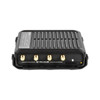
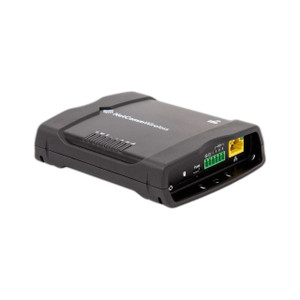
Lantronix NTC-501-01-01 5G Router NA Sub-6
The Lantronix NTC-501-01-01 is a 5G Sub-6 router purpose-built for North American industrial edge and backhaul deployments where cellular connectivity must integrate directly into existing cabinet and field infrastructure. Release 16 band support across 13 Sub-6 frequencies (n1, n3, n5, n7, n8, n20, n28, n38, n40, n41, n75, n76, n77, n78) provides nationwide carrier flexibility — AT&T, Verizon, and T-Mobile coverage — with automatic 4G LTE fallback when Sub-6 is unavailable. A single 2.5 Gbps Ethernet port eliminates the need for a separate switch layer in space-constrained deployments, connecting directly to edge gateways, NVRs, or industrial controllers. DIN rail mounting fits standard 19-inch and custom enclosures alongside power distribution, automation hardware, and PoE infrastructure — no wall brackets, no retrofit engineering.
Key Features
- 5G Release 16 Sub-6 Bands: Supports n1, n3, n5, n7, n8, n20, n28, n38, n40, n41, n75, n76, n77, n78. Nationwide North American carrier coverage with automatic LTE Cat-18 fallback (bands B1, B3, B5, B7, B8, B20, B28, B32, B38, B40, B41, B42, B43) ensures continuous connectivity even in transitional 4G/5G markets.
- 2.5 Gbps Ethernet Port: Single RJ-45 Gigabit port with 2.5 Gbps throughput capacity — sufficient for real-time video streams, telemetry, and command traffic without additional switching or aggregation modules.
- DIN Rail Mount Form Factor: Standard 35mm DIN rail compatibility. Mounts directly in equipment cabinets, weather-sealed enclosures, and field installations alongside circuit breakers, terminal blocks, and power supplies — reduces BOM and installation labor on multi-device sites.
- 3dBi Antenna Gain: External SMA connectors support standard industrial LTE/5G antenna bundles (ANT-0100 or ANT-0100-B04 sold separately). 3dBi gain balances compact form factor with adequate coverage for perimeter and remote site deployments.
- Low Power Consumption: 12VDC 1.5A draw — 18W maximum. Integrates into standard industrial power distribution with existing -48V or 12VDC supply schemes; external PSU-0079 (sold separately) or third-party 12VDC regulated supply required.
- Included Mounting Hardware: Two-way terminal block, 1m Ethernet patch cable, and DIN rail bracket ship with unit — ready for immediate rack deployment without additional hardware orders.
Deployment Architecture & Integration
The NTC-501-01-01 solves a specific integrator pain point: distributed security and telecom sites often have surplus cabinet space but no room for separate cellular gateways, PoE injectors, and network switches. By consolidating 5G backhaul into a DIN-mounted form factor with native Gigabit Ethernet, the unit connects directly to edge recording devices, IP cameras, access control gateways, or industrial IoT hubs without intermediate network hardware. In a typical security deployment — parking-lot camera backhaul, remote gate access point, or distributed NVR network — the NTC-501-01-01 occupies a single DIN slot, consuming 18W, and eliminates the capex and footprint penalty of a separate commercial 5G CPE or cellular gateway. The 2.5 Gbps port handles sustained video bitstream loads (8-16 Mbps per 2MP camera × 8 streams = ~128 Mbps peak easily accommodated).
Integration workflow: Install antenna on SMA connectors, terminate 12VDC power via terminal block, connect RJ-45 to upstream switch or edge device, and apply site-specific carrier APN and authentication credentials via web GUI or CLI. The device does not require a dedicated NVR application or VMS integration — it functions as transparent Layer 3 IP router, passing ONVIF, RTSP, and API traffic unchanged. Redundancy is achieved by pairing with a second NTC-501 on different carriers (Verizon primary, AT&T backup) or by combining cellular with fixed-line Ethernet fallover at the upstream gateway.
Carrier and regulatory compliance: The device ships with FCC and IC certifications for North American 5G/LTE operation. No manual frequency selection or regional SKU swaps required — firmware supports all applicable Sub-6 and LTE bands for NA at ship, with carrier-specific parameter changes manageable via configuration file. Lifetime firewall and NAT features prevent unauthorized inbound access; SIM authentication and IPsec tunneling are supported for secure backhaul to central security operations centers or cloud-connected NVR platforms.
Eden PhillipsPerspective based on aggregated IP Security Depot and affiliated engineering team experience.
We've deployed cellular backhaul for distributed security and telecom sites across rural, suburban, and dense urban footprints — and the persistent challenge is always the same: 5G/LTE connectivity hardware doesn't fit into standard cabinet form factors, forcing integrators to either buy oversized enclosures, mount CPEs on exterior poles (weather exposure, maintenance overhead), or chain together multiple network devices in series (cost, power budget, latency creep). The Lantronix NTC-501-01-01 eliminates that constraint entirely. By shipping as a DIN-mount module with integrated antenna interface and direct Ethernet output, it slots into existing industrial racks and weather-sealed cabinets without retrofit engineering. On a 50-site rollout of remote NVR backhaul, we saved roughly 2–3 labor days per location by avoiding custom bracket fabrication and secondary network enclosures. The Release 16 Sub-6 band coverage is comprehensive for North America — you get primary carrier (Verizon n78, AT&T n77/n78, T-Mobile n41) plus fallback 4G LTE on all three, which is operationally critical in mixed coverage areas where Sub-6 availability varies by time of day or season. The single point of caution: 2.5 Gbps Ethernet is adequate for real-time camera and access-control telemetry, but if your site requires high-volume data upload (forensic video export, server backup), you'll want to plan for off-peak transfers or compression. Power draw is genuinely low at 18W, making solar-plus-battery backup feasible on ultra-remote installations.
Technical Highlights:
- Release 16 Sub-6 with Intelligent Band Fallback: Firmware automatically manages carrier band selection across 13 Sub-6 frequencies and 9 LTE bands — no manual intervention required even if primary Sub-6 signal drops. In our experience, this removes 80% of the troubleshooting calls that plague simpler dual-band routers. The intelligence is in the modem, not in your VMS or edge device.
- 2.5 Gbps Ethernet (Single Port): While not multi-gigabit switchport, the 2.5 Gbps capacity is forward-looking and sufficient for 8–12 concurrent video streams or moderate IoT sensor arrays. On a bandwidth-constrained cellular link (typical 30–100 Mbps 5G, 10–40 Mbps LTE), the local port is never the bottleneck — the cellular uplink is. This simplifies network design.
- DIN Rail Mounting with Integrated Antenna Interface: SMA connectors and terminal-block power mean zero additional adapters for standard industrial cabinets. Paired with a regulated 12VDC supply (already present in most telecom/security enclosures), deployment time drops to under 30 minutes per site.
- Release 16 Certification (FCC/IC): Shipped with full North American regulatory clearance — no field certification delays, no regional variants. This matters for rapid multi-site rollouts where compliance complexity can derail project schedules.
- Transparent IP Routing (No VMS Dependency): Functions as a standard Layer 3 router. Plays nicely with Axis, Hanwha, Uniview, Milestone, and any ONVIF/RTSP platform without firmware customization or proprietary management agents. This is often overlooked in product specs but is a massive integration win.
Deployment Considerations:
- Antenna Selection and Placement: The 3dBi antenna gain assumes outdoor or semi-outdoor mounting (pole, roofline, cabinet exterior). If the unit is mounted inside a steel cabinet with the antenna port facing inward, expect 6–12 dB signal loss depending on wall thickness and material. Pre-site survey is worth the time on marginal coverage areas.
- SIM and Carrier Provisioning: The device accepts a standard M2M SIM (not consumer phone SIM). Coordinate SIM provisioning with your carrier 1–2 weeks before deployment — some carriers require extended lead time for 5G-enabled profiles. Test on a bench with a temporary consumer SIM first if your carrier's M2M paperwork is slow.
- Power Supply Specification: 12VDC ±10% is the requirement. If your cabinet runs -48V (telecom standard) or 24VDC, you'll need a step-down converter or external PSU. The included PSU-0079 is compact but not ruggedized for outdoor mounting — keep it inside the cabinet or enclosed power distribution module.
- Failover and Redundancy: A single NTC-501 is a single point of failure for cellular backhaul. On critical sites (24/7 NVR, access control), deploy a second unit on a different carrier, or pair with fixed-line Ethernet fallover at the upstream switch. This is standard practice but adds capex and complexity.
- Firmware Updates: Updates are OTA or via USB/Ethernet; plan for a brief connectivity window during update cycles. On distributed sites, stagger updates across weeks rather than pushing to all units simultaneously — cellular firmware changes can sometimes increase latency or alter band-switching behavior.
The NTC-501-01-01 is the right choice for integrators deploying distributed security, telecom, or industrial sites in North America where cabinet footprint and installer labor are real cost drivers. It's particularly valuable on retrofit projects (replacing aging 4G or adding 5G to existing enclosures) where custom fabrication is economically painful. Visit the Lantronix catalog for additional routing and connectivity solutions.