
Zebra DS8108 vs Zebra DS8108: Specification Comparison
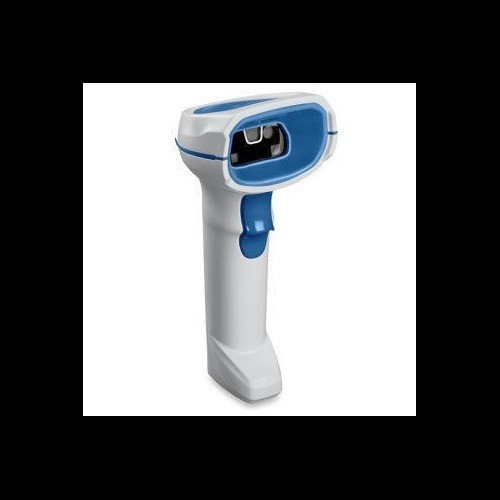
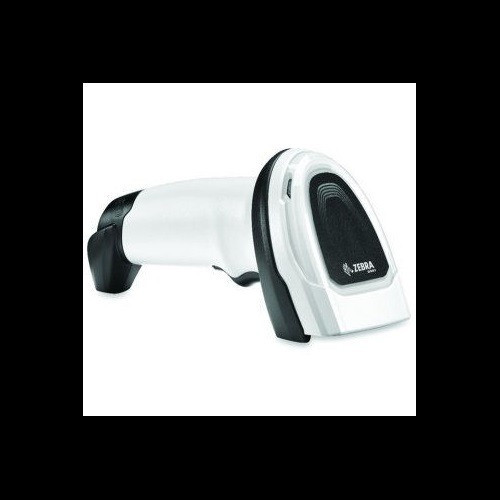
Both products are Zebra DS8108-series corded area-imager 2D barcode scanners sharing the same physical platform, imaging engine, and Bluetooth 4.0/BLE radio. The comparison pits the DS8108-HC4000BVZWW — a Healthcare-configured model with a vibration motor, disinfectant-ready housing, and HC White finish — against the DS8108-DL00006ZZWW — a Standard Range model with Driver's License parsing (DL Parsing) capability and Nova White finish. Buyers cross-shopping these two are typically choosing between a clinical/patient-care deployment and a retail/government ID-verification deployment on identical hardware.
In This Guide
- How do the scanning capabilities and decode feature sets differ between these two models?
- Which model offers broader host interface and connectivity options?
- How do the environmental ratings and healthcare-specific design features compare?
- Which should you choose: the DS8108 or the DS8108?
- Side-by-Side Specs
- FAQ
How do the scanning capabilities and decode feature sets differ between these two models?
Both scanners share the same core imaging engine: a 1,280 × 960 pixel sensor, 48° H × 37° V field of view, 16% minimum print contrast, and ±60°/±60°/0–360° skew/pitch/roll tolerance. The HC model's spec sheet provides explicit decode range data — Code 39 3 mil reads from 2.2 in. to 5.0 in., Code 128 5 mil from 1.6 in. to 8.4 in., and PDF 417 6.7 mil from 1.8 in. to 8.5 in. — whereas the DL model's provided specs do not list comparable per-symbology range tables (only a Minimum Element Resolution of Code 39 3.0 mil is noted).
The DL model carries two capabilities absent from the HC model's spec sheet: Driver's License parsing (the 'DL' designation indicating parsed data extraction from AAMVA-format DLs) and Digimarc digital watermark decode support. The DL model also lists Graphics Format Support (Bitmap, JPEG, TIFF) and Image Quality Resolution of 109 PPI on an A4 document. The HC model's spec sheet does not list these imaging output or DL-parsing features. Supported 1D symbologies are enumerated only for the DL model: Code 39, Code 128, Code 93, Codabar/NW7, Code 11, MSI Plessey, UPC/EAN, I 2 of 5, Korean 3 of 5, GS1 DataBar, and Base 32.
Which model offers broader host interface and connectivity options?
Both models implement Bluetooth 4.0 with BLE, Class 1, with a stated wireless range of 330 ft. (100 m). The DL model additionally calls out a Class 2 range figure of 33 ft. (10 m); the HC model's spec sheet does not list a Class 2 range figure.
Host interface support is explicitly documented only for the DL model: USB, RS232, Keyboard Wedge, and TGCS (IBM) 46xx over RS485, with support for over 90 international keyboards. The HC model's spec sheet does not enumerate supported host interfaces. The DL model is also the only one with a stated FIPS 140-2 security compliance listing, which is relevant for government and regulated-enterprise deployments. Both models use the same cradle power input specifications (5V: 4.7–5.5 VDC; 12V: 10.8–13.2 VDC), though the DL model's spec sheet records cradle current as 470 mA (5V) and 743 mA (12V), while the HC model lists only 470 mA at 12V.
How do the environmental ratings and healthcare-specific design features compare?
Both scanners share identical environmental ratings across all provided specs: IP42 sealing, 6.0 ft./1.8 m drop to concrete, 2,000 tumbles at 0.5 m, ±15 kV air / ±8 kV direct / ±8 kV indirect ESD, 0–9,000 foot-candle ambient light immunity, 0°–50°C operating temperature, 0°–40°C charging temperature, −40°–70°C storage temperature, and 5–95% RH non-condensing humidity. Regulatory compliance listings are substantially the same across both models.
The HC model is differentiated at the configuration level by its vibration motor (tactile decode feedback), HC White housing (formulated for repeated disinfectant-wipe cleaning per healthcare standards), and the 'HC' SKU designation. These are configuration attributes rather than published numerical specs, but they are stated in the product description. The DL model's Nova White housing does not carry an HC designation and is not described as disinfectant-ready. Neither model's spec sheet documents disinfectant chemical compatibility test results or lists specific cleaning agents; buyers requiring detailed chemical compatibility should request Zebra's environmental specifications document.
Which should you choose: the DS8108 or the DS8108?
Our take: The DS8108-HC4000BVZWW is the stronger choice when the deployment is a clinical or patient-care environment requiring disinfectant-ready hardware and tactile vibration feedback, while the DS8108-DL00006ZZWW is the stronger choice when the use case demands Driver's License parsing, Digimarc watermark decode, FIPS 140-2 security compliance, or explicit multi-interface host support (USB/RS232/Keyboard Wedge/IBM 46xx). Three concrete spec deltas: (1) the DL model lists FIPS 140-2 compliance; the HC model's spec sheet does not; (2) the DL model documents cradle current at both 5V (470 mA) and 12V (743 mA), while the HC model lists only a 12V figure (470 mA); (3) the DL model explicitly enumerates 11 supported 1D symbologies plus Digimarc, while the HC model's spec sheet provides decode range tables instead. Both models are otherwise electrically, mechanically, and environmentally identical per the provided specifications.
Side-by-Side Comparison
Spec-for-spec, from manufacturer data.
| Specification | Zebra DS8108 | Zebra DS8108 |
|---|---|---|
| SKU | DS8108-HC4000BVZWW | DS8108-DL00006ZZWW |
| Configuration | Healthcare, Vibration Motor, HC White | Standard Range, DL Parsing, Nova White |
| Dimensions (Corded) | 6.6 x 2.6 x 4.2 in. | 6.6 x 2.6 x 4.2 in. |
| Weight (Corded) | 5.4 oz. / 154 g | 5.4 oz. / 154 g |
| Image Sensor | 1,280 x 960 pixels | 1,280 x 960 pixels |
| Field of View | 48° H x 37° V | 48° H x 37° V |
| Bluetooth | v4.0 + BLE, Class 1, 330 ft. | v4.0 + BLE, Class 1, 330 ft.; Class 2, 33 ft. |
| Battery | 2,500 mAh Li-Ion | 2,500 mAh Li-Ion Power Precision+ |
| Scans Per Charge | 65,000 | 65,000 |
| Operating Time Per Charge | 83 hours | 83 hours |
| IP Sealing | IP42 | IP42 |
| Drop Specification | 6.0 ft. / 1.8 m to concrete | 6.0 ft. / 1.8 m to concrete |
| DL Parsing | — | Yes |
| FIPS 140-2 Compliance | — | Yes |
| Digimarc Watermark Decode | — | Yes |
| Host Interfaces | — | USB, RS232, Keyboard Wedge, IBM 46xx RS485 |
Frequently Asked Questions
Which should you choose: the DS8108 or the DS8108?
The DS8108-HC4000BVZWW is the stronger choice when the deployment is a clinical or patient-care environment requiring disinfectant-ready hardware and tactile vibration feedback, while the DS8108-DL00006ZZWW is the stronger choice when the use case demands Driver's License parsing, Digimarc watermark decode, FIPS 140-2 security compliance, or explicit multi-interface host support (USB/RS232/Keyboard Wedge/IBM 46xx). Three concrete spec deltas: (1) the DL model lists FIPS 140-2 compliance; the HC model's spec sheet does not; (2) the DL model documents cradle current at both 5V (470 mA) and 12V (743 mA), while the HC model lists only a 12V figure (470 mA); (3) the DL model explicitly enumerates 11 supported 1D symbologies plus Digimarc, while the HC model's spec sheet provides decode range tables instead. Both models are otherwise electrically, mechanically, and environmentally identical per the provided specifications.
Can the DS8108-HC model parse Driver's Licenses like the DL model?
Based on the provided specifications, Driver's License parsing is listed only for the DS8108-DL00006ZZWW. The DS8108-HC4000BVZWW spec sheet does not mention DL parsing. Buyers requiring AAMVA DL data extraction should select the DL-designated model.
Is the Healthcare model tougher or more sealed than the standard DL model?
No — per the provided specifications, both models carry identical environmental ratings: IP42 sealing, 6.0 ft. drop to concrete, 2,000 tumbles at 0.5 m, the same operating/storage temperature range, and the same ESD discharge ratings. The HC model's differentiation is its disinfectant-ready housing and vibration motor, not a higher ingress-protection or drop rating.
Which model is appropriate for a government ID-check or age-verification deployment?
The DS8108-DL00006ZZWW is the specified choice for that use case. It carries the DL Parsing capability for AAMVA-format Driver's Licenses, FIPS 140-2 security compliance, and explicit support for over 90 international keyboards — all relevant to government or retail ID-verification workflows. The HC model's spec sheet does not list any of these features.
More Barcode Scanner Comparisons
- Zebra DS8108 vs Datalogic GBT4600-HC-BTK1-HP
- Zebra DS8108 vs Datalogic GD4590-HCK10-HDR-B
- Zebra DS8108 vs Honeywell 1202G-2USB-5BF-N
- Zebra DS8108 vs Datalogic GBT4500-BK-BTK1DRA
- Zebra DS8108 vs Zebra DS3608
- Zebra DS8108 vs Zebra LI3608
Barcode Scanner Buying Guides
Get a Second Opinion on Your Camera Choice
Share your site layout, coverage goals, and budget. Our team will validate the camera selection, flag anything we would change, and recommend products that match the use case.