
Vertiv PSI5-3000SRT120LI vs APC by Schneider Electric SMT3000RM2UCUS: Specification Comparison
Both the Vertiv Liebert PSI5-3000SRT120LI and the APC Smart-UPS SMT3000RM2UCUS are 120V, line-interactive, sine-wave rack-mount UPS units rated at 3000VA/2700W, targeting server rooms, network closets, and edge deployments where protected, regulated power is critical. The comparison covers three decision-relevant axes for this product class: power capacity and output quality; physical form factor, battery technology, and operating environment; and management, interface, and certification ecosystems.
In This Guide
- How do the two units compare on real power output, efficiency, and output waveform quality?
- What are the physical, battery, and environmental differences that affect rack planning and total cost of ownership?
- Which unit offers better remote management, protocol support, and compliance credentials?
- Which should you choose: the PSI5-3000SRT120LI or the SMT3000RM2UCUS?
- Side-by-Side Specs
- FAQ
How do the two units compare on real power output, efficiency, and output waveform quality?
Both units share the same 2700W active power rating, but they diverge on VA: the Vertiv PSI5-3000SRT120LI is rated at 3000VA, while the APC SMT3000RM2UCUS is rated at 2880VA. This gives the Vertiv unit a marginally higher power factor ceiling (2700W ÷ 3000VA = 0.90 vs. 2700W ÷ 2880VA = 0.9375), though both target the same watt load.
Efficiency is specified only for the Vertiv at 0.981 (98.1%); APC's spec sheet does not list an efficiency figure for this model, making a direct comparison impossible on that dimension. Both units deliver a true sine wave on battery — confirmed in spec for both — which is essential for active PFC power supplies common in modern servers and networking equipment.
The Vertiv supports user-selectable output voltages (100/110/115/120/125VAC), providing flexibility for mixed-equipment environments or international equipment. The APC output is fixed at 120VAC. APC does specify harmonic distortion of less than 5% and a transfer time of 6ms typical / 10ms maximum; Vertiv does not publish transfer time or THD figures in the provided spec set.
What are the physical, battery, and environmental differences that affect rack planning and total cost of ownership?
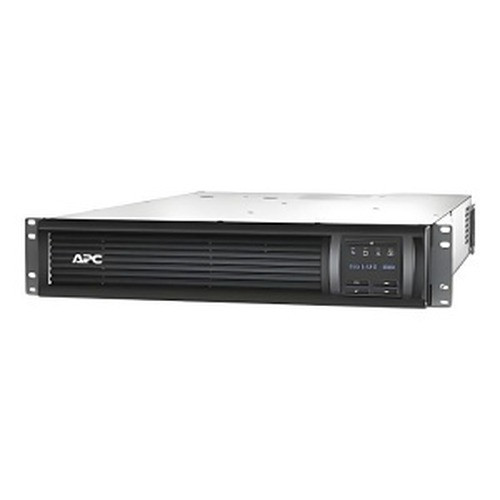
The form-factor difference is significant for rack planning. The APC SMT3000RM2UCUS occupies 2U (3.4 in tall, 26.9 in deep, 97.62 lb), while the Vertiv PSI5-3000SRT120LI occupies 3U (5.14 in tall, 16.92 in deep, 56 lb). The Vertiv is 41.6% lighter and 37% shallower — a meaningful advantage in short-depth racks (e.g., wall-mount enclosures or 2-post open racks) and in installations where weight limits apply. The APC consumes one less rack unit but requires substantially more cabinet depth.
Battery technology is the sharpest differentiator: the Vertiv uses lithium-ion chemistry, while the APC uses lead-acid. Lithium-ion offers a longer design life (Vertiv does not publish a specific year figure in these specs; APC states 3–5 years for its lead-acid cells), lower weight (reflected in the 56 lb vs. 97.62 lb delta), and front-access hot-swap capability on the Vertiv. APC specifies a 3-hour typical recharge time and a 172W battery charge power; Vertiv does not publish recharge time in the provided specs.
Both units share identical operating temperature ranges (32–104°F / 0–40°C). APC additionally specifies storage temperature (5–113°F), operating altitude (0–10,000 ft), storage altitude (0–50,000 ft), relative humidity (0–95%), an acoustic noise level of 55 dBA, and online thermal dissipation of 348 Btu/h — none of these are provided for the Vertiv in the supplied spec set, which limits data-center facility planning comparisons.
Which unit offers better remote management, protocol support, and compliance credentials?
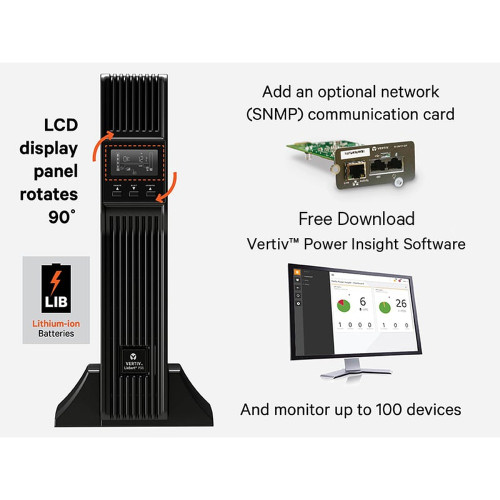
The Vertiv PSI5-3000SRT120LI ships with USB and an EPO connector as standard interfaces. SNMP and web management require the optional Liebert IntelliSlot UNITY communications card, which occupies the unit's expansion slot. The LCD control panel is rotatable to support both rack and tower orientations. Vertiv certifications include UL 1778, c-UL-us, UN38.3 (lithium-ion transport), NOM, and FCC Part 15 Class B.
The APC SMT3000RM2UCUS includes SmartConnect as indicated in its product name, providing cloud-based monitoring without an additional card. It ships with one free expansion slot and an 8 ft input cable. APC certifications include cULus, ENERGY STAR V2.0, and TAA compliance — the TAA designation is relevant for federal, SLED, and government-contract purchasing. APC does not list an EPO connector in the provided specs.
APC specifies a 24-month standard warranty with a 36-month contractual warranty option. Vertiv does not publish a warranty term in the provided spec set. For Modbus, BACnet, or other building-management integration, neither unit lists those protocols; both appear limited to SNMP/web for network management (APC natively; Vertiv via optional card).
Which should you choose: the PSI5-3000SRT120LI or the SMT3000RM2UCUS?
Our take: The PSI5-3000SRT120LI is the stronger choice when rack depth is constrained, weight capacity is a concern, or lithium-ion battery longevity and hot-swap serviceability are priorities. At 16.92 in deep and 56 lb, it fits short-depth enclosures where the APC's 26.9 in depth and 97.62 lb are disqualifying. The Vertiv's 0.981 efficiency figure (APC not specified) and user-selectable output voltages (100–125VAC vs. APC's fixed 120VAC) add operational flexibility. However, the SMT3000RM2UCUS is the stronger choice for government and federal buyers requiring TAA compliance (not listed for Vertiv), for installers who need native SmartConnect cloud monitoring without an optional card, and for shops standardized on APC's ecosystem. APC's 2U vs. Vertiv's 3U footprint also matters in fully populated racks. Buyers should note that transfer time and THD are published only for the APC, and recharge time and warranty are published only for the APC from the available spec data.
Side-by-Side Comparison
Spec-for-spec, from manufacturer data.
| Specification | Vertiv PSI5-3000SRT120LI | APC by Schneider Electric SMT3000RM2UCUS |
|---|---|---|
| Power Rating (VA) | 3000 VA | 2880 VA |
| Power Rating (W) | 2700 W | 2700 W |
| Topology | Line-interactive | Line Interactive |
| Output Waveform | Pure sine wave | Sine wave |
| Battery Technology | Lithium-ion | Lead-Acid |
| Rack Height | 3U (5.14 in) | 2U (3.4 in) |
| Depth | 16.92 in | 26.9 in (683 mm) |
| Width | 17.24 in | 17.008 in (432 mm) |
| Weight | 56 lb | 97.62 lb |
| Input Connection | NEMA L5-30P | NEMA L5-30P |
| Output Receptacles | 9 × 5-20R, 1 × L5-30R | 6 × NEMA 5-15R |
| Efficiency | 98.1% (0.981) | — |
| Transfer Time | — | 6 ms typical / 10 ms max |
| Recharge Time | — | 3 hours typical |
| Battery Life | — | 3–5 years |
| Management (Standard) | USB, EPO; SNMP via optional card | SmartConnect (native), 1 free expansion slot |
| Operating Temperature | 32–104 °F (0–40 °C) | 32–104 °F (0–40 °C) |
| Certifications | UL 1778, c-UL-us, UN38.3, NOM, FCC Part 15 Class B | cULus, ENERGY STAR V2.0, TAA compliant |
| Warranty | — | 24 months standard / 36 months contractual |
| Battery Service | Front-access hot-swap | — |
Frequently Asked Questions
Which should you choose: the PSI5-3000SRT120LI or the SMT3000RM2UCUS?
The PSI5-3000SRT120LI is the stronger choice when rack depth is constrained, weight capacity is a concern, or lithium-ion battery longevity and hot-swap serviceability are priorities. At 16.92 in deep and 56 lb, it fits short-depth enclosures where the APC's 26.9 in depth and 97.62 lb are disqualifying. The Vertiv's 0.981 efficiency figure (APC not specified) and user-selectable output voltages (100–125VAC vs. APC's fixed 120VAC) add operational flexibility. However, the SMT3000RM2UCUS is the stronger choice for government and federal buyers requiring TAA compliance (not listed for Vertiv), for installers who need native SmartConnect cloud monitoring without an optional card, and for shops standardized on APC's ecosystem. APC's 2U vs. Vertiv's 3U footprint also matters in fully populated racks. Buyers should note that transfer time and THD are published only for the APC, and recharge time and warranty are published only for the APC from the available spec data.
Which UPS is better for a short-depth wall-mount or 2-post rack cabinet?
The Vertiv PSI5-3000SRT120LI is the clear choice here. Its specified depth is 16.92 in versus 26.9 in for the APC SMT3000RM2UCUS — nearly 10 inches shallower. It also weighs 56 lb versus 97.62 lb, which matters for wall-mount enclosures with weight ratings. The APC's 2U vs. 3U height advantage does not offset a nearly 10-inch depth penalty in short-depth deployments.
Does either UPS qualify for government or federal contract purchases requiring TAA compliance?
Only the APC SMT3000RM2UCUS lists TAA compliance in its specifications. The Vertiv PSI5-3000SRT120LI's provided spec sheet does not include a TAA compliance statement. For federal, SLED, or GSA Schedule purchases where TAA is a contract requirement, the APC is the documented-compliant option based on the available data.
Which unit requires less hands-on maintenance over time — the Vertiv lithium-ion or the APC lead-acid?
The Vertiv PSI5-3000SRT120LI uses lithium-ion chemistry with front-access hot-swappable battery kits, meaning battery replacement does not require pulling the unit from the rack. The APC SMT3000RM2UCUS uses lead-acid batteries rated at 3–5 years per specification; its serviceability approach is not described in the provided specs. Vertiv does not publish a battery life figure in the supplied data, so a direct year-for-year comparison cannot be made from these specs alone.
More UPS Comparisons
- APC by Schneider Electric SMT3000RMI2U vs Vertiv GXT5-3000LVRT2UXL
- APC by Schneider Electric SMT3000RMI2U vs Panduit U03N11L
- APC by Schneider Electric SMT3000RMI2U vs Panduit U03N12L
- APC by Schneider Electric SMT3000RMI2U vs Panduit U03S12V
- APC by Schneider Electric SMT3000RMI2U vs APC by Schneider Electric SRT3000XLT
- APC by Schneider Electric SMT3000RMI2U vs APC by Schneider Electric SRT3000XLW-IEC
UPS Buying Guides
Get a Second Opinion on Your Camera Choice
Share your site layout, coverage goals, and budget. Our team will validate the camera selection, flag anything we would change, and recommend products that match the use case.