
Vertiv GXT5-6000MVRT4UXLN vs Vertiv GXT5-6KL630RT5UXLN: Specification Comparison
Both units are Vertiv GXT5-series online double-conversion rack/tower UPS systems nominally positioned at the 6 kVA tier, sharing the same topology, efficiency ratings, management card, and certifications. The comparison focuses on the three dimensions that matter most for data-center and critical-infrastructure buyers: real power capacity and output wiring, physical form factor and weight, and input/output voltage flexibility — areas where the two models diverge in spec despite appearing nearly identical on the surface.
In This Guide
- Which model delivers more usable power and how are loads connected?
- How do the two units compare in rack space, depth, and installation weight?
- Which unit better handles voltage flexibility and output configuration for mixed or international loads?
- Which should you choose: the GXT5-6000MVRT4UXLN or the GXT5-6KL630RT5UXLN?
- Side-by-Side Specs
- FAQ
Which model delivers more usable power and how are loads connected?
The GXT5-6000MVRT4UXLN is rated 6,000 VA / 6,000 W — a unity power factor meaning every VA translates to a watt of real load capacity. The GXT5-6KL630RT5UXLN carries a nameplate of 4,900 VA / 4,600 W, a 0.94 power factor, representing 18–23 % less usable power despite the '6K' model number. For a buyer calculating how many servers or edge devices can be protected, that gap is material.
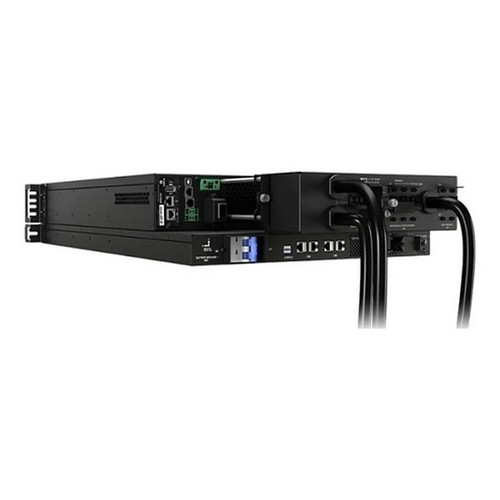
Output wiring also diverges sharply. The GXT5-6000MVRT4UXLN uses hardwired input and output with optional Power Distribution (POD) accessories, giving integrators flexibility to specify the exact receptacle mix at installation. The GXT5-6KL630RT5UXLN ships with a fixed L6-30P input plug and a defined output panel of 2 × L6-20R plus 2 × L6-30R receptacles — a plug-and-play arrangement suited to environments where those NEMA locking connectors are already deployed, but inflexible if the load mix differs.
How do the two units compare in rack space, depth, and installation weight?
The GXT5-6000MVRT4UXLN occupies 6.8 in of height — approximately 4U — and measures 25.6 in deep, weighing 125.6 lb. The GXT5-6KL630RT5UXLN stands 8.5 in tall (approximately 5U) and is 23.6 in deep, but weighs 149.1 lb — 23.5 lb heavier. Width is identical at 16.9 in for both.
For installers working in shallow or space-constrained enclosures, the GXT5-6000MVRT4UXLN's 1U shorter profile and 2-in greater depth may be the deciding factor. Conversely, the GXT5-6KL630RT5UXLN's shorter depth (23.6 in vs 25.6 in) may fit four-post racks with limited clearance behind the front rail, though the heavier chassis demands attention to rack weight limits and two-person lift procedures. Both units support the same rack/tower convertible form factor per specs.
Which unit better handles voltage flexibility and output configuration for mixed or international loads?
Input voltage range is essentially equivalent: the GXT5-6000MVRT4UXLN accepts 176–280 VAC and the GXT5-6KL630RT5UXLN accepts 175–280 VAC, both centered on a typical 208 VAC feed — a 1 V difference at the low end that is not operationally significant.
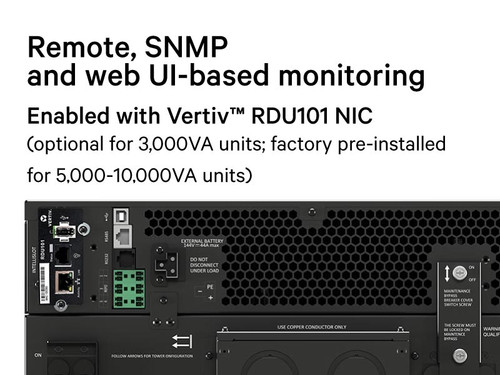
Output voltage configuration is where the models part ways. The GXT5-6000MVRT4UXLN outputs 208/120 VAC user-configurable — covering both the 208 V distribution rail and 120 V branch circuits common in North American data centers and server rooms. The GXT5-6KL630RT5UXLN outputs 200/208/220/230/240 VAC user-configurable but does not list 120 VAC output; it is oriented toward 200–240 V single-phase loads. Buyers who need to power a mix of 120 V and 208 V equipment should verify receptacle compatibility before specifying the GXT5-6KL630RT5UXLN. Both units include the same RDU101 SNMP/Webcard, USB, RS485, RS232, terminal block, and external battery interfaces.
Which should you choose: the GXT5-6000MVRT4UXLN or the GXT5-6KL630RT5UXLN?
Our take: The GXT5-6000MVRT4UXLN is the stronger choice when maximum real-power capacity and North American dual-voltage output (208/120 VAC) are required. It delivers 6,000 W versus 4,600 W — a 30 % advantage in real watts — at a 1U shorter rack profile and 23.5 lb lighter chassis, reducing structural load on the rack. Its hardwired I/O with optional POD accessories gives installers full control over the receptacle mix, versus the fixed L6-30P/L6-20R/L6-30R topology of the GXT5-6KL630RT5UXLN. The GXT5-6KL630RT5UXLN is appropriate where the load is exclusively 200–240 V single-phase, L6-series locking connectors are already standardized in the facility, and the 2-in shallower depth matters for a tight rack bay. Shared attributes — topology, efficiency (98 % ECO / 95 % on-line), RDU101 management card, ENERGY STAR 2.0, UL1778 — mean neither unit has an advantage in connectivity or compliance.
Side-by-Side Comparison
Spec-for-spec, from manufacturer data.
| Specification | Vertiv GXT5-6000MVRT4UXLN | Vertiv GXT5-6KL630RT5UXLN |
|---|---|---|
| SKU | GXT5-6000MVRT4UXLN | GXT5-6KL630RT5UXLN |
| Power Rating (VA) | 6,000 VA | 4,900 VA |
| Power Rating (W) | 6,000 W | 4,600 W |
| Power Factor | 1.00 | 0.94 |
| Topology | On-line double conversion | On-line double conversion |
| Input Voltage (Typical) | 208 VAC | 208 VAC |
| Input Voltage Range | 176–280 VAC | 175–280 VAC |
| Input Wiring | Hardwired | L6-30P plug |
| Output Voltage | 208/120 VAC (user-configurable) | 200/208/220/230/240 VAC (user-configurable) |
| Output Wiring | Hardwired; optional PODs | 2 × L6-20R, 2 × L6-30R |
| Efficiency (ECO / On-line) | Up to 98% / up to 95% | Up to 98% / up to 95% |
| Height | 6.8 in (~4U) | 8.5 in (~5U) |
| Width | 16.9 in | 16.9 in |
| Depth | 25.6 in | 23.6 in |
| Weight | 125.6 lb | 149.1 lb |
| Management Card | Vertiv RDU101 SNMP/Webcard (factory) | Vertiv RDU101 SNMP/Webcard (factory) |
| Certifications | ENERGY STAR 2.0, UL1778, c-UL, RoHS2, REACH | ENERGY STAR 2.0, UL1778, c-UL, RoHS2, REACH |
| Operating Temperature | +32 to +104 °F (0 to 40 °C) | +32 to +104 °F (0 to 40 °C) |
Frequently Asked Questions
Which should you choose: the GXT5-6000MVRT4UXLN or the GXT5-6KL630RT5UXLN?
The GXT5-6000MVRT4UXLN is the stronger choice when maximum real-power capacity and North American dual-voltage output (208/120 VAC) are required. It delivers 6,000 W versus 4,600 W — a 30 % advantage in real watts — at a 1U shorter rack profile and 23.5 lb lighter chassis, reducing structural load on the rack. Its hardwired I/O with optional POD accessories gives installers full control over the receptacle mix, versus the fixed L6-30P/L6-20R/L6-30R topology of the GXT5-6KL630RT5UXLN. The GXT5-6KL630RT5UXLN is appropriate where the load is exclusively 200–240 V single-phase, L6-series locking connectors are already standardized in the facility, and the 2-in shallower depth matters for a tight rack bay. Shared attributes — topology, efficiency (98 % ECO / 95 % on-line), RDU101 management card, ENERGY STAR 2.0, UL1778 — mean neither unit has an advantage in connectivity or compliance.
Is the GXT5-6000MVRT4UXLN or GXT5-6KL630RT5UXLN better for a mixed 120 V / 208 V server room?
The GXT5-6000MVRT4UXLN is the specified choice for mixed-voltage environments. Its output is user-configurable between 208 VAC and 120 VAC, which accommodates both distribution-level and branch-circuit loads in a typical North American data center. The GXT5-6KL630RT5UXLN's output range per spec covers 200–240 VAC only; 120 VAC output is not listed for that model.
The GXT5-6KL630RT5UXLN has '6K' in its model number — does it actually support 6,000 W of load?
No. Per the published specifications, the GXT5-6KL630RT5UXLN is rated 4,900 VA / 4,600 W. The GXT5-6000MVRT4UXLN is the model rated at the full 6,000 VA / 6,000 W. Buyers sizing UPS capacity against a known watt load should use the 4,600 W figure for the GXT5-6KL630RT5UXLN and the 6,000 W figure for the GXT5-6000MVRT4UXLN.
Which unit is physically lighter and takes up less rack space?
The GXT5-6000MVRT4UXLN is lighter (125.6 lb vs 149.1 lb) and shorter (6.8 in vs 8.5 in), though it is 2 in deeper (25.6 in vs 23.6 in). If rack weight capacity or vertical U-space is the constraint, the GXT5-6000MVRT4UXLN has the advantage. If rack depth behind the front rail is the binding constraint, the GXT5-6KL630RT5UXLN's shallower chassis may be preferable.
More UPS Comparisons
- APC by Schneider Electric SYH6K6RMT vs CyberPower OL6KRTHW
- APC by Schneider Electric SYH6K6RMT vs CyberPower OL6KRTHD
- APC by Schneider Electric SYH6K6RMT vs Vertiv GXT5-6000MVRT4UXLN
- APC by Schneider Electric SYH6K6RMT vs Vertiv GXT5-6KL630RT5UXLN
- APC by Schneider Electric SYH6K6RMT vs APC by Schneider Electric SYH6K6RMI
- APC by Schneider Electric SYH6K6RMT vs APC by Schneider Electric SYH6K6RMT-TF3
UPS Buying Guides
Get a Second Opinion on Your Camera Choice
Share your site layout, coverage goals, and budget. Our team will validate the camera selection, flag anything we would change, and recommend products that match the use case.