
Vertiv GXT5-5000HVRT5UXLN vs Vertiv GXT5-5000MVRT4UXLN: Specification Comparison
Both units are Vertiv GXT5 5 kVA / 5,000 W online double-conversion UPS systems in a flexible rack/tower form factor, making them legitimate cross-shop candidates for IT buyers sizing a 5 kVA runtime solution. The comparison turns on three practical axes: output voltage architecture and wiring flexibility, physical footprint and weight, and input voltage tolerance — differences that directly affect which load types, rack spaces, and electrical infrastructure each unit suits.
In This Guide
- Which model supports the output voltage and receptacle configuration my loads require?
- How do the two units differ in rack space consumption, depth, and shipping/installation weight?
- Which unit has the wider input voltage ride-through range, and do both carry the same compliance listings?
- Which should you choose: the GXT5-5000HVRT5UXLN or the GXT5-5000MVRT4UXLN?
- Side-by-Side Specs
- FAQ
Which model supports the output voltage and receptacle configuration my loads require?
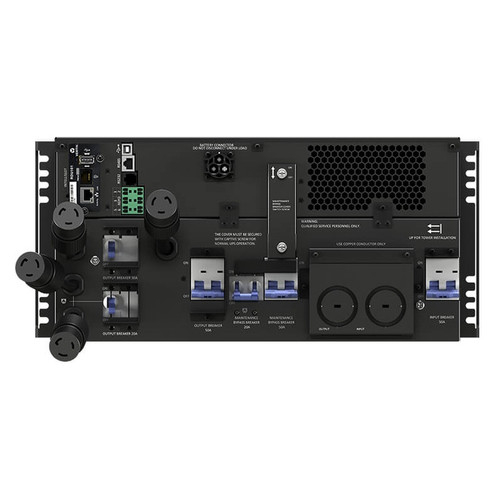
The GXT5-5000HVRT5UXLN (Product A) delivers 200/208/220/230/240 VAC output (user-configurable) and provides hardwired output plus two L6-20R and two L6-30R receptacles. This gives installers both hardwired branch-circuit capability and direct plug-and-play connections for 208 V single-phase equipment — useful in environments where a mix of hardwired and receptacle-fed loads must be served from a single UPS.
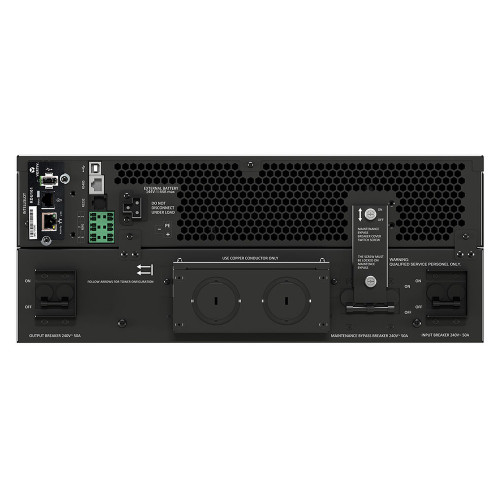
The GXT5-5000MVRT4UXLN (Product B) outputs 208/120 VAC (user-configurable) and is hardwired in/out only, with optional Power Distribution (POD) modules available for receptacle breakout. This dual-voltage output capability is the key differentiator: it can natively feed both 208 V equipment and standard 120 V North American loads from the same unit. However, no receptacles are factory-installed; PODs must be specified and added separately, which is an additional procurement and installation step.
How do the two units differ in rack space consumption, depth, and shipping/installation weight?
Product A (GXT5-5000HVRT5UXLN) occupies 8.5 in of rack height (approximately 5U), measures 16.9 in wide and 24.8 in deep, and weighs 156.7 lb. The greater height means it consumes more rack units, a meaningful constraint in high-density cabinets.
Product B (GXT5-5000MVRT4UXLN) is 6.8 in tall (approximately 4U), shares the same 16.9 in width, runs slightly deeper at 25.6 in, and weighs 125.6 lb — 31.1 lb lighter than Product A. The 1U height savings and lower weight make Product B easier to install in space-constrained racks and reduce floor-loading and two-person lift requirements. The 0.8 in additional depth is a minor trade-off that most standard 1,000 mm deep cabinets can absorb.
Which unit has the wider input voltage ride-through range, and do both carry the same compliance listings?
Product A accepts input from 176 VAC to 288 VAC. Product B accepts 176 VAC to 280 VAC. Both share the same low-end tolerance (176 VAC), but Product A extends the upper limit by 8 VAC. In most North American 208 V installations this difference is unlikely to be operationally significant, but in facilities with documented over-voltage events on the input feed, Product A provides marginally wider headroom on the high side.
Both models are rated identically for ENERGY STAR 2.0, UL1778, c-UL, RoHS2, and REACH. Efficiency claims are also identical: up to 98% in Active ECO Mode and up to 95% in online mode. Management interfaces are the same on both: factory-installed Vertiv RDU101 SNMP/Webcard, USB, RS485, RS232, terminal block, and external battery connector. The full-color gravity-sensing LCD control panel is specified on both units.
Which should you choose: the GXT5-5000HVRT5UXLN or the GXT5-5000MVRT4UXLN?
Our take: The GXT5-5000HVRT5UXLN is the stronger choice when loads are exclusively 208 V single-phase and the installation benefits from factory-installed L6-20R and L6-30R receptacles alongside hardwired outputs. Product A provides a broader output voltage range (200–240 VAC configurable vs. 208/120 VAC) and a slightly wider input upper tolerance (288 VAC vs. 280 VAC), with receptacles eliminating the need for add-on POD modules. The GXT5-5000MVRT4UXLN is the stronger choice when the protected load mix includes both 208 V and 120 V equipment, rack space is at a premium, or installation weight is a constraint — it saves one rack unit of height and 31.1 lb of shipping weight. Both units are otherwise specification-identical in power rating, efficiency, management interface, and compliance listings. Platform qualifier: specify Product A for pure 208 V data-center rows with mixed hardwired/receptacle loads; specify Product B for mixed-voltage IDF closets or space-constrained racks requiring 120/208 V dual-output capability via PODs.
Side-by-Side Comparison
Spec-for-spec, from manufacturer data.
| Specification | Vertiv GXT5-5000HVRT5UXLN | Vertiv GXT5-5000MVRT4UXLN |
|---|---|---|
| SKU | GXT5-5000HVRT5UXLN | GXT5-5000MVRT4UXLN |
| Power Rating | 5,000 VA / 5,000 W | 5,000 VA / 5,000 W |
| Topology | Online double conversion | Online double conversion |
| Input Voltage (Typical) | 208 VAC | 208 VAC |
| Input Voltage Range | 176–288 VAC | 176–280 VAC |
| Output Voltage (Configurable) | 200/208/220/230/240 VAC | 208/120 VAC |
| Wiring / Receptacles | Hardwired in/out + 2× L6-20R, 2× L6-30R | Hardwired in/out; optional PODs |
| Efficiency (ECO Mode) | Up to 98% | Up to 98% |
| Efficiency (Online Mode) | Up to 95% | Up to 95% |
| Height | 8.5 in (~5U) | 6.8 in (~4U) |
| Width | 16.9 in | 16.9 in |
| Depth | 24.8 in | 25.6 in |
| Weight | 156.7 lb | 125.6 lb |
| Management Interface | RDU101 SNMP/Webcard, USB, RS485, RS232, terminal block, ext. battery connector | RDU101 SNMP/Webcard, USB, RS485, RS232, terminal block, ext. battery connector |
| Control Panel | Full-color graphic LCD with gravity sensing | Full-color graphic LCD with gravity sensing |
| Certifications | ENERGY STAR 2.0, UL1778, c-UL, RoHS2, REACH | ENERGY STAR 2.0, UL1778, c-UL, RoHS2, REACH |
Frequently Asked Questions
Which should you choose: the GXT5-5000HVRT5UXLN or the GXT5-5000MVRT4UXLN?
The GXT5-5000HVRT5UXLN is the stronger choice when loads are exclusively 208 V single-phase and the installation benefits from factory-installed L6-20R and L6-30R receptacles alongside hardwired outputs. Product A provides a broader output voltage range (200–240 VAC configurable vs. 208/120 VAC) and a slightly wider input upper tolerance (288 VAC vs. 280 VAC), with receptacles eliminating the need for add-on POD modules. The GXT5-5000MVRT4UXLN is the stronger choice when the protected load mix includes both 208 V and 120 V equipment, rack space is at a premium, or installation weight is a constraint — it saves one rack unit of height and 31.1 lb of shipping weight. Both units are otherwise specification-identical in power rating, efficiency, management interface, and compliance listings. Platform qualifier: specify Product A for pure 208 V data-center rows with mixed hardwired/receptacle loads; specify Product B for mixed-voltage IDF closets or space-constrained racks requiring 120/208 V dual-output capability via PODs.
Can the GXT5-5000MVRT4UXLN power standard 120 V North American equipment directly?
Yes. The GXT5-5000MVRT4UXLN specifies a user-configurable 208/120 VAC output, meaning it can be configured to supply 120 V loads. The GXT5-5000HVRT5UXLN does not list 120 V as an output option — its configurable range is 200/208/220/230/240 VAC, so it is not suited for direct 120 V load protection.
Does either model include output receptacles, or is everything hardwired?
The GXT5-5000HVRT5UXLN includes two L6-20R and two L6-30R receptacles in addition to hardwired in/out connections. The GXT5-5000MVRT4UXLN is hardwired in/out only at the factory; optional Power Distribution (POD) accessories are listed as available but are not included. Buyers of the MVRT4 model should budget for PODs if receptacle outputs are needed.
Which unit is lighter and takes up less rack space — relevant for retrofit installs in existing cabinets?
The GXT5-5000MVRT4UXLN is both lighter (125.6 lb vs. 156.7 lb, a 31.1 lb difference) and shorter (6.8 in / ~4U vs. 8.5 in / ~5U). It is also 0.8 in deeper (25.6 in vs. 24.8 in), which is a minor consideration. For retrofit installations in populated racks with limited U-space or weight budgets, the MVRT4 model has the physical advantage.
More UPS Comparisons
- APC by Schneider Electric SRTL5KRM2UT-5KRMTF vs Panduit U05N11V
- APC by Schneider Electric SRTL5KRM2UT-5KRMTF vs Vertiv GXT5-5000HVRT5UXLN
- APC by Schneider Electric SRTL5KRM2UT-5KRMTF vs Vertiv GXT5-5000MVRT4UXLN
- APC by Schneider Electric SRTL5KRM2UT-5KRMTF vs APC by Schneider Electric SRTL5KRMTF
- APC by Schneider Electric SRT5KRMTF vs Vertiv GXT5-5000HVRT5UXLN
- APC by Schneider Electric SRT5KRMTF vs Vertiv GXT5-5000MVRT4UXLN
UPS Buying Guides
Get a Second Opinion on Your Camera Choice
Share your site layout, coverage goals, and budget. Our team will validate the camera selection, flag anything we would change, and recommend products that match the use case.