
APC by Schneider Electric SRTL5KRM2UT-5KRMTF vs Vertiv GXT5-5000HVRT5UXLN: Specification Comparison
Both the APC Smart-UPS Ultra SRTL5KRM2UT-5KRMTF and the Vertiv GXT5-5000HVRT5UXLN are 5 kVA rack-mount, on-line double-conversion UPS units designed for data center and critical IT infrastructure deployments. They occupy the same power class and device category and are direct cross-shop candidates for buyers standardizing on 208 V input infrastructure who need hardened, managed power protection in the 4.9–5.0 kW range.
In This Guide
- How do the two units differ in rated output power, voltage flexibility, and output receptacle options?
- Which unit delivers better efficiency, and how do their battery technologies and runtime profiles compare?
- How do the management interfaces, monitoring capabilities, and certifications compare between the two units?
- Which should you choose: the SRTL5KRM2UT-5KRMTF or the GXT5-5000HVRT5UXLN?
- Side-by-Side Specs
- FAQ
How do the two units differ in rated output power, voltage flexibility, and output receptacle options?
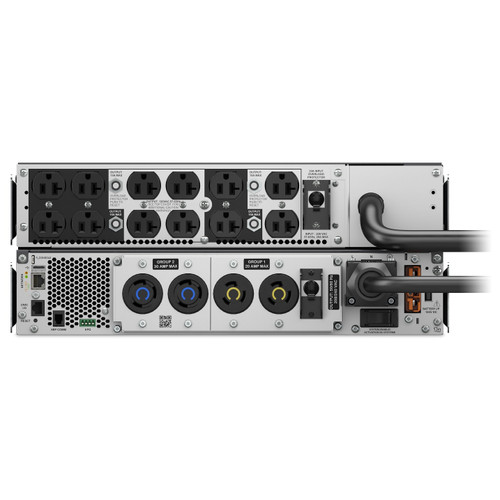
The APC SRTL5KRM2UT-5KRMTF is rated at 4,900 VA / 4,900 W output, with a fixed 120 V AC single-phase output and a secondary 240 V option. Its outlet complement is extensive: 12 × NEMA 5-20R, 2 × NEMA L6-20R, and 2 × NEMA L6-30R — fourteen receptacles in total, all individually circuit-protected. Input is via a NEMA L6-30P plug, accepting 208 V or 240 V at 40–70 Hz. This makes the APC unit purpose-built for step-down scenarios feeding North American 120 V loads from a 208 V distribution circuit.
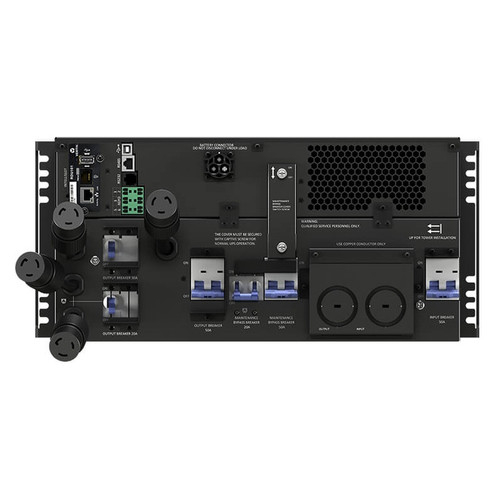
The Vertiv GXT5-5000HVRT5UXLN is rated at 5,000 VA / 5,000 W — a 2% higher VA/W ceiling than the APC. Critically, its output voltage is user-configurable across 200/208/220/230/240 VAC, making it inherently more flexible for international deployments or mixed-voltage environments. Its output wiring is hardwired in/out plus 2 × L6-20R and 2 × L6-30R receptacles, which is fewer convenience outlets than the APC. Input range spans 176–288 VAC, a wider window than the APC's spec-stated 208/240 V nominal.
For deployments requiring high outlet count and 120 V stepped-down feeds, the APC's 14-receptacle array and dedicated step-down transformer architecture provide a clear advantage. For environments that need configurable output voltage across a broad range or hardwired integration, the Vertiv's flexibility is the differentiator.
Which unit delivers better efficiency, and how do their battery technologies and runtime profiles compare?
The APC SRTL5KRM2UT-5KRMTF specifies harmonic distortion of less than 2% and a crest factor of 3:1. Its efficiency figures are not stated as a percentage in the provided specs — only 'View Efficiency Graph' is noted. Battery technology is Lithium-Ion (Li-Ion) at 180 V battery voltage, with a rated recharge time of 1.5 hours and a stated battery life of 8–10 years. Battery charging power is 600 W. The unit also accommodates extendable runtime via external battery modules. Runtime figures are referenced as graphs rather than discrete values in the provided specs.
The Vertiv GXT5-5000HVRT5UXLN states efficiency of up to 98% in Active ECO Mode and up to 95% in on-line mode — both figures are explicitly provided. Battery technology and chemistry are not specified in the provided data. Recharge time, battery life expectancy, and runtime figures at full or half load are not stated in the provided specs.
The Vertiv holds a clear documented advantage in stated efficiency (up to 98% ECO / 95% on-line vs. unstated for APC). The APC holds a clear documented advantage in battery technology (Li-Ion, 8–10 year life, 1.5 h recharge) given Vertiv's battery specs are absent from the provided data. Buyers optimizing for energy cost should weight the Vertiv's published efficiency; buyers optimizing for battery longevity and recharge cycle should note the APC's superior documented battery specs.
How do the management interfaces, monitoring capabilities, and certifications compare between the two units?
The APC SRTL5KRM2UT-5KRMTF ships with a pre-installed Network Management Card 3 (NMC3) with environmental monitoring, USB, and serial port connectivity. Alarms are audible and visible, prioritized by severity. The unit carries ENERGY STAR V2.0 certification and IP20 ingress protection. Operating altitude is specified at 0–10,000 ft; storage altitude extends to 50,000 ft. Operating temperature range is not stated in the provided specs; storage temperature is 5–113 °F (−15–45 °C).
The Vertiv GXT5-5000HVRT5UXLN includes a factory pre-installed Vertiv RDU101 SNMP/Webcard with full SNMP and web management, USB, RS485, RS232, terminal block, and external battery connector. Its control panel features a full-color graphic LCD with gravity-sensing orientation — a notable usability feature absent from the APC's spec list. Certifications include ENERGY STAR 2.0, UL1778, c-UL, RoHS2, and REACH. Operating temperature is rated at 32–104 °F (0–40 °C). Altitude and IP ratings are not stated in the provided specs.
Both units ship with pre-installed network management cards supporting SNMP. The Vertiv's RDU101 adds RS485, RS232, and a color LCD with gravity sensing, giving it a broader physical interface set and a more informative local display. The APC's NMC3 with environmental monitoring is an established platform with wide DCIM ecosystem support. The Vertiv carries more listed certifications (UL1778, RoHS2, REACH in addition to ENERGY STAR); the APC lists IP20 and an operating altitude spec that Vertiv does not provide.
Which should you choose: the SRTL5KRM2UT-5KRMTF or the GXT5-5000HVRT5UXLN?
Our take: The SRTL5KRM2UT-5KRMTF is the stronger choice when a deployment specifically requires 208 V to 120 V step-down with maximum outlet density, long-life Li-Ion batteries, and APC NMC3 ecosystem integration. Its 12 × NEMA 5-20R plus 4 mixed-voltage outlets serve dense North American 120 V rack loads that the Vertiv's hardwired-primary output cannot match directly. The APC's Li-Ion battery offers a documented 8–10 year life and 1.5-hour recharge — figures absent from Vertiv's spec sheet. Conversely, the GXT5-5000HVRT5UXLN holds a 100 VA / 100 W rated-power edge (5,000 vs 4,900), a wider input voltage window (176–288 VAC vs 208/240 V nominal), user-configurable output voltage across 200–240 VAC, and explicitly stated efficiency of up to 98% ECO / 95% on-line versus APC's unpublished figure. Choose the Vertiv for international or mixed-voltage environments, documented high-efficiency operation, and broader certification coverage (UL1778, RoHS2, REACH); choose the APC for 120 V step-down, high outlet count, and proven Li-Ion battery longevity.
Side-by-Side Comparison
Spec-for-spec, from manufacturer data.
| Specification | APC by Schneider Electric SRTL5KRM2UT-5KRMTF | Vertiv GXT5-5000HVRT5UXLN |
|---|---|---|
| Device Type | On-line UPS + Step-down Transformer | On-line Double-Conversion UPS |
| Rated Power (VA) | 4,900 VA | 5,000 VA |
| Rated Power (W) | 4,900 W | 5,000 W |
| Input Voltage (Nominal) | 208 V / 240 V AC | 208 VAC typical; 176–288 VAC range |
| Input Connection | NEMA L6-30P | Hardwired |
| Input Frequency | 40–70 Hz auto-sensing | — |
| Output Voltage | 120 V AC (step-down); 240 V secondary | 200/208/220/230/240 VAC (user-configurable) |
| Output Receptacles | 12 × NEMA 5-20R, 2 × L6-20R, 2 × L6-30R | Hardwired + 2 × L6-20R, 2 × L6-30R |
| Efficiency (On-line) | Not stated in provided specs | Up to 95% |
| Efficiency (ECO Mode) | — | Up to 98% |
| Battery Technology | Li-Ion (Lithium-Ion) | Not stated in provided specs |
| Battery Life | 8–10 years | — |
| Recharge Time | 1.5 hours | — |
| Management Interface | NMC3 (pre-installed), USB, Serial | RDU101 SNMP/Webcard (pre-installed), USB, RS485, RS232, Terminal block |
| Local Display | Audible/visible alarms | Full-color graphic LCD with gravity sensing |
| Certifications | ENERGY STAR V2.0, IP20 | ENERGY STAR 2.0, UL1778, c-UL, RoHS2, REACH |
| Rack Height | 4U | 5U (8.5 in) |
| Weight | 159.37 lb (72.29 kg) | 156.7 lb |
| Operating Temperature | Not stated in provided specs | +32 to +104 °F (0 to +40 °C) |
| Surge Energy Rating | 1,260 J | — |
| Waveform | Sine wave | — |
Frequently Asked Questions
Which should you choose: the SRTL5KRM2UT-5KRMTF or the GXT5-5000HVRT5UXLN?
The SRTL5KRM2UT-5KRMTF is the stronger choice when a deployment specifically requires 208 V to 120 V step-down with maximum outlet density, long-life Li-Ion batteries, and APC NMC3 ecosystem integration. Its 12 × NEMA 5-20R plus 4 mixed-voltage outlets serve dense North American 120 V rack loads that the Vertiv's hardwired-primary output cannot match directly. The APC's Li-Ion battery offers a documented 8–10 year life and 1.5-hour recharge — figures absent from Vertiv's spec sheet. Conversely, the GXT5-5000HVRT5UXLN holds a 100 VA / 100 W rated-power edge (5,000 vs 4,900), a wider input voltage window (176–288 VAC vs 208/240 V nominal), user-configurable output voltage across 200–240 VAC, and explicitly stated efficiency of up to 98% ECO / 95% on-line versus APC's unpublished figure. Choose the Vertiv for international or mixed-voltage environments, documented high-efficiency operation, and broader certification coverage (UL1778, RoHS2, REACH); choose the APC for 120 V step-down, high outlet count, and proven Li-Ion battery longevity.
Is the SRTL5KRM2UT-5KRMTF or the GXT5-5000HVRT5UXLN better for a mixed 120 V and 208 V load environment?
The SRTL5KRM2UT-5KRMTF is purpose-built for this scenario: it steps 208 V input down and provides 12 × NEMA 5-20R (120 V) receptacles alongside 2 × L6-20R and 2 × L6-30R (208 V) outlets. The Vertiv GXT5-5000HVRT5UXLN does not include a step-down transformer and its output is configurable to 200–240 VAC only, making it unsuitable for direct 120 V North American loads without additional downstream transformation.
Which unit has a longer battery life and faster recharge, the SRTL5KRM2UT-5KRMTF or the GXT5-5000HVRT5UXLN?
The APC SRTL5KRM2UT-5KRMTF specifies a Li-Ion battery rated for 8–10 years with a 1.5-hour recharge time and 600 W charging power. The Vertiv GXT5-5000HVRT5UXLN does not provide battery chemistry, battery life expectancy, or recharge time in the specifications supplied, so a direct comparison on these points cannot be made from available data.
Does either the SRTL5KRM2UT-5KRMTF or the GXT5-5000HVRT5UXLN offer better energy efficiency?
The Vertiv GXT5-5000HVRT5UXLN explicitly states up to 98% efficiency in Active ECO Mode and up to 95% in on-line double-conversion mode. The APC SRTL5KRM2UT-5KRMTF does not state a numeric efficiency percentage in the provided specifications — only a reference to a runtime/efficiency graph. Buyers for whom published efficiency figures are a procurement requirement will find only the Vertiv supplies them in the available spec data.
More UPS Comparisons
- APC by Schneider Electric SRTL5KRM2UT-5KRMTF vs Panduit U05N11V
- APC by Schneider Electric SRTL5KRM2UT-5KRMTF vs Vertiv GXT5-5000MVRT4UXLN
- APC by Schneider Electric SRTL5KRM2UT-5KRMTF vs APC by Schneider Electric SRTL5KRMTF
- APC by Schneider Electric SRT5KRMTF vs Vertiv GXT5-5000HVRT5UXLN
- APC by Schneider Electric SRT5KRMTF vs Vertiv GXT5-5000MVRT4UXLN
- APC by Schneider Electric SRT5KRMTF vs APC by Schneider Electric SRTL5KRMTF
UPS Buying Guides
Get a Second Opinion on Your Camera Choice
Share your site layout, coverage goals, and budget. Our team will validate the camera selection, flag anything we would change, and recommend products that match the use case.