
APC by Schneider Electric SRTL5KRM2UT-5KRMTF vs Vertiv GXT5-5000MVRT4UXLN: Specification Comparison
Both the APC Smart-UPS Ultra SRTL5KRM2UT-5KRMTF and the Vertiv GXT5 GXT5-5000MVRT4UXLN are rack-mountable, online double-conversion UPS units rated at approximately 5 kVA, targeting data centers, server rooms, and critical IT infrastructure. The APC unit is a bundled system combining a 5 kVA UPS with an integrated 208 V to 120 V step-down transformer in a 4U form factor using lithium-ion batteries. The Vertiv GXT5 is a standalone 5 kVA online UPS with hardwired input/output supporting 208 V and 120 V user-configurable output, occupying a flexible rack/tower form factor. Both carry ENERGY STAR 2.0 certification and ship with factory-installed network management cards.
In This Guide
- How do the power capacity, input/output flexibility, and outlet configurations compare?
- What are the differences in battery technology, runtime characteristics, and operating efficiency?
- How do the management interfaces, physical footprint, and environmental operating parameters differ?
- Which should you choose: the SRTL5KRM2UT-5KRMTF or the GXT5-5000MVRT4UXLN?
- Side-by-Side Specs
- FAQ
How do the power capacity, input/output flexibility, and outlet configurations compare?
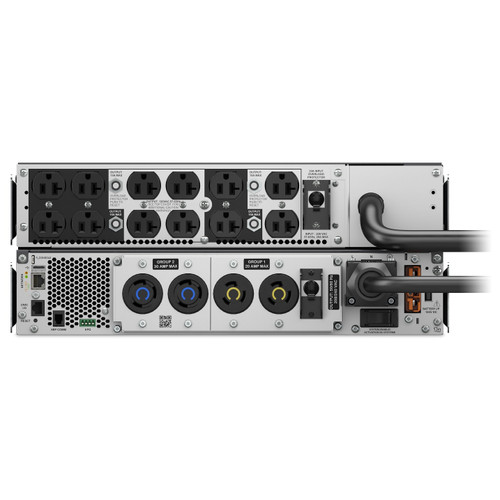
The APC SRTL5KRM2UT-5KRMTF is rated at 4,900 VA / 4,900 W and accepts 208 V AC (with 240 V as an alternate) via a NEMA L6-30P plug, stepping down to 120 V AC output (with 240 V as an alternate). Its output receptacle complement is substantial for distributed branch circuits: 12 × NEMA 5-20R, 2 × NEMA L6-20R, and 2 × NEMA L6-30R. The integrated transformer makes this a single-SKU solution for facilities that have 208 V feeds but require 120 V device support.
The Vertiv GXT5-5000MVRT4UXLN is rated at 5,000 VA / 5,000 W — a marginal 100 VA / 100 W advantage over the APC. Its input voltage range is explicitly specified as 176–280 V AC (typical 208 V), and output is user-configurable between 208 V and 120 V. However, Vertiv specifies hardwired input and output with optional Power Output Distribution (POD) accessories required for receptacle-level connections; no discrete outlet counts are listed in the provided specs. Buyers who need plug-and-play receptacle distribution must factor in those additional POD costs.
What are the differences in battery technology, runtime characteristics, and operating efficiency?
The APC unit uses lithium-ion (Li-Ion) batteries with a rated battery voltage of 180 V, a typical recharge time of 1.5 hours, and a projected battery life of 8–10 years. Runtime is load-dependent: the spec sheet references runtime graphs rather than discrete minute values, citing 4,900 W at full load and 2,450 W at half load as the reference points. The surge energy rating is 1,260 J. Harmonic distortion is specified at less than 2%, and the output waveform is a true sine wave. Battery charging power is 600 W rated. An extendable runtime option is noted (value: 1), indicating external battery module compatibility, though no included battery modules or free slots are listed.
The Vertiv GXT5 does not specify battery chemistry, battery voltage, recharge time, or battery life in the provided specifications. Efficiency is stated as up to 98% in Active ECO Mode and up to 95% in online mode — concrete figures the APC spec sheet does not publish in comparable form (the APC lists only 'View Efficiency Graph'). No surge energy rating, harmonic distortion figure, or discrete runtime data are present in the Vertiv specs provided. Buyers requiring detailed runtime or battery longevity projections for the Vertiv unit will need to consult the referenced datasheet PDF.
How do the management interfaces, physical footprint, and environmental operating parameters differ?
The APC SRTL5KRM2UT-5KRMTF ships with a pre-installed APC Network Management Card 3 (NMC3) with environmental monitoring, plus USB and serial ports. Alarms are audible and visible, prioritized by severity. The unit occupies 4U of rack space, weighs 159.37 lb (72.29 kg), and dimensions are listed as 6.9 in height (176 mm). Operating altitude is 0–10,000 ft. Acoustic output is 55 dBA. Heat dissipation is rated at 1,047 Btu/h. Operating temperature range is not explicitly stated in the provided specs, though storage temperature is 5–113 °F (−15 to 45 °C). IP protection is IP20. Relative humidity tolerance is 0–95% non-condensing.
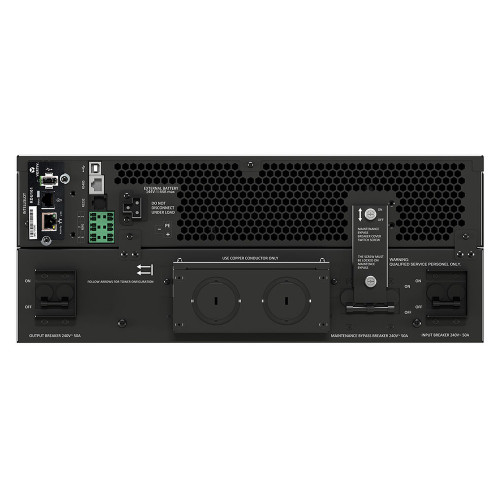
The Vertiv GXT5-5000MVRT4UXLN ships with a factory pre-installed Vertiv RDU101 SNMP/Web card and supports USB, RS485, RS232, a terminal block, and an external battery connector — a broader set of physical interface options than the APC. It features a full-color graphic LCD with gravity-sensing orientation for intuitive installation in either rack or tower position. The unit weighs 125.6 lb — approximately 34 lb lighter than the APC — and measures 6.8 in H × 16.9 in W × 25.6 in D. Operating temperature is explicitly stated as 32–104 °F (0–40 °C). Rack unit count, acoustic level, heat dissipation, and IP rating are not provided in the supplied Vertiv specs. Certifications include UL 1778, c-UL, RoHS2, REACH, and ENERGY STAR 2.0.
Which should you choose: the SRTL5KRM2UT-5KRMTF or the GXT5-5000MVRT4UXLN?
Our take: The SRTL5KRM2UT-5KRMTF is the stronger choice when a facility has an existing 208 V feed and needs plug-ready 120 V receptacle distribution, long battery life, and a fully integrated single-box solution without accessory purchases. Its 12 × NEMA 5-20R plus 4 mixed L6 receptacles eliminate the POD add-on cost Vertiv buyers must plan for, its Li-Ion battery carries an 8–10 year rated life versus no battery-life spec published for the GXT5, and its 1,260 J surge rating is a concrete protective specification absent from the Vertiv data. Conversely, the GXT5-5000MVRT4UXLN holds advantages in rated efficiency (up to 98% ECO / 95% online vs. no published figure for APC), a marginally higher power rating (5,000 VA/W vs. 4,900 VA/W), a 34 lb lighter chassis (125.6 lb vs. 159.37 lb), broader serial interface options (RS485, RS232, terminal block), a color LCD with gravity-sensing, and additional compliance listings (UL 1778, RoHS2, REACH). Choose the APC for integrated step-down transformer convenience and receptacle-rich 120 V distribution; choose the Vertiv where hardwired infrastructure already exists and peak efficiency or flexible rack/tower orientation is the priority.
Side-by-Side Comparison
Spec-for-spec, from manufacturer data.
| Specification | APC by Schneider Electric SRTL5KRM2UT-5KRMTF | Vertiv GXT5-5000MVRT4UXLN |
|---|---|---|
| Power Rating (VA) | 4,900 VA | 5,000 VA |
| Power Rating (W) | 4,900 W | 5,000 W |
| UPS Topology | On-line double conversion | On-line double conversion |
| Input Voltage (nominal) | 208 V AC (alt: 240 V) | 208 V AC (range: 176–280 V) |
| Input Connection | NEMA L6-30P | Hardwired |
| Output Voltage | 120 V AC (alt: 240 V) | 208/120 V user-configurable |
| Output Connections | 12× NEMA 5-20R, 2× NEMA L6-20R, 2× NEMA L6-30R | Hardwired out; POD accessories optional |
| Efficiency | Not published in provided specs | Up to 98% ECO / 95% online |
| Battery Type | Li-Ion (Lithium Ion) | Not specified |
| Battery Life | 8–10 years | — |
| Typical Recharge Time | 1.5 hours | — |
| Surge Energy Rating | 1,260 J | — |
| Output Harmonic Distortion | Less than 2% | — |
| Rack Units | 4U | Not specified in provided specs |
| Weight | 159.37 lb (72.29 kg) | 125.6 lb |
| Certifications | ENERGY STAR V2.0 | ENERGY STAR 2.0, UL 1778, c-UL, RoHS2, REACH |
| Management Interfaces | NMC3 (pre-installed), USB, serial | RDU101 SNMP/Web (pre-installed), USB, RS485, RS232, terminal block |
| Operating Temperature | Not stated in provided specs | 32–104 °F (0–40 °C) |
| Acoustic Level | 55 dBA | — |
| Heat Dissipation | 1,047 Btu/h | — |
| Form Factor | Rack-mounted (horizontal) | Rack or tower (gravity-sensing LCD) |
Frequently Asked Questions
Which should you choose: the SRTL5KRM2UT-5KRMTF or the GXT5-5000MVRT4UXLN?
The SRTL5KRM2UT-5KRMTF is the stronger choice when a facility has an existing 208 V feed and needs plug-ready 120 V receptacle distribution, long battery life, and a fully integrated single-box solution without accessory purchases. Its 12 × NEMA 5-20R plus 4 mixed L6 receptacles eliminate the POD add-on cost Vertiv buyers must plan for, its Li-Ion battery carries an 8–10 year rated life versus no battery-life spec published for the GXT5, and its 1,260 J surge rating is a concrete protective specification absent from the Vertiv data. Conversely, the GXT5-5000MVRT4UXLN holds advantages in rated efficiency (up to 98% ECO / 95% online vs. no published figure for APC), a marginally higher power rating (5,000 VA/W vs. 4,900 VA/W), a 34 lb lighter chassis (125.6 lb vs. 159.37 lb), broader serial interface options (RS485, RS232, terminal block), a color LCD with gravity-sensing, and additional compliance listings (UL 1778, RoHS2, REACH). Choose the APC for integrated step-down transformer convenience and receptacle-rich 120 V distribution; choose the Vertiv where hardwired infrastructure already exists and peak efficiency or flexible rack/tower orientation is the priority.
Does the SRTL5KRM2UT-5KRMTF or the GXT5-5000MVRT4UXLN include a network management card out of the box?
Both units ship with a factory-installed network management card. The APC includes the NMC3 with environmental monitoring, accessible via USB and serial in addition to the network card. The Vertiv includes the RDU101 SNMP/Web card and adds RS485, RS232, and a terminal block as additional interface options — neither unit requires a separate management card purchase.
Which UPS is easier to deploy if my rack already has 208 V hardwired power and I need to support 120 V devices?
The APC SRTL5KRM2UT-5KRMTF is purpose-built for this scenario: it integrates a 208 V to 120 V step-down transformer with 12 × NEMA 5-20R and 4 additional L6 receptacles in one 4U unit. The Vertiv GXT5 requires hardwired input and output connections and optional POD accessories for receptacle-level distribution — adding procurement and installation steps not needed with the APC bundle.
Is the GXT5-5000MVRT4UXLN more energy-efficient than the SRTL5KRM2UT-5KRMTF?
Based on provided specifications, the Vertiv GXT5 publishes explicit efficiency figures — up to 98% in Active ECO Mode and up to 95% in standard online mode. The APC SRTL5KRM2UT-5KRMTF does not publish a discrete efficiency percentage in the supplied specs, referencing only an efficiency graph. A direct numerical comparison cannot be made from the available data; buyers requiring APC efficiency figures should consult the product's runtime and efficiency graphs available from APC directly.
More UPS Comparisons
- APC by Schneider Electric SRTL5KRM2UT-5KRMTF vs Panduit U05N11V
- APC by Schneider Electric SRTL5KRM2UT-5KRMTF vs Vertiv GXT5-5000HVRT5UXLN
- APC by Schneider Electric SRTL5KRM2UT-5KRMTF vs APC by Schneider Electric SRTL5KRMTF
- APC by Schneider Electric SRT5KRMTF vs Vertiv GXT5-5000HVRT5UXLN
- APC by Schneider Electric SRT5KRMTF vs Vertiv GXT5-5000MVRT4UXLN
- APC by Schneider Electric SRT5KRMTF vs APC by Schneider Electric SRTL5KRMTF
UPS Buying Guides
Get a Second Opinion on Your Camera Choice
Share your site layout, coverage goals, and budget. Our team will validate the camera selection, flag anything we would change, and recommend products that match the use case.