
APC by Schneider Electric SRTL5KRM2UT-5KRMTF vs Panduit U05N11V: Specification Comparison
Both the APC Smart-UPS Ultra SRTL5KRM2UT-5KRMTF and the Panduit SteadySine U05N11V are 5 kVA double-conversion online (VFI) rackmount UPS units targeting data center, edge, and enterprise environments. Despite coming from different vendors and occupying slightly different rack heights (4U vs. 3U), they serve the same fundamental role: regulated, battery-backed 120/240 V AC output for critical IT loads. A buyer evaluating either unit is making a capital decision around runtime architecture, power density, input flexibility, and management depth.
In This Guide
- How do rated power capacity, output connections, and input flexibility compare?
- What are the battery technology, runtime, and field-serviceability characteristics?
- How do rack footprint, remote management depth, and compliance certifications differ?
- Which should you choose: the SRTL5KRM2UT-5KRMTF or the U05N11V?
- Side-by-Side Specs
- FAQ
How do rated power capacity, output connections, and input flexibility compare?
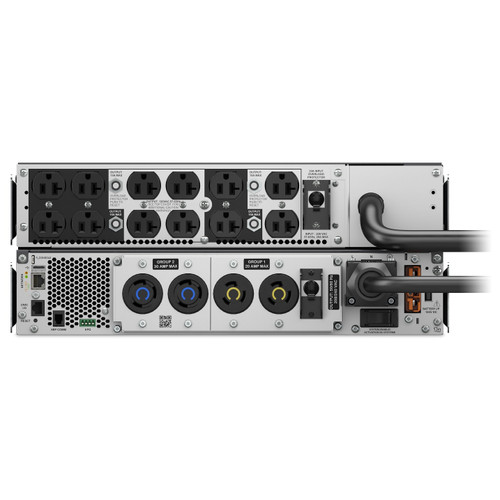
The APC SRTL5KRM2UT-5KRMTF is rated at 4,900 VA / 4,900 W (unity power factor) with a 120 V AC single-phase output. It accepts 208 V AC input via a NEMA L6-30P plug and is also rated for 240 V input, with an auto-sensing frequency range of 40–70 Hz. The output receptacle complement is extensive: 12 × NEMA 5-20R, 2 × NEMA L6-20R, and 2 × NEMA L6-30R — 16 outlets total. Output frequency tracks mains at 50/60 Hz ±3 Hz, and harmonic distortion is specified at less than 2% THD.
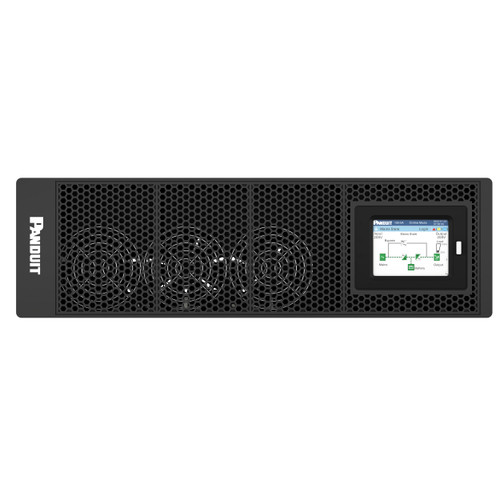
The Panduit U05N11V is rated at 5,000 VA / 4,500 W at a 0.9 power factor. Output waveform is pure sine wave with less than 3% THD. Input voltage, input connector type, output voltage, and specific output receptacle counts are not stated in the available Panduit specifications. The APC unit therefore provides materially more granular electrical data for pre-installation planning, including explicit input plug type and a fully enumerated outlet strip.
On raw wattage the APC edges ahead at 4,900 W vs. 4,500 W for the Panduit. Buyers who need a specific outlet mix or must confirm input plug compatibility at the PDU or transfer-switch level will find the APC spec sheet more immediately actionable. For the Panduit, those details would need to be confirmed via its datasheet (/content/product-datasheets/U05N11V.pdf) before installation planning can be completed.
What are the battery technology, runtime, and field-serviceability characteristics?
The APC SRTL5KRM2UT-5KRMTF uses a Lithium-Ion (Li-Ion) battery at 180 V nominal. Rated battery life is 8–10 years, and typical recharge time is 1.5 hours at a 600 W charging rate. The unit ships with 1 RBC (replacement battery cartridge) slot filled. Runtime at full load (4,900 W) and half load (2,450 W) is specified only as 'View Runtime Graph' in the provided data — no discrete minute values are given. The unit supports extendable runtime (flagged as supported in specs) but the number of external battery module slots is listed as 0 in the provided data, creating an ambiguity that should be resolved with APC documentation.
The Panduit U05N11V uses hot-swappable battery modules and explicitly supports external battery extension via rear DC connectors. Specific battery chemistry, nominal battery voltage, recharge time, and runtime curves are not included in the provided Panduit specifications.
From a serviceability standpoint, Panduit's hot-swap battery design and declared support for external battery expansion are clearly stated advantages for environments where mean time to repair (MTTR) and zero-downtime battery replacement are requirements. APC's Li-Ion chemistry offers a longer rated cell life (8–10 years) and faster recharge (1.5 h), but the runtime extension path is ambiguous in the provided specs. Both points warrant verification against full datasheets before making a serviceability-driven decision.
How do rack footprint, remote management depth, and compliance certifications differ?
The APC SRTL5KRM2UT-5KRMTF occupies 4U of rack space and weighs 159.37 lb (72.29 kg) — a significant physical and structural load. Width is not explicitly stated as a dimension in the specs (the 6.9 in / 176 mm figure appears to be height of a sub-component, not overall unit width). It ships with a pre-installed Network Management Card 3 (NMC3) with environmental monitoring, providing out-of-box SNMP/web/SSH management without an add-on card purchase. Connectivity includes serial, USB, and the pre-installed NMC3. Surge energy rating is 1,260 J. Certification is ENERGY STAR V2.0.
The Panduit U05N11V occupies 3U and has a stated width of 17.3 in (440 mm) and height of 10.3 in (262 mm). Unit weight is not provided. Management is via a network card slot (card not stated as pre-installed), USB, and serial. Certifications are UL 1778 and cUL. Airflow is specified as front-to-rear, which is directly relevant for hot-aisle/cold-aisle containment design. Serviceable components explicitly include fan assemblies in addition to battery modules.
The Panduit saves 1U of rack space (3U vs. 4U) and its front-to-rear airflow is explicitly documented — a meaningful advantage in contained-aisle deployments. The APC includes a pre-installed NMC3, which eliminates the cost and lead time of a separate management card; for the Panduit, buyers must verify whether a network card is included or must be purchased separately. APC carries ENERGY STAR V2.0; Panduit carries UL 1778/cUL. Neither certification set supersedes the other — they address different compliance frameworks.
Which should you choose: the SRTL5KRM2UT-5KRMTF or the U05N11V?
Our take: The SRTL5KRM2UT-5KRMTF is the stronger choice when a fully documented input/output electrical profile, pre-installed remote management, and Li-Ion battery longevity are the primary requirements. It delivers 4,900 W at unity power factor vs. the U05N11V's 4,500 W at 0.9 PF — a 400 W working advantage at full load. Its pre-installed NMC3 card eliminates a separate management card purchase that the Panduit's slot-based design may require. Battery life is rated at 8–10 years against no stated figure for the Panduit. Conversely, the U05N11V is the stronger choice in high-density, contained-aisle data centers: it saves 1U of rack space, explicitly supports hot-swap batteries for zero-downtime replacement, documents front-to-rear airflow for containment compatibility, and carries UL 1778 certification. Buyers prioritizing field serviceability and rack density should favor the Panduit; those prioritizing wattage headroom, outlet variety, and out-of-box SNMP management should favor the APC.
Side-by-Side Comparison
Spec-for-spec, from manufacturer data.
| Specification | APC by Schneider Electric SRTL5KRM2UT-5KRMTF | Panduit U05N11V |
|---|---|---|
| Product Type | Online Double-Conversion UPS | Online Double-Conversion UPS (VFI) |
| Power Rating (VA) | 4,900 VA | 5,000 VA |
| Power Rating (W) | 4,900 W | 4,500 W |
| Power Factor | 1.0 (unity) | 0.9 |
| Form Factor / Rack Height | 4U Rackmount | 3U Rackmount |
| Input Voltage | 208 V AC (also 240 V) | Not specified |
| Input Connector | NEMA L6-30P | Not specified |
| Output Voltage | 120 V AC (also 240 V) | Not specified |
| Output Receptacles | 12× NEMA 5-20R, 2× NEMA L6-20R, 2× NEMA L6-30R | Not specified |
| Output THD | <2% | <3% |
| Battery Technology | Li-Ion | Not specified |
| Battery Serviceability | Not stated as hot-swap | Hot-swappable modules |
| External Battery Expansion | Supported (extendable runtime flagged); slot count not confirmed | Yes, via rear DC connectors |
| Battery Life | 8–10 years | Not specified |
| Recharge Time | 1.5 hours | Not specified |
| Network Management | Pre-installed NMC3 (SNMP/web/SSH + env. monitoring) | Network card slot (card inclusion not confirmed) |
| Management Interfaces | NMC3, USB, serial | Network card slot, USB, serial |
| Airflow Direction | Not specified | Front-to-rear |
| Surge Energy Rating | 1,260 J | Not specified |
| Weight | 159.37 lb (72.29 kg) | Not specified |
| Certifications | ENERGY STAR V2.0 | UL 1778, cUL |
| Bypass | Internal (automatic and manual) | Not specified |
Frequently Asked Questions
Which should you choose: the SRTL5KRM2UT-5KRMTF or the U05N11V?
The SRTL5KRM2UT-5KRMTF is the stronger choice when a fully documented input/output electrical profile, pre-installed remote management, and Li-Ion battery longevity are the primary requirements. It delivers 4,900 W at unity power factor vs. the U05N11V's 4,500 W at 0.9 PF — a 400 W working advantage at full load. Its pre-installed NMC3 card eliminates a separate management card purchase that the Panduit's slot-based design may require. Battery life is rated at 8–10 years against no stated figure for the Panduit. Conversely, the U05N11V is the stronger choice in high-density, contained-aisle data centers: it saves 1U of rack space, explicitly supports hot-swap batteries for zero-downtime replacement, documents front-to-rear airflow for containment compatibility, and carries UL 1778 certification. Buyers prioritizing field serviceability and rack density should favor the Panduit; those prioritizing wattage headroom, outlet variety, and out-of-box SNMP management should favor the APC.
Does either UPS include a network management card out of the box?
Yes — the APC SRTL5KRM2UT-5KRMTF ships with a pre-installed Network Management Card 3 (NMC3) with environmental monitoring included. The Panduit U05N11V has a network card slot, but the provided specifications do not state that a card is pre-installed; buyers should confirm with Panduit whether one is included or sold separately.
Can I replace the batteries without taking either UPS offline?
The Panduit U05N11V explicitly specifies hot-swappable battery modules, meaning battery replacement can be performed without a maintenance window. The APC SRTL5KRM2UT-5KRMTF does not describe its battery as hot-swappable in the provided specifications. Buyers with a zero-downtime battery replacement requirement should verify APC's field-swap procedure in its installation guide before purchasing.
Which unit is better suited for a high-density, contained-aisle data center?
The Panduit U05N11V has a documented advantage in that environment: it occupies 3U vs. the APC's 4U, its airflow is explicitly specified as front-to-rear (compatible with hot-aisle/cold-aisle containment), and its fan assemblies are listed as serviceable components. The APC's weight of 159.37 lb (72.29 kg) and 4U footprint impose greater structural and space demands. For pure density and airflow-managed deployments, the Panduit's physical profile is more favorable based on the available specifications.
More UPS Comparisons
- APC by Schneider Electric SRTL5KRM2UT-5KRMTF vs Vertiv GXT5-5000HVRT5UXLN
- APC by Schneider Electric SRTL5KRM2UT-5KRMTF vs Vertiv GXT5-5000MVRT4UXLN
- APC by Schneider Electric SRTL5KRM2UT-5KRMTF vs APC by Schneider Electric SRTL5KRMTF
- APC by Schneider Electric SRT5KRMTF vs Vertiv GXT5-5000HVRT5UXLN
- APC by Schneider Electric SRT5KRMTF vs Vertiv GXT5-5000MVRT4UXLN
- APC by Schneider Electric SRT5KRMTF vs APC by Schneider Electric SRTL5KRMTF
UPS Buying Guides
Get a Second Opinion on Your Camera Choice
Share your site layout, coverage goals, and budget. Our team will validate the camera selection, flag anything we would change, and recommend products that match the use case.