
Ubiquiti USW-PRO-HD-24-POE vs Vivotek GEV-288A-370: Specification Comparison
Both the Ubiquiti USW-PRO-HD-24-POE and the Vivotek AW-GEV-288A-370 are 1U rack-mount, 24-port managed PoE switches targeting IP security and surveillance infrastructure. A buyer evaluating either unit is weighing PoE budget, uplink speed, switching capacity, and ecosystem management features for a camera-dense or mixed wireless/camera deployment. The Ubiquiti delivers multi-gigabit port speeds and a higher power budget; the Vivotek is purpose-built around Vivotek device discovery and mixed 30W/90W PoE output tiers at a shallower switching capacity.
In This Guide
- Which switch delivers more bandwidth and PoE headroom for a dense camera or wireless deployment?
- How do the two switches compare on physical build, power resilience, and operating environment?
- Which switch offers more capable network management and surveillance ecosystem integration?
- Which should you choose: the USW-PRO-HD-24-POE or the GEV-288A-370?
- Side-by-Side Specs
- FAQ
Which switch delivers more bandwidth and PoE headroom for a dense camera or wireless deployment?
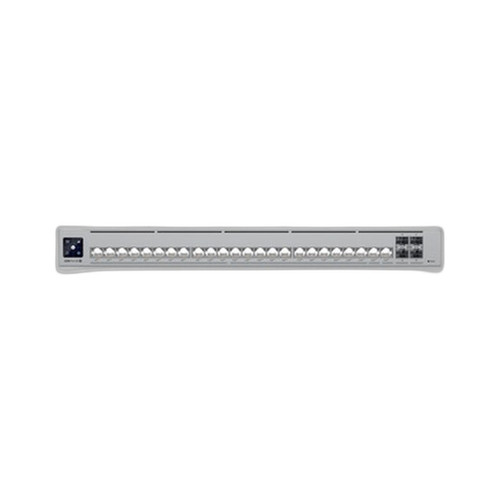
The USW-PRO-HD-24-POE provides 22× 2.5GbE access ports plus 2× 10GbE copper uplinks and 4× 10G SFP+ fiber uplinks, yielding a 230 Gbps switching capacity and 115 Gbps non-blocking throughput at 171 Mpps forwarding rate. Its PoE budget is 600W across all 24 ports, supporting PoE++ (802.3bt) on every port at roughly 25W each simultaneously, backed by a 660W internal supply with DC redundancy input.
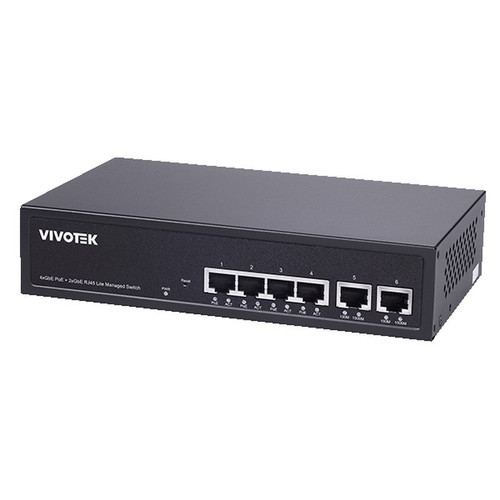
The AW-GEV-288A-370 provides 24× 1GbE PoE ports (ports 1–20 capped at 30W, ports 21–24 at 90W via 4-pair PoE) plus 4 combo Gigabit uplink ports, for a total of 28 physical ports. Switching bandwidth is 56 Gbps with a forwarding capacity of 41.7 Mpps. Total PoE budget is 370W. The per-port maximum on the high-power tier is 90W (ports 21–24), accommodating PTZ or thermal cameras drawing above standard PoE+ levels, while the remaining 20 ports are limited to 30W each.
On raw throughput the Ubiquiti is 4.1× wider (230 Gbps vs 56 Gbps) and delivers 230W more total PoE budget. The Vivotek's 90W ports are unique: no comparable high-wattage per-port spec is published for the Ubiquiti, which instead spreads its larger aggregate budget across 24 ports at the 802.3bt standard without specifying a per-port ceiling above the standard limit. Buyers running high-draw PTZ or thermal units on a handful of ports should note this asymmetry.
How do the two switches compare on physical build, power resilience, and operating environment?
The USW-PRO-HD-24-POE is housed in SGCC steel and measures 442 × 400 × 44 mm (1U), weighing 6.2 kg without brackets. It accepts 100–240V AC input and adds a DC backup input for power redundancy — the switch can remain operational on DC power if the AC feed is interrupted, a meaningful resilience feature in surveillance infrastructure. Operating temperature is rated -5°C to 40°C (23°F to 104°F). Certifications listed are CE, FCC, IC, and Anatel.
The AW-GEV-288A-370 is housed in a white enclosure measuring 442 × 44 × 211 mm (1U) and weighs 3.2 kg — roughly half the Ubiquiti's mass. It accepts 100–240V AC at 50–60 Hz. No DC backup or redundant power input is specified in the provided data. Operating temperature range is -10°C to 50°C (14°F to 122°F), and storage temperature extends to 70°C. Certifications include UL, CE, UKCA, FCC, VCCI, LVD, and ICES. The Vivotek's wider thermal range (-10°C vs -5°C lower; 50°C vs 40°C upper) may matter in unconditioned wiring closets or outdoor-adjacent enclosures.
The Ubiquiti's DC redundancy input is a clear advantage for installations requiring power continuity. The Vivotek's broader operating temperature range (10°C wider at both ends) and lighter weight are practical advantages in space-constrained or environmentally variable locations. NDAA compliance is confirmed only for the Ubiquiti; no NDAA status is stated in the Vivotek specifications provided.
Which switch offers more capable network management and surveillance ecosystem integration?
The USW-PRO-HD-24-POE is managed through Ubiquiti's UniFi platform (management interface specified as Ethernet/Layer 2–3). It supports up to 1,000 VLANs (802.1Q), STP/RSTP, and 802.1X port authentication. Layer 3 routing capability is noted in the provided data. Specific management protocols (SNMP version, RMON, LLDP) are not listed in the provided specifications; buyers requiring those details should consult the datasheet.
The AW-GEV-288A-370 carries an extensive and explicitly documented management feature set: SNMP v1/v2c/v3, RMON groups 1/2/3/9, LLDP/LLDP-MED, RADIUS/TACACS+, SSL, IP Source Guard, DHCP Snooping, 802.1X, port mirroring, S-Flow, NTP, UPnP, cable diagnostics, and traffic monitoring. VLAN support reaches 4,096 IDs (802.1Q tag-based) with port-based, MAC-based, IP subnet-based, voice, Q-in-Q, and protocol-based VLAN modes. QoS includes 8 hardware queues, WRR, DSCP/CoS, and 802.1p.
The Vivotek switch also integrates a Vivotek-specific surveillance management layer: auto-discovery of up to 256 Vivotek devices, PoE alive-checking with reboot, PoE scheduling, non-stop PoE, extended PoE mode (up to 250m at 10 Mbps), topology/floor/Google Map views, device grouping for VLAN, and camera configuration file export/import — features absent from the Ubiquiti's listed specifications. The Ubiquiti's 1,000-VLAN support versus the Vivotek's 4,096-ID ceiling is relevant only at very large-scale segmentation. For mixed-vendor or UniFi-centric networks, the Ubiquiti ecosystem is the natural fit; for Vivotek-heavy surveillance networks, the AW-GEV-288A-370's native device management adds operational value unavailable on the Ubiquiti.
Which should you choose: the USW-PRO-HD-24-POE or the GEV-288A-370?
Our take: The USW-PRO-HD-24-POE is the stronger choice when maximum switching throughput, multi-gigabit access speeds, and AC/DC power redundancy are the primary requirements. It delivers 230 Gbps switching capacity versus the Vivotek's 56 Gbps (4.1× more), a 600W PoE budget versus 370W (230W more), and 22× 2.5GbE ports that future-proof the infrastructure for Wi-Fi 6 APs and multi-gig cameras — capabilities the Gigabit-only Vivotek cannot match. It also adds DC backup power input, absent from the Vivotek's listed specs, and carries confirmed NDAA compliance. Conversely, the AW-GEV-288A-370 is the better fit for pure Vivotek surveillance deployments: its native auto-discovery of up to 256 Vivotek devices, PoE alive-checking with remote reboot, PoE scheduling, 90W high-power ports on positions 21–24, a wider operating temperature range (-10°C to 50°C), and a far richer documented management protocol stack (SNMP v3, TACACS+, RMON, LLDP-MED) serve camera-centric operators who prioritize ecosystem integration over raw speed.
Side-by-Side Comparison
Spec-for-spec, from manufacturer data.
| Specification | Ubiquiti USW-PRO-HD-24-POE | Vivotek GEV-288A-370 |
|---|---|---|
| Form Factor | 1U Rack Mount | 1U Rack Mount |
| Access Port Speed | 22× 2.5GbE + 2× 10GbE | 24× 1GbE |
| Uplink / SFP Ports | 4× 10G SFP+ | 4× Gigabit Combo |
| Total PoE Ports | 24 | 24 |
| PoE Standard | 802.3bt (PoE++) | 802.3af/at/bt |
| PoE Budget | 600W | 370W |
| Per-Port Max PoE | Not specified (802.3bt) | 30W (ports 1–20); 90W (ports 21–24) |
| Switching Capacity | 230 Gbps | 56 Gbps |
| Non-Blocking Throughput | 115 Gbps | — |
| Forwarding Rate | 171 Mpps | 41.7 Mpps |
| VLAN Support | 1,000 VLANs | 4,096 VLAN IDs (802.1Q) |
| MAC Address Table | — | 8K entries |
| Operating Temperature | -5°C to 40°C | -10°C to 50°C |
| Power Redundancy | AC + DC backup input | AC only (not specified) |
| NDAA Compliant | Yes | Not specified |
| Warranty | Manufacturer Warranty (duration not specified) | 24 months |
| Weight | 6.2 kg | 3.2 kg |
| Dimensions (mm) | 442 × 400 × 44 | 442 × 211 × 44 |
| Vivotek Device Auto-Discovery | — | Up to 256 devices |
| Certifications | CE, FCC, IC, Anatel | UL, CE, UKCA, FCC, VCCI, LVD, ICES |
Frequently Asked Questions
Which should you choose: the USW-PRO-HD-24-POE or the GEV-288A-370?
The USW-PRO-HD-24-POE is the stronger choice when maximum switching throughput, multi-gigabit access speeds, and AC/DC power redundancy are the primary requirements. It delivers 230 Gbps switching capacity versus the Vivotek's 56 Gbps (4.1× more), a 600W PoE budget versus 370W (230W more), and 22× 2.5GbE ports that future-proof the infrastructure for Wi-Fi 6 APs and multi-gig cameras — capabilities the Gigabit-only Vivotek cannot match. It also adds DC backup power input, absent from the Vivotek's listed specs, and carries confirmed NDAA compliance. Conversely, the AW-GEV-288A-370 is the better fit for pure Vivotek surveillance deployments: its native auto-discovery of up to 256 Vivotek devices, PoE alive-checking with remote reboot, PoE scheduling, 90W high-power ports on positions 21–24, a wider operating temperature range (-10°C to 50°C), and a far richer documented management protocol stack (SNMP v3, TACACS+, RMON, LLDP-MED) serve camera-centric operators who prioritize ecosystem integration over raw speed.
Is the USW-PRO-HD-24-POE or the AW-GEV-288A-370 better for larger deployments with high camera counts?
For sheer switching scale the USW-PRO-HD-24-POE is stronger: 230 Gbps switching capacity and 115 Gbps non-blocking throughput versus the Vivotek's 56 Gbps, plus 600W PoE budget supporting all 24 ports simultaneously. However, if those cameras are Vivotek devices, the AW-GEV-288A-370's auto-discovery of up to 256 Vivotek units and native device management may reduce operational overhead enough to matter at scale.
Can either switch power high-draw PTZ or thermal cameras requiring more than 30W?
Yes, both support PoE++ (802.3bt). The Vivotek AW-GEV-288A-370 explicitly specifies 90W output on ports 21–24 (4-pair PoE), making those slots the documented choice for PTZ or thermal cameras drawing above 30W. The Ubiquiti USW-PRO-HD-24-POE supports 802.3bt across all 24 ports from its 600W budget, but no per-port maximum wattage above the 802.3bt standard is stated in the provided specifications; verify with the Ubiquiti datasheet for exact per-port limits.
Which switch is better suited for installations in non-climate-controlled spaces such as wiring closets without HVAC?
The Vivotek AW-GEV-288A-370 has the wider documented operating temperature range: -10°C to 50°C (14°F to 122°F), compared to the Ubiquiti USW-PRO-HD-24-POE's -5°C to 40°C (23°F to 104°F). If ambient temperatures in the installation space regularly approach or exceed 40°C, the Vivotek's 10°C higher upper rating is a meaningful differentiator. Neither switch is rated for outdoor or wet-location installation based on the provided specifications.
More Network Switch Comparisons
- Vivotek GEV-288A-370 vs Axis T8524
- Vivotek GEV-288A-370 vs Cradlepoint SW2400P-GN
- Vivotek GEV-288A-370 vs Allied Telesis AT-x530L-28GPX-901
- Vivotek GEV-288A-370 vs Ubiquiti USW-ENTERPRISE-24-POE
- Axis T8524 vs Cradlepoint SW2400P-GN
- Axis T8524 vs Allied Telesis AT-x530L-28GPX-901
Network Switch Buying Guides
Get a Second Opinion on Your Camera Choice
Share your site layout, coverage goals, and budget. Our team will validate the camera selection, flag anything we would change, and recommend products that match the use case.