
Ubiquiti USW-PRO-HD-24-POE vs Cradlepoint SW2400P-GN: Specification Comparison
Both the Ubiquiti USW-PRO-HD-24-POE and the Cradlepoint SW2400P-GN are managed 24-port PoE rack-mount switches targeted at enterprise and branch network deployments. The comparison covers PoE power delivery, port speed tiers, switching throughput, management ecosystem, and environmental ratings — the dimensions that most directly determine fit for IP camera, wireless AP, and branch-site infrastructure projects.
In This Guide
- Which switch delivers more bandwidth per port and aggregate throughput?
- Which switch provides more PoE headroom and what are the power delivery standards supported?
- How are the two switches managed, and what ecosystem constraints does each impose?
- Which should you choose: the USW-PRO-HD-24-POE or the SW2400P-GN?
- Side-by-Side Specs
- FAQ
Which switch delivers more bandwidth per port and aggregate throughput?
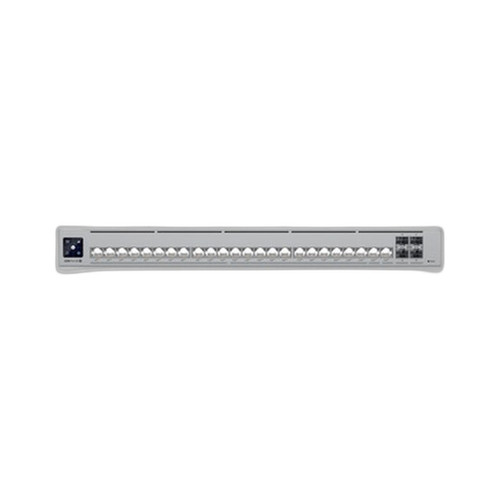
The USW-PRO-HD-24-POE provides 22× 2.5GbE access ports plus 2× 10GbE copper uplinks and 4× 10G SFP+ fiber uplinks, yielding a switching capacity of 230 Gbps aggregate with 115 Gbps non-blocking throughput and a forwarding rate of 171 Mpps. This multi-gig port profile directly benefits Wi-Fi 6/6E APs and next-generation IP cameras that saturate standard Gigabit links.
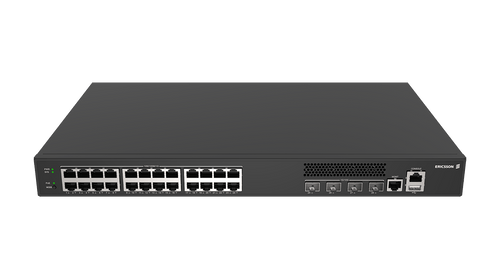
The SW2400P-GN provides 24-port Gigabit (1GbE) access speeds with 4× SFP+ slots and a stated switching capacity of 128 Gbps. Per-port bandwidth is capped at 1 Gbps on access ports. Specific forwarding rate (Mpps) is not listed in the provided specifications.
For deployments requiring multi-gig edge connectivity, the USW-PRO-HD-24-POE's 2.5GbE access ports and 230 Gbps fabric represent a material advantage. Buyers whose endpoints are all standard Gigabit devices will not realize that headroom from the Ubiquiti unit, and the SW2400P-GN's 128 Gbps capacity is sufficient for 24× 1GbE fully loaded.
Which switch provides more PoE headroom and what are the power delivery standards supported?
The USW-PRO-HD-24-POE carries a 600W PoE budget supporting PoE++ (802.3bt) across all 24 ports — approximately 25W per port when fully loaded. It includes an internal 660W AC/DC power supply with a DC backup input for continuity on AC failure. Input range is 100–240V AC.
The SW2400P-GN provides a 370W PoE budget using PoE+ (802.3at), which caps individual port delivery at 30W per the 802.3at standard. The specifications do not describe a redundant or backup power input. The operating temperature range is listed as -5°C to 45°C (industrial rating per the provided specs).
The 230W difference in PoE budget (600W vs. 370W) is significant for camera-dense or AP-dense rows. PoE++ (802.3bt) on the Ubiquiti unit supports devices drawing up to 90W per port — relevant for pan-tilt-zoom cameras, multi-radio APs, or thin clients. The Cradlepoint's PoE+ (802.3at) 30W ceiling covers the majority of standard IP cameras and indoor APs but cannot power 802.3bt devices at full draw.
How are the two switches managed, and what ecosystem constraints does each impose?
The USW-PRO-HD-24-POE is managed through Ubiquiti's UniFi controller platform, supporting Layer 2/3 routing, STP/RSTP, 802.1X port authentication, and up to 1,000 VLANs. Management is delivered over Ethernet. The switch is NDAA compliant and carries CE, FCC, IC, and Anatel certifications.
The SW2400P-GN is managed via Cradlepoint's NetCloud platform, a cloud-native SD-WAN and branch management service. The provided specifications note TAA compliance and list the use case as branch and fixed sites. SFP+ slots (4) are noted. Specific VLAN count, Layer 3 routing capability, and port-level authentication protocols are not stated in the provided specifications. USB connectivity is listed.
The management ecosystems are mutually exclusive: the Ubiquiti unit is tightly coupled to UniFi, while the Cradlepoint unit is designed for sites already running NetCloud. A buyer standardized on one platform will incur significant operational overhead adopting the other. TAA compliance on the SW2400P-GN is relevant for U.S. federal and government-adjacent purchasing requirements where NDAA/TAA matter — the Ubiquiti unit is noted as NDAA compliant but TAA status is not stated in the provided specifications.
Which should you choose: the USW-PRO-HD-24-POE or the SW2400P-GN?
Our take: The USW-PRO-HD-24-POE is the stronger choice when the deployment demands high per-port bandwidth, maximum PoE headroom, and resilient power delivery. It outpaces the SW2400P-GN on three concrete dimensions: 600W PoE++ budget versus 370W PoE+ (a 230W delta), 230 Gbps switching capacity versus 128 Gbps, and multi-gig 2.5GbE access ports versus Gigabit access ports. The DC backup input adds power resilience the SW2400P-GN spec does not describe. The SW2400P-GN is the more natural fit for organizations already operating Cradlepoint NetCloud across branch sites, where centralized SD-WAN policy management outweighs raw throughput, and where an industrial temperature rating (-5°C to 45°C) and TAA compliance are procurement requirements. Neither switch is a drop-in replacement for the other without ecosystem reconfiguration.
Side-by-Side Comparison
Spec-for-spec, from manufacturer data.
| Specification | Ubiquiti USW-PRO-HD-24-POE | Cradlepoint SW2400P-GN |
|---|---|---|
| Port Count (Access) | 24 | 24 |
| Access Port Speed | 22× 2.5GbE + 2× 10GbE | 24× 1GbE |
| Uplink / SFP+ Slots | 4× 10G SFP+ | 4× SFP+ |
| PoE Standard | PoE++ (802.3bt) | PoE+ (802.3at) |
| PoE Budget | 600W | 370W |
| Switching Capacity | 230 Gbps | 128 Gbps |
| Non-Blocking Throughput | 115 Gbps | — |
| Forwarding Rate | 171 Mpps | — |
| VLAN Support | 1,000 | — |
| Management Platform | Ubiquiti UniFi | Cradlepoint NetCloud |
| Layer 3 Routing | Yes | — |
| Power Supply | Internal 660W AC/DC | — |
| DC Backup Input | Yes | — |
| Operating Temperature | -5°C to 40°C | -5°C to 45°C |
| Form Factor | 1U Rack Mount (442 × 400 × 44 mm) | Rack Mount |
| Compliance | NDAA; CE, FCC, IC, Anatel | TAA |
Frequently Asked Questions
Which should you choose: the USW-PRO-HD-24-POE or the SW2400P-GN?
The USW-PRO-HD-24-POE is the stronger choice when the deployment demands high per-port bandwidth, maximum PoE headroom, and resilient power delivery. It outpaces the SW2400P-GN on three concrete dimensions: 600W PoE++ budget versus 370W PoE+ (a 230W delta), 230 Gbps switching capacity versus 128 Gbps, and multi-gig 2.5GbE access ports versus Gigabit access ports. The DC backup input adds power resilience the SW2400P-GN spec does not describe. The SW2400P-GN is the more natural fit for organizations already operating Cradlepoint NetCloud across branch sites, where centralized SD-WAN policy management outweighs raw throughput, and where an industrial temperature rating (-5°C to 45°C) and TAA compliance are procurement requirements. Neither switch is a drop-in replacement for the other without ecosystem reconfiguration.
Is the USW-PRO-HD-24-POE or the SW2400P-GN better for powering a dense IP camera deployment?
The USW-PRO-HD-24-POE is better suited for dense camera deployments. Its 600W PoE++ (802.3bt) budget provides roughly 25W per port across all 24 ports simultaneously, and it supports devices drawing up to 90W per port. The SW2400P-GN's 370W PoE+ (802.3at) budget caps individual ports at 30W and delivers less total headroom across the port array.
Can either switch be used in an unconditioned IDF room or wiring closet without climate control?
The SW2400P-GN is specified with an industrial operating temperature range of -5°C to 45°C, making it explicitly suited for unconditioned spaces. The USW-PRO-HD-24-POE is rated -5°C to 40°C. The 5°C upper-limit difference may be relevant in warm environments; buyers should verify that ambient temperatures in the target space fall within the Ubiquiti unit's 40°C ceiling before deploying it in an unconditioned closet.
Do I need an existing Ubiquiti or Cradlepoint environment to use either switch?
Both switches are designed for their respective management platforms. The USW-PRO-HD-24-POE is managed through Ubiquiti's UniFi controller and is most effective in a UniFi network environment. The SW2400P-GN is managed through Cradlepoint NetCloud, which is a subscription-based cloud service. Deploying either unit outside its native ecosystem will limit management capability. The provided specifications do not indicate that either switch supports a fully standalone or third-party SNMP/CLI management mode, so buyers should confirm compatibility with their existing infrastructure before purchasing.
More Network Switch Comparisons
- Vivotek GEV-288A-370 vs Axis T8524
- Vivotek GEV-288A-370 vs Cradlepoint SW2400P-GN
- Vivotek GEV-288A-370 vs Allied Telesis AT-x530L-28GPX-901
- Vivotek GEV-288A-370 vs Ubiquiti USW-ENTERPRISE-24-POE
- Axis T8524 vs Cradlepoint SW2400P-GN
- Axis T8524 vs Allied Telesis AT-x530L-28GPX-901
Network Switch Buying Guides
Get a Second Opinion on Your Camera Choice
Share your site layout, coverage goals, and budget. Our team will validate the camera selection, flag anything we would change, and recommend products that match the use case.