
Ubiquiti USW-PRO-24-POE vs Vivotek GEV-288A-370: Specification Comparison
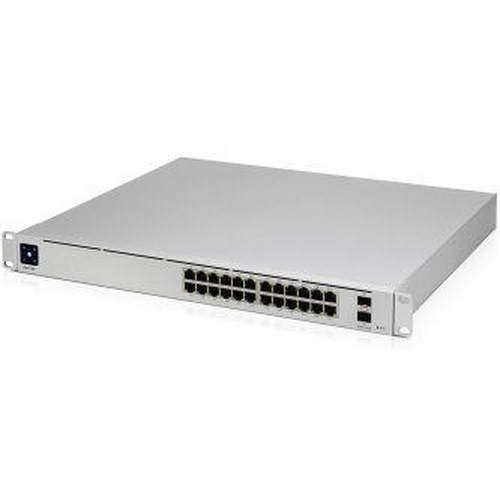
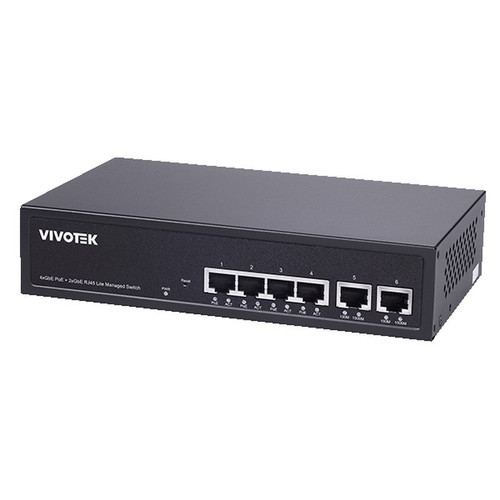
Both the Ubiquiti USW-PRO-24-POE and the Vivotek AW-GEV-288A-370 are 1U rack-mount, 24-port Gigabit managed PoE switches targeting access-layer deployments in surveillance and enterprise networks. Each accepts 100–240VAC, delivers PoE across all 24 RJ-45 ports, and supports 802.1Q VLANs, QoS, and link aggregation. The comparison centers on three decision-critical axes: switching fabric and port throughput, PoE budget and port-power allocation, and management depth including platform-specific integration.
In This Guide
- Which switch delivers more headroom on switching fabric and forwarding throughput?
- How does PoE power budget and per-port power allocation differ between the two switches?
- Which switch offers deeper management and platform-specific integration for surveillance deployments?
- Which should you choose: the USW-PRO-24-POE or the GEV-288A-370?
- Side-by-Side Specs
- FAQ
Which switch delivers more headroom on switching fabric and forwarding throughput?
The USW-PRO-24-POE specifies an 88 Gbps switching capacity with a 44 Gbps non-blocking throughput figure and a forwarding rate of 65 Mpps. The AW-GEV-288A-370 specifies 56 Gbps switching bandwidth and 41.7 Mpps forwarding capacity; a non-blocking throughput sub-figure is not stated in the provided specs.
The USW-PRO-24-POE also adds two 10G SFP+ uplink ports, raising total port bandwidth beyond the base 24-port Gigabit fabric. The AW-GEV-288A-370 provides four Gigabit Combo ports (RJ-45/SFP) as uplinks, topping out at 1G per uplink. For aggregating multiple access switches into a core, the 10G uplinks on the USW-PRO-24-POE represent a meaningful architectural difference.
MAC address table depth is not specified for the USW-PRO-24-POE; the AW-GEV-288A-370 states an 8K MAC table. Jumbo frame support (9,216 bytes) is specified for the AW-GEV-288A-370; this figure is not provided for the USW-PRO-24-POE.
How does PoE power budget and per-port power allocation differ between the two switches?
The USW-PRO-24-POE carries a 400W PoE output budget across all 24 ports, compliant with IEEE 802.3bt (PoE++), with a maximum of 30W noted per the provided power spec field. The total power supply is rated at 450W (50W switch consumption + 400W PoE output).
The AW-GEV-288A-370 provides a 370W total PoE budget with a split allocation: ports 1–20 deliver up to 30W each (802.3af/at, PoE+), while ports 21–24 deliver up to 90W each (802.3bt, 4-pair PoE). This asymmetric design benefits deployments mixing standard IP cameras on ports 1–20 with high-draw devices such as PTZ cameras, thermal cameras, or multi-radio APs on ports 21–24. AC input is rated 100–240VAC at 50–60 Hz.
The USW-PRO-24-POE's 400W budget exceeds the AW-GEV-288A-370's 370W total, but the Vivotek model's four 90W ports provide burst headroom per-port that the Ubiquiti spec does not explicitly enumerate at that level. Buyers powering multiple high-draw PoE++ endpoints should verify per-port maximum against device draw for both models.
Which switch offers deeper management and platform-specific integration for surveillance deployments?
The USW-PRO-24-POE is managed via the UniFi controller ecosystem (web/cloud/on-prem). The provided specs cite Ethernet management, VLAN support for up to 1,000 VLANs, NDAA Section 889 compliance, and certifications including CE, FCC, IC, and Anatel. Specific Layer 2/3 protocol lists (STP variants, RADIUS, ACL detail) are not enumerated in the provided specs.
The AW-GEV-288A-370 provides an extensive Layer 2 feature set documented in the specs: IEEE 802.1D/w/s spanning tree, LACP, 4,096 VLAN IDs (802.1Q), Q-in-Q, private VLAN edge, voice VLAN, IP subnet-based VLAN, IGMP/MLD snooping, DHCP server/relay/snooping, RADIUS/TACACS+ authentication, SSL, IP source guard, storm control, port security, SNMP v1/v2c/v3, RMON groups 1/2/3/9, LLDP-MED, S-Flow, and port mirroring.
The AW-GEV-288A-370 also includes Vivotek-specific surveillance management features: auto-discovery of up to 256 Vivotek devices, PoE reboot/alive-check/scheduling, topology/floor/Google Map views, camera configuration export/import, extended PoE mode up to 250m at 10 Mbps, and per-device grouping and VLAN assignment. These features are exclusive to the Vivotek platform. The USW-PRO-24-POE does not include comparable camera-vendor-specific management in the provided specs.
Which should you choose: the USW-PRO-24-POE or the GEV-288A-370?
Our take: The USW-PRO-24-POE is the stronger choice when raw switching headroom and 10G uplink capacity are the primary requirements: its 88 Gbps fabric and 44 Gbps non-blocking throughput exceed the AW-GEV-288A-370's 56 Gbps bandwidth by 57%, its forwarding rate of 65 Mpps outpaces the Vivotek's 41.7 Mpps, and its dual 10G SFP+ uplinks provide an order-of-magnitude more uplink bandwidth than the AW-GEV-288A-370's four 1G combo ports. It also carries a 400W PoE budget (versus 370W) and holds NDAA Section 889 compliance. Conversely, the AW-GEV-288A-370 is purpose-built for Vivotek surveillance deployments: it auto-discovers up to 256 Vivotek cameras, provides four dedicated 90W PoE++ ports for PTZ or thermal devices, exposes a broader documented Layer 2 feature set (4,096 VLANs, TACACS+, RMON, S-Flow), and carries a UL listing absent from the Ubiquiti spec. Buyers running mixed Vivotek camera fleets with high-draw PTZ endpoints should favor the AW-GEV-288A-370; those building UniFi or multi-vendor networks requiring high throughput and 10G uplinks should favor the USW-PRO-24-POE.
Side-by-Side Comparison
Spec-for-spec, from manufacturer data.
| Specification | Ubiquiti USW-PRO-24-POE | Vivotek GEV-288A-370 |
|---|---|---|
| Device Type | Managed PoE Switch | Managed PoE Switch |
| Form Factor | 1U Rack-mount | 1U Rack-mount |
| Total RJ-45 PoE Ports | 24 | 24 |
| Uplink Ports | 2× 10G SFP+ | 4× Gigabit Combo (RJ-45/SFP) |
| Total Ports | 26 (24+2 SFP+) | 28 (24 PoE + 4 Combo) |
| Switching Capacity | 88 Gbps | 56 Gbps |
| Non-blocking Throughput | 44 Gbps | — |
| Forwarding Rate | 65 Mpps | 41.7 Mpps |
| PoE Budget | 400W | 370W |
| Per-Port PoE Maximum | 802.3bt (PoE++); per-port max not specified beyond 30W field | Ports 1–20: 30W; Ports 21–24: 90W |
| PoE Standard | IEEE 802.3bt (PoE++) | IEEE 802.3af/at/bt |
| VLAN Support | Up to 1,000 VLANs | 4,096 VLAN IDs (802.1Q) |
| MAC Address Table | — | 8K |
| Operating Temperature | -5 to 40°C (23 to 104°F) | -10 to 50°C (14 to 122°F) |
| Dimensions (mm) | 442 × 285 × 44 | 442 × 44 × 211 |
| Weight | 4.3 kg (9.5 lb) | 3.2 kg |
| Power Supply | Internal, 450W (50W switch + 400W PoE) | Internal; AC input 100–240VAC, 50–60 Hz |
| NDAA Section 889 Compliant | Yes | — |
| Certifications | CE, FCC, IC, Anatel | UL, CE, UKCA, FCC, VCCI, LVD, ICES |
| Vivotek Device Auto-Discovery | — | Up to 256 devices |
| Extended PoE Mode (250m) | — | Yes (10 Mbps) |
| Warranty | Manufacturer Warranty (duration not specified) | 24 months |
Frequently Asked Questions
Which should you choose: the USW-PRO-24-POE or the GEV-288A-370?
The USW-PRO-24-POE is the stronger choice when raw switching headroom and 10G uplink capacity are the primary requirements: its 88 Gbps fabric and 44 Gbps non-blocking throughput exceed the AW-GEV-288A-370's 56 Gbps bandwidth by 57%, its forwarding rate of 65 Mpps outpaces the Vivotek's 41.7 Mpps, and its dual 10G SFP+ uplinks provide an order-of-magnitude more uplink bandwidth than the AW-GEV-288A-370's four 1G combo ports. It also carries a 400W PoE budget (versus 370W) and holds NDAA Section 889 compliance. Conversely, the AW-GEV-288A-370 is purpose-built for Vivotek surveillance deployments: it auto-discovers up to 256 Vivotek cameras, provides four dedicated 90W PoE++ ports for PTZ or thermal devices, exposes a broader documented Layer 2 feature set (4,096 VLANs, TACACS+, RMON, S-Flow), and carries a UL listing absent from the Ubiquiti spec. Buyers running mixed Vivotek camera fleets with high-draw PTZ endpoints should favor the AW-GEV-288A-370; those building UniFi or multi-vendor networks requiring high throughput and 10G uplinks should favor the USW-PRO-24-POE.
Is the USW-PRO-24-POE or the AW-GEV-288A-370 better for powering PTZ cameras that draw more than 30W?
The AW-GEV-288A-370 explicitly allocates four ports (21–24) at up to 90W each via 802.3bt 4-pair PoE, making it the documented choice for high-draw PTZ or thermal cameras. The USW-PRO-24-POE is rated 802.3bt (PoE++) but the provided specs do not state a per-port maximum above 30W for individual ports; verify the per-port ceiling against your camera's draw before deploying.
Which switch is better suited for a non-Vivotek or multi-vendor camera deployment?
The USW-PRO-24-POE is vendor-agnostic and integrates into the UniFi ecosystem, which supports cameras and APs from multiple manufacturers. The AW-GEV-288A-370's advanced management features—auto-discovery, topology view, PoE reboot, camera config export—are specific to Vivotek devices and provide less value in a mixed-brand environment. For multi-vendor deployments, the USW-PRO-24-POE is the more versatile option based on the provided specs.
Does either switch meet NDAA Section 889 compliance requirements for government or federally funded projects?
Yes—the USW-PRO-24-POE is explicitly listed as NDAA compliant in its provided specifications. NDAA Section 889 compliance is not stated anywhere in the AW-GEV-288A-370 specifications supplied; buyers with federal compliance requirements should confirm this status directly with Vivotek before specifying that model.
More Network Switch Comparisons
- Vivotek GEV-288A-370 vs Axis T8524
- Vivotek GEV-288A-370 vs Cradlepoint SW2400P-GN
- Vivotek GEV-288A-370 vs Allied Telesis AT-x530L-28GPX-901
- Vivotek GEV-288A-370 vs Ubiquiti USW-ENTERPRISE-24-POE
- Axis T8524 vs Cradlepoint SW2400P-GN
- Axis T8524 vs Allied Telesis AT-x530L-28GPX-901
Network Switch Buying Guides
Get a Second Opinion on Your Camera Choice
Share your site layout, coverage goals, and budget. Our team will validate the camera selection, flag anything we would change, and recommend products that match the use case.