
Ubiquiti USW-PRO-24-POE vs Ubiquiti USW-PRO-HD-24-POE: Specification Comparison
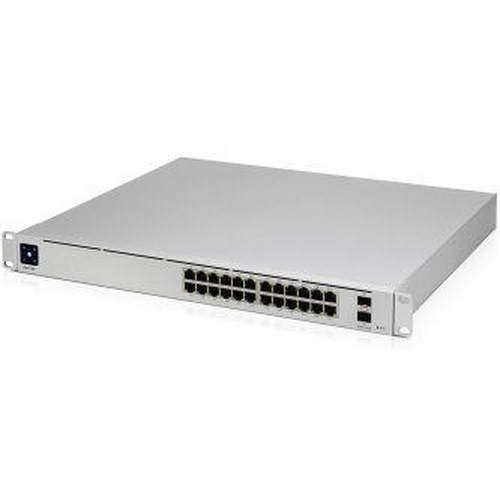
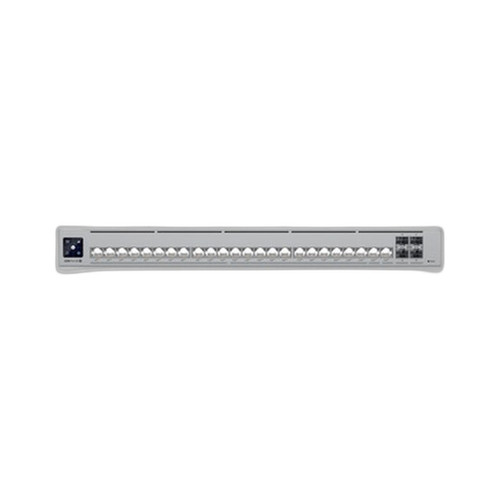
Both products are 1U rack-mount, 24-port managed PoE switches from Ubiquiti designed for enterprise access-layer deployments. The USW-PRO-24-POE delivers Gigabit copper ports with a 400W PoE++ budget, while the USW-PRO-HD-24-POE steps up to a multi-gigabit copper port mix with a 600W PoE++ budget and a larger switching fabric. Buyers cross-shopping these models are typically evaluating whether their edge devices — IP cameras, Wi-Fi 6/6E APs, or VoIP phones — demand per-port speeds above 1G and whether the 50% larger power budget justifies the higher cost and deeper chassis.
In This Guide
- Which switch delivers the right per-port speeds and switching capacity for your edge devices?
- Does either switch provide enough PoE budget and power resilience for your deployment density?
- How do chassis size, weight, and management capabilities compare between the two models?
- Which should you choose: the USW-PRO-24-POE or the USW-PRO-HD-24-POE?
- Side-by-Side Specs
- FAQ
Which switch delivers the right per-port speeds and switching capacity for your edge devices?
The USW-PRO-24-POE provides 24× Gigabit RJ-45 (10/100/1000) copper ports plus 2× 10G SFP+ uplinks, producing an 88 Gbps switching fabric with 44 Gbps non-blocking throughput and a forwarding rate of 65 Mpps. Every copper port is capped at 1 Gbps, which covers the vast majority of current IP cameras, VoIP endpoints, and first-generation Wi-Fi 6 APs.
The USW-PRO-HD-24-POE raises the bar substantially: 22× 2.5GbE copper ports plus 2× 10GbE copper ports and 4× 10G SFP+ uplinks yield a 230 Gbps switching fabric with 115 Gbps non-blocking throughput and a forwarding rate of 171 Mpps. The 2.5GbE copper ports are directly relevant for Wi-Fi 6/6E APs rated above 1 Gbps aggregate, high-resolution multi-sensor cameras, and NVR uplinks. The fabric is 2.6× larger and the forwarding rate is 2.6× higher than the PRO-24-POE.
Buyers whose installed base is entirely 1G-capable devices will see no practical benefit from the HD's higher per-port speeds. Those deploying 2.5GbE-capable APs or cameras will be bottlenecked at the port on the PRO-24-POE and cannot work around that limitation.
Does either switch provide enough PoE budget and power resilience for your deployment density?
The USW-PRO-24-POE carries a 400W PoE++ (802.3bt) output budget from an internal 450W AC power supply, consuming 50W for its own switching electronics. There is no DC backup input specified in the provided specifications.
The USW-PRO-HD-24-POE provides a 600W PoE++ budget — 50% more than the PRO-24-POE — backed by an internal 660W AC supply consuming 60W for the switch itself. The provided specifications explicitly note DC power backup redundancy, meaning a secondary DC source can sustain PoE output during an AC failure. This is a meaningful operational differentiator in installations where UPS coverage is partial or where generator switchover gaps exist.
At 24 ports, the PRO-24-POE averages 16.7W per port at full budget; the HD averages 25W per port. Deployments mixing 802.3bt class 4 cameras (≤30W) and Wi-Fi 6E APs (≤25W) will approach or exceed the PRO-24-POE budget at full population, whereas the HD provides headroom across all 24 ports simultaneously. Both units share the same operating power draw range (50W vs 60W switch-only) and identical AC input voltage range of 100–240V.
How do chassis size, weight, and management capabilities compare between the two models?
Both switches share identical height (44 mm, 1U) and width (442 mm) for standard rack compatibility. The USW-PRO-24-POE is 285 mm deep and weighs 4.3 kg (9.5 lb). The USW-PRO-HD-24-POE is 400 mm deep — 115 mm longer — and weighs 6.2 kg (13.7 lb). The depth difference is relevant in shallow-depth racks or wall-mount enclosures; buyers should verify at least 425 mm of usable rear clearance before deploying the HD model.
Both units are constructed from SGCC steel and share an identical operating temperature range of -5°C to 40°C (23°F to 104°F). Both are NDAA Section 889 compliant. Certifications are equivalent in category (CE, FCC, IC, Anatel) though the Anatel registration numbers differ.
The PRO-24-POE specifications list 1,000 VLAN support. The HD specifications explicitly list Layer 2/3 routing, STP/RSTP, 802.1X, and 1,000 VLAN support. The PRO-24-POE specifications provided do not enumerate Layer 2/3 routing or 802.1X by name; buyers requiring those features confirmed by spec should verify against the USW-PRO-24-POE datasheet independently.
Which should you choose: the USW-PRO-24-POE or the USW-PRO-HD-24-POE?
Our take: The USW-PRO-HD-24-POE is the stronger choice when the deployment includes 2.5GbE-capable endpoints, requires sustained full-budget PoE across all 24 ports, or demands power redundancy via DC backup. Three concrete spec deltas make the case: the HD's switching fabric is 230 Gbps versus 88 Gbps (2.6× larger), its PoE budget is 600W versus 400W (50% more headroom), and its copper ports run at 2.5GbE versus 1GbE — a hard ceiling the PRO-24-POE cannot overcome in software. The USW-PRO-24-POE is the appropriate choice for cost-sensitive deployments where all connected devices are 1G-capable, PoE load stays below 400W, AC-only power is acceptable, and rack depth is constrained — its 285 mm chassis is 115 mm shallower than the HD. Both models are NDAA-compliant, share the same 1U form factor and operating temperature range, and carry equivalent certification classes.
Side-by-Side Comparison
Spec-for-spec, from manufacturer data.
| Specification | Ubiquiti USW-PRO-24-POE | Ubiquiti USW-PRO-HD-24-POE |
|---|---|---|
| Copper Port Speed | 24× 1GbE (10/100/1000) | 22× 2.5GbE + 2× 10GbE |
| SFP+ Uplink Ports | 2× 10G SFP+ | 4× 10G SFP+ |
| Switching Fabric | 88 Gbps | 230 Gbps |
| Non-Blocking Throughput | 44 Gbps | 115 Gbps |
| Forwarding Rate | 65 Mpps | 171 Mpps |
| PoE Standard | PoE++ (802.3bt) | PoE++ (802.3bt) |
| PoE Output Budget | 400W | 600W |
| DC Backup Power | Not specified | Yes |
| Internal PSU Rating | 450W | 660W |
| Switch Power Draw (no PoE) | 50W | 60W |
| VLAN Support | 1,000 | 1,000 |
| Chassis Depth | 285 mm | 400 mm |
| Weight (no brackets) | 4.3 kg (9.5 lb) | 6.2 kg (13.7 lb) |
| Operating Temperature | -5 to 40°C | -5 to 40°C |
| NDAA Section 889 Compliant | Yes | Yes |
| Enclosure Material | SGCC steel | SGCC steel |
Frequently Asked Questions
Which should you choose: the USW-PRO-24-POE or the USW-PRO-HD-24-POE?
The USW-PRO-HD-24-POE is the stronger choice when the deployment includes 2.5GbE-capable endpoints, requires sustained full-budget PoE across all 24 ports, or demands power redundancy via DC backup. Three concrete spec deltas make the case: the HD's switching fabric is 230 Gbps versus 88 Gbps (2.6× larger), its PoE budget is 600W versus 400W (50% more headroom), and its copper ports run at 2.5GbE versus 1GbE — a hard ceiling the PRO-24-POE cannot overcome in software. The USW-PRO-24-POE is the appropriate choice for cost-sensitive deployments where all connected devices are 1G-capable, PoE load stays below 400W, AC-only power is acceptable, and rack depth is constrained — its 285 mm chassis is 115 mm shallower than the HD. Both models are NDAA-compliant, share the same 1U form factor and operating temperature range, and carry equivalent certification classes.
Can the USW-PRO-24-POE power all 24 ports simultaneously at full PoE load?
At 400W across 24 ports the average available budget is approximately 16.7W per port. Devices drawing at or near 802.3bt Class 4 maximums (up to 30W each) will exceed the total budget before all 24 ports are fully loaded. The USW-PRO-HD-24-POE's 600W budget averages 25W per port, providing headroom to power all 24 ports at typical camera and AP draw levels simultaneously.
Is the USW-PRO-HD-24-POE worth the added depth and weight in a shallow-rack installation?
The HD chassis is 400 mm deep and weighs 6.2 kg, versus 285 mm deep and 4.3 kg for the PRO-24-POE. If usable rack depth is less than approximately 425 mm, the HD model may not physically fit. In that scenario the PRO-24-POE's shallower profile is not merely a convenience — it may be the only viable option regardless of performance requirements.
Does either switch support DC power backup for PoE continuity during AC outages?
Based on the provided specifications, the USW-PRO-HD-24-POE explicitly supports DC power backup redundancy, which can sustain PoE output during an AC failure. The USW-PRO-24-POE specifications do not include a DC backup input; its PoE output depends entirely on the internal 450W AC supply.
More Network Switch Comparisons
- Vivotek GEV-288A-370 vs Axis T8524
- Vivotek GEV-288A-370 vs Cradlepoint SW2400P-GN
- Vivotek GEV-288A-370 vs Allied Telesis AT-x530L-28GPX-901
- Vivotek GEV-288A-370 vs Ubiquiti USW-ENTERPRISE-24-POE
- Axis T8524 vs Cradlepoint SW2400P-GN
- Axis T8524 vs Allied Telesis AT-x530L-28GPX-901
Network Switch Buying Guides
Get a Second Opinion on Your Camera Choice
Share your site layout, coverage goals, and budget. Our team will validate the camera selection, flag anything we would change, and recommend products that match the use case.