
Ubiquiti USW-24-POE vs Ubiquiti USW-ENTERPRISE-24-POE: Specification Comparison
Both the USW-24-POE and the USW-ENTERPRISE-24-POE are Ubiquiti 24-port managed PoE switches in a 1U rack form factor, sharing the same port count, VLAN ceiling, operating temperature range, enclosure material, and NDAA compliance status. The comparison centers on three dimensions that drive purchase decisions in IP camera and enterprise wireless deployments: PoE power budget and port speed, switching fabric capacity and forwarding performance, and physical footprint, power infrastructure, and uplink options.

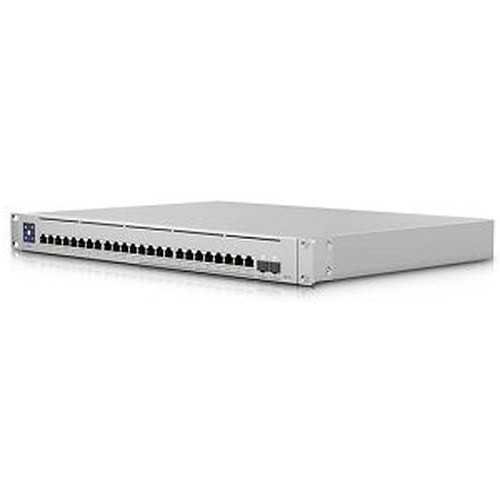
In This Guide
- Which switch delivers more PoE power and what port speeds are available?
- How do the switching capacity and forwarding rates compare under load?
- What are the differences in physical size, power draw, and management capabilities?
- Which should you choose: the USW-24-POE or the USW-ENTERPRISE-24-POE?
- Side-by-Side Specs
- FAQ
Which switch delivers more PoE power and what port speeds are available?
The USW-24-POE provides a 95W shared PoE budget across all 24 ports at 1G Gigabit Ethernet speed per port, powered by an internal 120W supply. At 95W total, installers planning multi-camera runs should budget approximately 13W per port when fully populated with standard 802.3af devices.
The USW-ENTERPRISE-24-POE provides a 400W shared PoE+ (802.3at) budget across 24 ports, powered by an internal 550W supply. Port speed is listed as 2.5G/1G PoE+, meaning each access port can negotiate up to 2.5 Gbps — relevant for high-throughput APs or multi-gigabit capable cameras. At 400W across 24 ports, average per-port headroom is approximately 16.7W, and the higher total allows simultaneous powering of more high-draw devices such as PTZ cameras or Wi-Fi 6/6E access points.
The PoE budget difference is 4.2× (400W vs 95W). Port speed on the Enterprise model is up to 2.5× higher per access port (2.5G vs 1G). PoE standard for the Enterprise is explicitly 802.3af/at on all 24 ports; the USW-24-POE spec does not explicitly state the PoE standard beyond the 95W budget figure.
How do the switching capacity and forwarding rates compare under load?
The USW-24-POE has a switching capacity of 52 Gbps aggregate with 26 Gbps non-blocking throughput and a forwarding rate of 39 Mpps. For a 24-port 1G switch, 26 Gbps non-blocking throughput is sufficient to sustain wire-speed on all ports simultaneously.
The USW-ENTERPRISE-24-POE has a switching capacity of 124 Gbps aggregate with 62 Gbps non-blocking throughput and a forwarding rate of 92 Mpps. These figures are 2.4× higher in switching capacity, 2.4× higher in non-blocking throughput, and 2.4× higher in forwarding rate than the USW-24-POE. The Enterprise model also adds two 10G SFP+ uplink ports, which are not present on the USW-24-POE per the provided specifications.
For deployments where uplink bandwidth to a core switch or NVR aggregation layer is a bottleneck, the dual 10G SFP+ uplinks on the Enterprise model represent a structural advantage the USW-24-POE does not offer. The USW-24-POE specifications do not list any dedicated uplink ports beyond the 24 access ports.
What are the differences in physical size, power draw, and management capabilities?
Both switches are 1U rack-mount units with identical width (442 mm) and height (44 mm). Depth differs: the USW-24-POE is 200 mm deep versus 325 mm for the USW-ENTERPRISE-24-POE — a 62.5% increase in chassis depth that matters in shallow rack installations. Weight is 3 kg (6.6 lb) for the USW-24-POE versus 5.1 kg (11.3 lb) for the Enterprise, both without mounting brackets.
Non-PoE power consumption is 25W for the USW-24-POE versus 60W for the USW-ENTERPRISE-24-POE. Both units use universal 100–240V AC input, internal AC/DC power supplies, and SGCC steel enclosures. Operating temperature range is identical: -5 to 40°C (23 to 104°F) for both models.
Both switches are listed as Ethernet-managed. VLAN support is 1,000 on both models. Both carry NDAA compliance and identical certification marks (CE, FCC, IC, Anatel), differing only in Anatel registration numbers. Neither spec set references a specific software platform, CLI version, or Layer 3 routing protocol list beyond the Enterprise model's 'Layer 3 Managed' designation in the product name. Warranty is listed as 'Manufacturer Warranty' for both without a stated duration.
Which should you choose: the USW-24-POE or the USW-ENTERPRISE-24-POE?
Our take: The USW-ENTERPRISE-24-POE is the stronger choice when the deployment requires high PoE power loads, multi-gigabit access speeds, or 10G uplink connectivity. Its 400W PoE budget is 4.2× the USW-24-POE's 95W — sufficient to simultaneously drive 12 or more high-draw PTZ cameras or 16+ Wi-Fi 6 APs from a single unit. Its 62 Gbps non-blocking switching fabric and 92 Mpps forwarding rate are 2.4× those of the USW-24-POE (26 Gbps / 39 Mpps), and its dual 10G SFP+ uplinks — absent entirely from the USW-24-POE spec — are essential when aggregating traffic to a core layer. The USW-24-POE remains appropriate for smaller camera systems where total PoE draw stays under 95W, rack depth is constrained to under 200 mm, and 1G per-port speed is sufficient. Both models share the same 1U height, NDAA compliance, 1,000-VLAN limit, and -5 to 40°C operating range, so platform and compliance requirements do not differentiate them.
Side-by-Side Comparison
Spec-for-spec, from manufacturer data.
| Specification | Ubiquiti USW-24-POE | Ubiquiti USW-ENTERPRISE-24-POE |
|---|---|---|
| Port Count | 24 | 24 |
| Port Speed | 1G Gigabit Ethernet | 2.5G / 1G PoE+ |
| Uplink Ports | — | 2 × 10G SFP+ |
| PoE Budget | 95W total | 400W total |
| PoE Standard | Not specified in provided specs | IEEE 802.3af/at (PoE+) |
| Switching Capacity | 52 Gbps aggregate | 124 Gbps aggregate |
| Non-Blocking Throughput | 26 Gbps | 62 Gbps |
| Forwarding Rate | 39 Mpps | 92 Mpps |
| Internal Power Supply | 120W | 550W |
| Non-PoE Power Consumption | 25W | 60W |
| Voltage Input | 100–240V AC, 50/60 Hz | 100–240V AC |
| Dimensions (mm) | 442 × 200 × 44 | 442 × 325 × 44 |
| Weight (without brackets) | 3 kg (6.6 lb) | 5.1 kg (11.3 lb) |
| VLAN Support | 1,000 | 1,000 |
| Operating Temperature | -5 to 40°C (23 to 104°F) | -5 to 40°C (23 to 104°F) |
| NDAA Compliant | Yes | Yes |
Frequently Asked Questions
Which should you choose: the USW-24-POE or the USW-ENTERPRISE-24-POE?
The USW-ENTERPRISE-24-POE is the stronger choice when the deployment requires high PoE power loads, multi-gigabit access speeds, or 10G uplink connectivity. Its 400W PoE budget is 4.2× the USW-24-POE's 95W — sufficient to simultaneously drive 12 or more high-draw PTZ cameras or 16+ Wi-Fi 6 APs from a single unit. Its 62 Gbps non-blocking switching fabric and 92 Mpps forwarding rate are 2.4× those of the USW-24-POE (26 Gbps / 39 Mpps), and its dual 10G SFP+ uplinks — absent entirely from the USW-24-POE spec — are essential when aggregating traffic to a core layer. The USW-24-POE remains appropriate for smaller camera systems where total PoE draw stays under 95W, rack depth is constrained to under 200 mm, and 1G per-port speed is sufficient. Both models share the same 1U height, NDAA compliance, 1,000-VLAN limit, and -5 to 40°C operating range, so platform and compliance requirements do not differentiate them.
Is the USW-24-POE or USW-ENTERPRISE-24-POE better for larger IP camera deployments?
For larger deployments with higher per-port or aggregate PoE demand, the USW-ENTERPRISE-24-POE's 400W budget is the deciding factor. The USW-24-POE's 95W total limits average per-port PoE to roughly 4W if all 24 ports are populated simultaneously, which is insufficient for most PTZ or high-resolution cameras. The Enterprise model's 400W budget provides approximately 16.7W average per port, accommodating PoE+ devices across all 24 ports.
Do both switches support 10G uplinks for connecting to a core switch?
Based on the provided specifications, only the USW-ENTERPRISE-24-POE includes uplink ports — two 10G SFP+ ports. The USW-24-POE specifications list only 24 access ports with no dedicated uplink or SFP ports mentioned. If 10G uplink connectivity is required, the USW-24-POE does not satisfy that requirement per its spec sheet.
Are both switches NDAA compliant and suitable for government or regulated installations?
Yes. Both the USW-24-POE and USW-ENTERPRISE-24-POE are listed as NDAA compliant in the provided specifications. Both also carry CE, FCC, and IC certifications. The compliance posture is equivalent between the two models on this dimension, so the choice between them for regulated installations would rest on the power and performance specifications rather than compliance status.
More Network Switch Comparisons
- Vivotek GEV-288A-370 vs Axis T8524
- Vivotek GEV-288A-370 vs Cradlepoint SW2400P-GN
- Vivotek GEV-288A-370 vs Allied Telesis AT-x530L-28GPX-901
- Vivotek GEV-288A-370 vs Ubiquiti USW-ENTERPRISE-24-POE
- Axis T8524 vs Cradlepoint SW2400P-GN
- Axis T8524 vs Allied Telesis AT-x530L-28GPX-901
Network Switch Buying Guides
Get a Second Opinion on Your Camera Choice
Share your site layout, coverage goals, and budget. Our team will validate the camera selection, flag anything we would change, and recommend products that match the use case.