
Ubiquiti USW-24-POE vs Axis T8524: Specification Comparison
Both the Ubiquiti USW-24-POE and the Axis T8524 are 24-port managed PoE switches in a 1U rack form factor, targeting IP surveillance and networked device deployments. The comparison covers PoE power delivery, switching performance, and management and security capabilities — the three axes most relevant to installers sizing a switch for IP camera systems, access control hardware, or mixed surveillance infrastructure.

In This Guide
Which switch delivers more PoE power per port and in total?
This is the sharpest divide between the two units. The Axis T8524 is rated for PoE+ (IEEE 802.3at, up to 30W per port) with a total PoE budget of 370W across all 24 ports. That means the T8524 can, in principle, drive every port at its rated class simultaneously — well-suited for PTZ cameras, thermal units, multi-radio access points, and other high-draw devices.
The Ubiquiti USW-24-POE carries a total PoE budget of only 95W shared across all 24 ports. No per-port wattage maximum is stated in the provided specs, but the shared budget works out to approximately 4W average per port if all 24 are loaded — far below the 30W per-port ceiling of the T8524. Installations with more than a handful of power-hungry cameras will exhaust the USW-24-POE's budget rapidly. The PoE standard (802.3af vs 802.3at) is not explicitly declared for the USW-24-POE in the provided specifications.
How do throughput, switching capacity, and physical environment ratings compare?
Both switches share an identical 52 Gbps switching capacity, so backplane bandwidth is not a differentiator. Forwarding rate diverges slightly: the T8524 is rated at 38.7 Mpps versus 39 Mpps for the USW-24-POE — a negligible difference in practice for 24-port deployments.
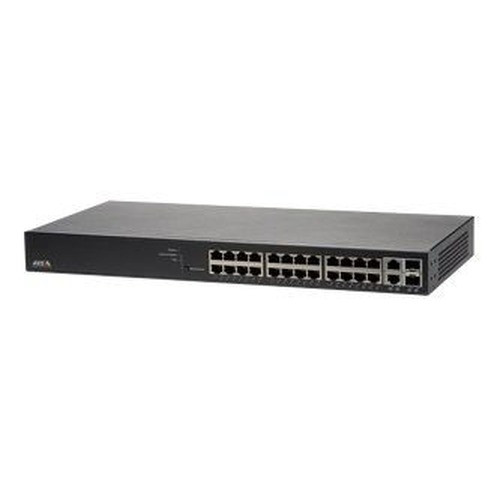
The T8524 offers two additional uplink ports (2× RJ45/SFP combo) and supports jumbo frames up to 9,216 bytes; neither of these features is listed in the USW-24-POE specifications. On surge protection, the T8524 explicitly specifies 6kV on all network ports and AC lines — a meaningful resilience spec for outdoor-adjacent or industrial environments. No surge protection rating is provided for the USW-24-POE.
Operating temperature range also differs. The T8524 is rated 0°C to 50°C, while the USW-24-POE is rated –5°C to 40°C. The USW-24-POE operates 5°C lower at the cold end, but the T8524 extends 10°C higher at the warm end — more relevant in equipment rooms without precision cooling. Enclosure material is specified for the USW-24-POE (SGCC steel at 3 kg); the T8524 is described as metal/black at 3.2 kg. Rack kits are included with the T8524; mounting hardware details for the USW-24-POE are not specified in the provided data.
Which switch offers stronger management, security features, and ecosystem integration?
The T8524 carries a substantially richer documented security and management feature set. Specified capabilities include IEEE 802.1X network access control, Private VLANs, DHCP Snooping, ACLs, IP address filtering, HTTPS encryption, and password protection. Network protocol support spans IPv4, IPv6, SNMP, SSH, HTTP/HTTPS, DHCP, NTP, and DNS. An integrated DHCP server is listed. The T8524 is managed via AXIS Device Manager and is explicitly listed as compatible with Milestone, Genetec, and ONVIF — directly relevant to VMS-centric surveillance deployments.
The USW-24-POE's management features in the provided specifications are described only as 'Ethernet' management with support for up to 1,000 VLANs. No security protocol list, ACL support, SNMP version, or VMS compatibility is stated in the provided specs. The USW-24-POE is marketed within the Ubiquiti UniFi ecosystem, though no UniFi-specific management capabilities are enumerated in the provided specification data.
The USW-24-POE carries NDAA compliance — explicitly listed — which is a procurement requirement for many U.S. federal, state, and critical-infrastructure projects. The T8524's provided specifications do not include an NDAA compliance statement. Warranty terms also differ: the T8524 specifies a 5-year warranty; the USW-24-POE lists only 'Manufacturer Warranty' without a duration in the provided specs.
Which should you choose: the USW-24-POE or the T8524?
Our take: The Axis T8524 is the stronger choice when PoE power capacity, documented security features, and VMS ecosystem integration are the primary criteria. The T8524's 370W total PoE budget and 30W-per-port PoE+ rating dwarf the USW-24-POE's 95W shared budget — a 3.9× difference that directly limits how many high-draw cameras or access-control panels the Ubiquiti unit can support. The T8524 also adds 6kV surge protection (not specified on the USW-24-POE), two SFP uplink ports (absent on the USW-24-POE), a 5-year warranty versus an unspecified term, and documented integration with Milestone and Genetec. The USW-24-POE holds an advantage for U.S. government or NDAA-sensitive deployments where T8524 compliance is unconfirmed, and may suit cost-sensitive UniFi-native installations with low per-port power demands. Choose the T8524 for full-camera-load surveillance racks; consider the USW-24-POE only where NDAA compliance is mandatory and camera power draw is modest.
Side-by-Side Comparison
Spec-for-spec, from manufacturer data.
| Specification | Ubiquiti USW-24-POE | Axis T8524 |
|---|---|---|
| PoE Standard | Not specified in provided specs | PoE+ IEEE 802.3at (Type 2 Class 4) |
| Total PoE Budget | 95W | 370W |
| Max PoE per Port | Not specified in provided specs | 30W |
| Total Ports | 24× PoE | 24× PoE+ + 2× RJ45/SFP uplink |
| Switching Capacity | 52 Gbps | 52 Gbps |
| Forwarding Rate | 39 Mpps | 38.7 Mpps |
| Non-Blocking Throughput | 26 Gbps | Not specified in provided specs |
| VLAN Support | Up to 1,000 | VLAN (count not specified in provided specs) |
| Surge Protection | Not specified in provided specs | 6kV on all network ports and AC lines |
| Jumbo Frames | Not specified in provided specs | 9,216 bytes |
| Operating Temperature | –5°C to 40°C | 0°C to 50°C |
| Security Features | Not specified in provided specs | 802.1X, ACL, Private VLANs, DHCP Snooping, HTTPS, IP filtering |
| VMS / Platform Compatibility | Not specified in provided specs | AXIS Device Manager, Milestone, Genetec, ONVIF |
| NDAA Compliant | Yes | Not specified in provided specs |
| Warranty | Not specified (duration not stated) | 5 years |
| Weight | 3 kg (6.6 lb) | 3.2 kg (7.05 lb) |
Frequently Asked Questions
Which should you choose: the USW-24-POE or the T8524?
The Axis T8524 is the stronger choice when PoE power capacity, documented security features, and VMS ecosystem integration are the primary criteria. The T8524's 370W total PoE budget and 30W-per-port PoE+ rating dwarf the USW-24-POE's 95W shared budget — a 3.9× difference that directly limits how many high-draw cameras or access-control panels the Ubiquiti unit can support. The T8524 also adds 6kV surge protection (not specified on the USW-24-POE), two SFP uplink ports (absent on the USW-24-POE), a 5-year warranty versus an unspecified term, and documented integration with Milestone and Genetec. The USW-24-POE holds an advantage for U.S. government or NDAA-sensitive deployments where T8524 compliance is unconfirmed, and may suit cost-sensitive UniFi-native installations with low per-port power demands. Choose the T8524 for full-camera-load surveillance racks; consider the USW-24-POE only where NDAA compliance is mandatory and camera power draw is modest.
Is the USW-24-POE or T8524 better for powering a full rack of PTZ cameras?
The T8524 is significantly better suited. Its 370W total PoE budget at up to 30W per port (PoE+ / 802.3at) can support high-draw PTZ cameras across all 24 ports. The USW-24-POE provides only 95W shared across all 24 ports — roughly 4W average per port at full load — which is insufficient for PTZ cameras that typically require 12–25W each under active operation.
Does either switch meet NDAA compliance requirements for government installations?
The USW-24-POE is explicitly listed as NDAA compliant in the provided specifications. The Axis T8524's provided specifications do not include an NDAA compliance statement. Buyers with federal or critical-infrastructure procurement mandates should verify T8524 NDAA status directly with Axis before specifying it.
Which switch integrates better with professional VMS platforms like Milestone or Genetec?
The Axis T8524 explicitly lists compatibility with AXIS Device Manager, Milestone, Genetec, and ONVIF in the provided specifications. It also supports IEEE 802.1X, SNMP, SSH, and Private VLANs — features commonly required by enterprise VMS deployments. The USW-24-POE's provided specifications do not list VMS compatibility, SNMP version support, or 802.1X, so integration capability with those platforms cannot be confirmed from the available data.
More Network Switch Comparisons
- Vivotek GEV-288A-370 vs Axis T8524
- Vivotek GEV-288A-370 vs Cradlepoint SW2400P-GN
- Vivotek GEV-288A-370 vs Allied Telesis AT-x530L-28GPX-901
- Vivotek GEV-288A-370 vs Ubiquiti USW-ENTERPRISE-24-POE
- Axis T8524 vs Cradlepoint SW2400P-GN
- Axis T8524 vs Allied Telesis AT-x530L-28GPX-901
Network Switch Buying Guides
Get a Second Opinion on Your Camera Choice
Share your site layout, coverage goals, and budget. Our team will validate the camera selection, flag anything we would change, and recommend products that match the use case.