
Ubiquiti UPS-TOWER-US vs Middle Atlantic OL1000R-8: Specification Comparison
Both the Ubiquiti UPS-TOWER-US and the Middle Atlantic UPX-RLNK-OL1000R-8 are 1 kVA uninterruptible power supplies targeting network and AV/security infrastructure protection. The comparison covers topology and output power, physical form factor and deployment environment, and management and outlet control capabilities — the three axes that most directly determine which unit fits a given installation.
In This Guide
- Which unit delivers cleaner power and how much wattage does each actually supply?
- Where does each unit physically install, and what are the size and weight trade-offs?
- How much remote visibility and per-outlet control does each unit offer?
- Which should you choose: the UPS-TOWER-US or the OL1000R-8?
- Side-by-Side Specs
- FAQ
Which unit delivers cleaner power and how much wattage does each actually supply?
The Middle Atlantic UPX-RLNK-OL1000R-8 uses an online (double-conversion) topology, which continuously regenerates a clean sine wave regardless of input quality — every watt of load passes through the inverter at all times, eliminating sags, surges, and frequency drift before they reach connected equipment. Its rated output is 1000 W at 1000 VA, giving a unity power factor.
The Ubiquiti UPS-TOWER-US is a line-interactive design. Under normal conditions, utility power passes through with AVR correction; the inverter only engages on transfer. Its output is rated at 600 W / 1000 VA, reflecting a 0.6 power factor — meaning loads drawing closer to 1000 VA but with a high power factor will hit the 600 W watt ceiling before the VA ceiling. Output voltage on both units is specified as 120 V AC.
For installations driving high-wattage, power-factor-corrected loads such as servers or powered rack equipment, the OL1000R-8's 1000 W output and double-conversion topology provide a meaningful advantage. For typical PoE switches and UniFi gear — which are generally modest wattage — the UPS-TOWER-US's 600 W budget is often sufficient, though buyers must confirm their total load stays below that ceiling.
Where does each unit physically install, and what are the size and weight trade-offs?
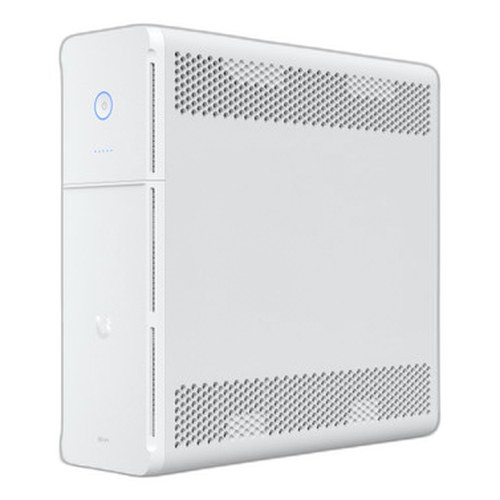
The Ubiquiti UPS-TOWER-US is a desktop form factor measuring 288 × 99 × 280.5 mm (11.3 × 3.9 × 11 in) and weighing 8.17 kg (18 lb). Its polycarbonate/ABS enclosure carries an IP20 rating, meaning it is suitable for indoor, dry environments only. It ships with a single IEC power cord and is designed to sit on a shelf or desk alongside UniFi network gear.
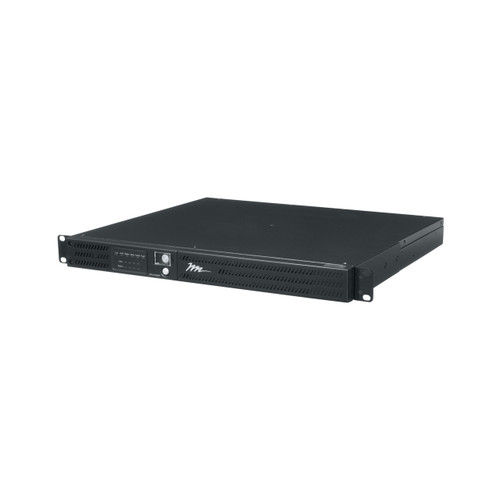
The Middle Atlantic UPX-RLNK-OL1000R-8 is a 2U rack-mount unit (3.5 in H × 19 in W × 16 in D / 8.9 × 48.3 × 40.6 cm) with a product weight of 33.1 lb (15 kg) and a shipping weight of 38.85 lb (17.6 kg). It uses four mounting points and a maximum rack depth of 34 in (86.4 cm). Its plug type is NEMA 5-15P with a 6 ft (1.8 m) cord.
The OL1000R-8 is nearly four times heavier and requires a standard 19-inch rack — appropriate for AV racks, server rooms, and security head-end closets. The UPS-TOWER-US targets small, open-air deployments without rack infrastructure. Operating temperature is identical on both: 0–40 °C (32–104 °F). No IP rating is published for the OL1000R-8.
How much remote visibility and per-outlet control does each unit offer?
The Ubiquiti UPS-TOWER-US includes a built-in 100/10 Mbps Ethernet port for integration with UniFi Network software. Management covers monitoring and graceful shutdown coordination. The spec lists five NEMA 5-15R outlets: two battery-backed and three surge-only. Outlet-level switching is not specified in the provided data. Battery runtime is described qualitatively as sufficient for graceful shutdown; no specific runtime figure at a defined load is provided.
The Middle Atlantic UPX-RLNK-OL1000R-8 provides eight NEMA 5-15R receptacles with individually controlled outlets — each outlet can be switched on or off independently, enabling sequenced power cycling or remote reboot of individual devices. Management interface details (Ethernet, SNMP, software) are not specified in the provided data. The unit is Energy Star 2.0 certified and carries cTUVus safety listing.
For installations requiring per-outlet reboot capability — common in AV control rooms and multi-device security head-ends — the OL1000R-8's individual outlet control is a distinct operational advantage. The UPS-TOWER-US's Ethernet management and native UniFi integration are compelling for UniFi-centric networks but provide no equivalent per-outlet switching. Buyers integrating into non-UniFi environments should note that the OL1000R-8's management protocol is not specified in available data.
Which should you choose: the UPS-TOWER-US or the OL1000R-8?
Our take: The UPX-RLNK-OL1000R-8 is the stronger choice when power quality, wattage headroom, and per-outlet control are the primary requirements. Its online double-conversion topology delivers continuously regenerated 120 V AC versus the UPS-TOWER-US's line-interactive design, which only switches to battery on transfer. The OL1000R-8 also outputs 1000 W versus the UPS-TOWER-US's 600 W ceiling — a 67% wattage advantage — making it the correct pick for rack loads approaching the 1 kVA mark. Eight individually switchable NEMA 5-15R outlets versus two battery-backed outlets on the UPS-TOWER-US further expand operational control. Conversely, the UPS-TOWER-US weighs 8.17 kg versus 15 kg, carries an IP20 rating, and natively integrates with UniFi software via its Ethernet port. It is the practical choice for small, desktop UniFi deployments without rack infrastructure. The OL1000R-8 is purpose-built for 19-inch rack installations in security head-ends, AV racks, or server closets where double-conversion power quality and individual outlet management are non-negotiable.
Side-by-Side Comparison
Spec-for-spec, from manufacturer data.
| Specification | Ubiquiti UPS-TOWER-US | Middle Atlantic OL1000R-8 |
|---|---|---|
| Capacity (VA) | 1000 VA | 1000 VA |
| Output Power (W) | 600 W | 1000 W |
| Topology | Line-interactive | Online (double-conversion) |
| Form Factor | Desktop | 2U rack-mount |
| Dimensions (H × W × D) | 99 × 288 × 280.5 mm | 89 × 483 × 406 mm |
| Weight | 8.17 kg (18 lb) | 15 kg (33.1 lb) |
| Outlet Count | 5 (2 battery-backed, 3 surge-only) | 8 |
| Outlet Control | Not specified | Individual per-outlet |
| Management Interface | 100/10 Mbps Ethernet | Not specified |
| Input/Output Voltage | 120 V AC | 110–127 V AC |
| Input Frequency | 50/60 Hz (auto-sensing) | Not specified |
| Battery | Lead Acid 12 V, 9 Ah | Not specified |
| Operating Temp | 0–40 °C (32–104 °F) | 0–40 °C (32–104 °F) |
| IP Rating | IP20 | — |
| Safety Certifications | UL 1778, FCC, IC, CSA C22.2, NDAA | cTUVus, FCC (REACH), Energy Star 2.0 |
| NDAA Compliant | Yes | No |
Frequently Asked Questions
Which should you choose: the UPS-TOWER-US or the OL1000R-8?
The UPX-RLNK-OL1000R-8 is the stronger choice when power quality, wattage headroom, and per-outlet control are the primary requirements. Its online double-conversion topology delivers continuously regenerated 120 V AC versus the UPS-TOWER-US's line-interactive design, which only switches to battery on transfer. The OL1000R-8 also outputs 1000 W versus the UPS-TOWER-US's 600 W ceiling — a 67% wattage advantage — making it the correct pick for rack loads approaching the 1 kVA mark. Eight individually switchable NEMA 5-15R outlets versus two battery-backed outlets on the UPS-TOWER-US further expand operational control. Conversely, the UPS-TOWER-US weighs 8.17 kg versus 15 kg, carries an IP20 rating, and natively integrates with UniFi software via its Ethernet port. It is the practical choice for small, desktop UniFi deployments without rack infrastructure. The OL1000R-8 is purpose-built for 19-inch rack installations in security head-ends, AV racks, or server closets where double-conversion power quality and individual outlet management are non-negotiable.
Is the UPS-TOWER-US or the OL1000R-8 better for protecting a UniFi network closet?
If the closet uses a standard 19-inch rack, the OL1000R-8 provides higher wattage output (1000 W vs 600 W), double-conversion power quality, and eight individually controlled outlets. However, if the installation is a small desktop UniFi setup without rack infrastructure, the UPS-TOWER-US integrates directly with UniFi software via its Ethernet port and is significantly lighter at 8.17 kg vs 15 kg. The right answer depends on rack availability and total load wattage.
Can either unit protect equipment drawing close to the full 1000 VA rating?
The OL1000R-8 is rated at 1000 W / 1000 VA (unity power factor), so it can sustain loads up to 1000 W. The UPS-TOWER-US is rated at 600 W / 1000 VA — loads above 600 W will exceed its watt ceiling even if they remain below 1000 VA. For loads exceeding 600 W, the OL1000R-8 is the appropriate choice.
Which UPS is easier to reboot a single connected device remotely without cycling all outlets?
The OL1000R-8 specifies individual outlet control across all eight NEMA 5-15R receptacles, enabling per-device remote power cycling. The UPS-TOWER-US spec does not indicate per-outlet switching; its Ethernet port supports UniFi software monitoring and graceful shutdown but no equivalent individual outlet control is documented in the provided specifications.
More UPS Comparisons
- Ubiquiti UPS-TOWER-US vs Panduit U01N12L
- Ubiquiti UPS-TOWER-US vs Panduit U01S12L
- Ubiquiti UPS-TOWER-US vs Middle Atlantic OL1000R-2
- Panduit U01N12L vs Middle Atlantic OL1000R-2
- Panduit U01N12L vs Middle Atlantic OL1000R-8
- Panduit U01N12L vs Panduit U01S12L
UPS Buying Guides
Get a Second Opinion on Your Camera Choice
Share your site layout, coverage goals, and budget. Our team will validate the camera selection, flag anything we would change, and recommend products that match the use case.