
Middle Atlantic OL3000R-2 vs APC by Schneider Electric SRT3000XLW-IEC: Specification Comparison
Both the Middle Atlantic UPX-OL3000R-2 and the APC SRT3000XLW-IEC are 3000VA / 2700W double-conversion online UPS units aimed at rack-mount and tower deployments in professional AV, physical-security, and IT environments. Each delivers pure sine-wave output with hardware-level bypass and targets integrators specifying always-on power protection for NVRs, servers, and access-control infrastructure. The comparison covers power delivery and output connectivity, physical and environmental characteristics, and management and integration capabilities.
In This Guide
- Which UPS better matches your power delivery and outlet requirements?
- How do the two units compare in physical size, weight, and operating environment?
- Which unit offers more management depth and integration flexibility?
- Which should you choose: the OL3000R-2 or the SRT3000XLW-IEC?
- Side-by-Side Specs
- FAQ
Which UPS better matches your power delivery and outlet requirements?
Both units share the same headline rating of 3000VA / 2700W, so neither has a capacity advantage at the nameplate level.
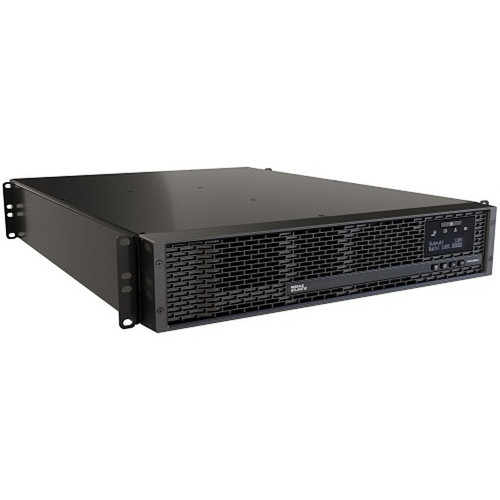
Where they diverge sharply is voltage domain and outlet configuration. The UPX-OL3000R-2 operates on 120V North American power, presenting a single NEMA L5-30R locking receptacle plus six NEMA 5-20R outlets (7 total) and a 30A NEMA L5-30P plug — suited to domestic AV racks fed from a 30A dedicated circuit. The SRT3000XLW-IEC operates on 208V or 230V (configurable for 220V or 240V) and provides 6× IEC 320 C13, 2× IEC 320 C19, and 2× IEC jumper outputs — 10 protected outlets total — making it the correct selection for international or 208V data-center rows.
The APC unit also specifies output voltage distortion of less than 2% and a load crest factor of 3:1, plus 340 joules of surge energy rating. None of these figures are provided in the Middle Atlantic spec sheet, so a direct numerical comparison on power quality cannot be made from the supplied data.
Input frequency acceptance also separates them: the SRT3000XLW-IEC auto-senses 40–70Hz, giving it broader compatibility with generator or international grid sources. The UPX-OL3000R-2 input frequency tolerance is not stated in the provided specifications.
How do the two units compare in physical size, weight, and operating environment?
The UPX-OL3000R-2 is specified at 19 × 3.5 × 22 in (W×H×D) and weighs 64.2 lb (29.1 kg), with a shipping weight of 75.18 lb. It is a rack-mount chassis (4 mounting points) accommodating rack depths of 28–36 in, and ships with a 10 ft (3.1 m) input cord.
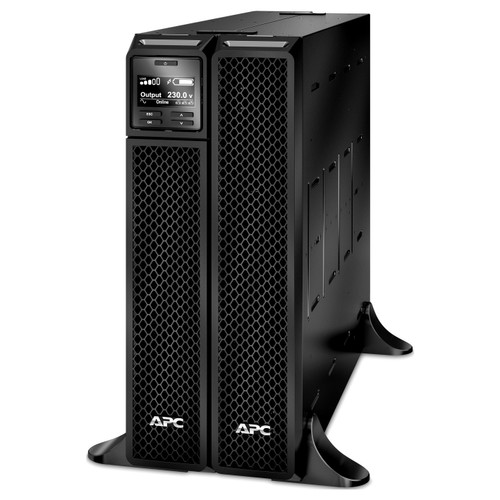
The SRT3000XLW-IEC is specified as a tower unit at 17.0 × 3.3 × 25.0 in and weighs an unspecified amount net; package weight is listed at 75 lb. Its input cord is 8.0 ft (2.4 m). Neither a rack-mount form factor nor mounting-point count is stated for the APC unit in the provided specifications.
Both share an identical operating temperature range of 32–104°F (0–40°C). The SRT3000XLW-IEC additionally specifies 0–95% non-condensing relative humidity, operation to 9,843 ft (3,000 m) elevation, an IP20 ingress-protection rating, and an audible noise figure of 55 dBA at 1 m. None of these environmental envelope figures are present in the UPX-OL3000R-2 specifications as provided.
The SRT3000XLW-IEC also lists online thermal dissipation at 703 BTU/hr, which is useful for data-center cooling calculations; no equivalent figure exists in the Middle Atlantic data.
Which unit offers more management depth and integration flexibility?
The APC SRT3000XLW-IEC provides a multi-function LCD status and control console, audible and visible alarms prioritized by severity, and three interface ports — RJ45 Serial, SmartSlot (for optional network management cards), and USB. The SmartSlot ecosystem supports APC network management cards widely used in security and IT infrastructure for SNMP monitoring, remote shutdown scripting, and integration with building management systems. Runtime is also extendable via the APC-Smart-UPS-SRT-3000VA-208-230V-IEC external battery module.
The UPX-OL3000R-2 is described as featuring 'Local Bank Control' and 'Outlet Control Type: Bank,' indicating software-addressable outlet grouping — a meaningful differentiator for AV and security racks where staged power sequencing or remote outlet cycling is required. However, no network management interface, display type, alarm specification, or remote-access protocol is listed in the provided specifications.
Battery serviceability is documented only for the APC unit: replacement battery APCRBC152, expected life 3–5 years, typical recharge time 3 hours with 1 included battery module. The UPX-OL3000R-2 provides no battery replacement part number or recharge time in the supplied data.
Compliance and certification lists differ: UPX-OL3000R-2 carries TAA Compliance, Energy Star 2.0, cTUVus, FCC, CSA, and REACH. The SRT3000XLW-IEC carries CE Mark, CSA C22.2, EAC, EN/IEC 62040-1/2, Energy Star V1.0 (USA and EU), FCC Part 15 Class A, RCM, UL 1778, VDE, and RoHS — a broader international certification stack.
Which should you choose: the OL3000R-2 or the SRT3000XLW-IEC?
Our take: The UPX-OL3000R-2 is the stronger choice when the installation is a North American 120V rack — specifically one requiring a 30A locking-input feed, NEMA 5-20R protected outlets, and per-bank outlet control for sequenced power-up of security or AV equipment. The SRT3000XLW-IEC is the correct selection for 208V or international 220/230/240V environments: it supplies 10 IEC-format protected outlets versus the UPX's 7 NEMA outlets, adds a documented SmartSlot network-management expansion path, specifies a 3:1 load crest factor and sub-2% output voltage distortion, and carries a broader international certification set including UL 1778, VDE, and EAC. Both units are rated identically at 3000VA / 2700W with a 0–40°C operating range. Buyers on North American 120V racks who need outlet-level switching should favor the Middle Atlantic; buyers specifying 208V data-center rows, international sites, or network-monitored UPS infrastructure should select the APC.
Side-by-Side Comparison
Spec-for-spec, from manufacturer data.
| Specification | Middle Atlantic OL3000R-2 | APC by Schneider Electric SRT3000XLW-IEC |
|---|---|---|
| UPS Topology | Double Conversion Online (implied by product name) | Double Conversion Online |
| Power Rating | 3000VA / 2700W | 3000VA / 2700W |
| Nominal Input Voltage | 110–127VAC (120V) | 208V & 230V (configurable 220V / 240V) |
| Input Frequency | Not stated in provided specs | 40–70 Hz (auto sensing) |
| Input Connection | NEMA L5-30P (30A locking) | BS1363A, IEC-320 C20, Schuko CEE 7/EU1-16P |
| Nominal Output Voltage | 110–127VAC | 208V & 230V (configurable 220V / 240V) |
| Output Connections | 1× NEMA L5-30R + 6× NEMA 5-20R (7 total) | 6× IEC C13 + 2× IEC C19 + 2× IEC Jumpers (10 total) |
| Output Voltage Distortion | — | Less than 2% |
| Load Crest Factor | — | 3:1 |
| Surge Energy Rating | — | 340 joules |
| Outlet Control | Bank (local) | — |
| Management Interfaces | — | RJ45 Serial, SmartSlot, USB |
| Display | — | Multi-function LCD |
| Extendable Runtime | — | Yes (external battery module) |
| Replacement Battery | — | APCRBC152 |
| Typical Recharge Time | — | 3 hours |
| Expected Battery Life | — | 3–5 years |
| Form Factor | Rack-mount (4 mounting points) | Tower |
| Dimensions (W×H×D) | 19 × 3.5 × 22 in (48.3 × 8.9 × 55.9 cm) | 17.0 × 3.3 × 25.0 in (43.2 × 8.5 × 63.5 cm) |
| Net Weight | 64.2 lb (29.1 kg) | Not stated in provided specs |
| Shipping Weight | 75.18 lb (34.1 kg) | 75 lb (package weight) |
| Input Cord Length | 10 ft (3.1 m) | 8.0 ft (2.4 m) |
| Operating Temperature | 32–104°F (0–40°C) | 32–104°F (0–40°C) |
| Operating Humidity | — | 0–95% non-condensing |
| Operating Elevation | — | 0–9,843 ft (0–3,000 m) |
| Audible Noise | — | 55 dBA at 1 m |
| Thermal Dissipation (Online) | — | 703 BTU/hr |
| IP Rating | — | IP 20 |
| Energy Star | Energy Star 2.0 | Energy Star V1.0 (USA & EU) |
| TAA Compliant | Yes | — |
| RoHS | Patents (listed under RoHS field) | Compliant |
| Key Certifications | cTUVus, CSA, FCC, REACH | UL 1778, CE, VDE, EAC, RCM, FCC Part 15 Class A, CSA C22.2, EN/IEC 62040-1/2 |
Frequently Asked Questions
Which should you choose: the OL3000R-2 or the SRT3000XLW-IEC?
The UPX-OL3000R-2 is the stronger choice when the installation is a North American 120V rack — specifically one requiring a 30A locking-input feed, NEMA 5-20R protected outlets, and per-bank outlet control for sequenced power-up of security or AV equipment. The SRT3000XLW-IEC is the correct selection for 208V or international 220/230/240V environments: it supplies 10 IEC-format protected outlets versus the UPX's 7 NEMA outlets, adds a documented SmartSlot network-management expansion path, specifies a 3:1 load crest factor and sub-2% output voltage distortion, and carries a broader international certification set including UL 1778, VDE, and EAC. Both units are rated identically at 3000VA / 2700W with a 0–40°C operating range. Buyers on North American 120V racks who need outlet-level switching should favor the Middle Atlantic; buyers specifying 208V data-center rows, international sites, or network-monitored UPS infrastructure should select the APC.
Can I use the SRT3000XLW-IEC on a standard 120V North American circuit?
No. Based on the provided specifications, the SRT3000XLW-IEC is rated for 208V and 230V nominal input (configurable to 220V or 240V) with IEC-format input connections (BS1363A, IEC-320 C20, Schuko CEE 7). It is not specified for 120V North American service. The UPX-OL3000R-2, with its NEMA L5-30P plug and 110–127VAC output, is the 120V-compatible unit in this comparison.
Which unit supports remote monitoring and network management?
The SRT3000XLW-IEC provides a SmartSlot expansion bay for optional APC network management cards, plus RJ45 Serial and USB ports, enabling SNMP-based monitoring and remote shutdown. The UPX-OL3000R-2 specifies local bank outlet control but no network management interface, serial port, or expansion slot is listed in the provided specifications; remote-monitoring capability for that unit cannot be confirmed from the supplied data.
Is the OL3000R-2 or SRT3000XLW-IEC better for larger deployments needing extended runtime?
The SRT3000XLW-IEC explicitly supports extended runtime via an external battery module (APC-Smart-UPS-SRT-3000VA-208-230V-IEC) and documents its replacement battery (APCRBC152) and 3-hour typical recharge time, making it the verifiably scalable option for longer outage coverage in 208V or international deployments. No extended-battery-module compatibility, replacement battery part number, or recharge time is stated in the UPX-OL3000R-2 specifications as provided.
More UPS Comparisons
- APC by Schneider Electric SMT3000RMI2U vs Vertiv GXT5-3000LVRT2UXL
- APC by Schneider Electric SMT3000RMI2U vs Panduit U03N11L
- APC by Schneider Electric SMT3000RMI2U vs Panduit U03N12L
- APC by Schneider Electric SMT3000RMI2U vs Panduit U03S12V
- APC by Schneider Electric SMT3000RMI2U vs APC by Schneider Electric SRT3000XLT
- APC by Schneider Electric SMT3000RMI2U vs APC by Schneider Electric SRT3000XLW-IEC
UPS Buying Guides
Get a Second Opinion on Your Camera Choice
Share your site layout, coverage goals, and budget. Our team will validate the camera selection, flag anything we would change, and recommend products that match the use case.