
Honeywell 3320GER-4 vs Honeywell 1960GSR-2USB-N: Specification Comparison
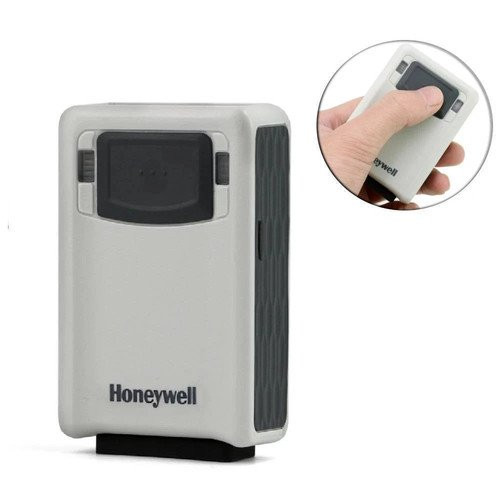
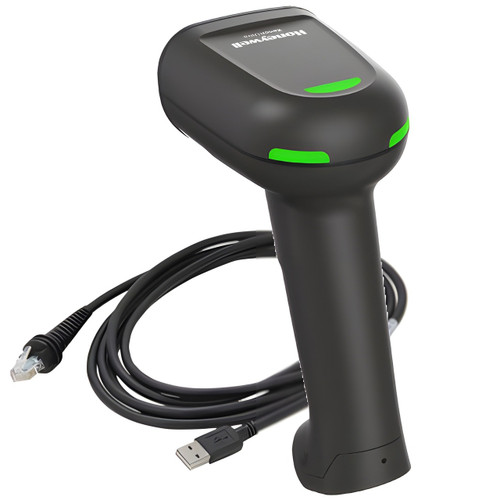
Both the Honeywell Vuquest 3320GER-4 and the Honeywell Xenon XP 1960GSR-2USB-N are Honeywell-branded handheld/presentation barcode scanners capable of reading 1D and 2D symbologies. However, the 3320GER-4 is a corded USB presentation scanner designed for fixed retail point-of-sale countertops, while the 1960GSR-2USB-N is a dual-mode wireless Bluetooth 4.2 plus USB handheld scanner targeting general-purpose and mobile scan environments. A buyer choosing between a fixed-mount corded POS scanner and a wireless handheld unit would legitimately cross-shop these two within the same barcode scanner category.
In This Guide
Which scanner fits your wired-vs-wireless workflow?
The 3320GER-4 connects exclusively via corded USB at 5 VDC ±0.25 V, making it a permanently tethered presentation scanner suited to fixed checkout counters. There is no wireless option; the cable provides both power and data, eliminating battery management entirely.
The 1960GSR-2USB-N operates in dual mode — Bluetooth 4.2 or USB — without requiring a hardware swap between modes. Input voltage is specified as 4.4 V DC to 5.5 V DC. This gives warehouse pickers, stockroom associates, or roving retail staff the freedom to move untethered while retaining the option to connect via USB when a wired session is preferred.
For a single fixed POS lane, the wired-only 3320GER-4 is simpler and requires no pairing management. For any deployment where the operator moves away from a fixed surface — warehouse receiving docks, pop-up retail, or queue-busting — the 1960GSR-2USB-N's Bluetooth 4.2 is a hard requirement the 3320GER-4 cannot meet.
Which scanner survives harsher operating environments?
The 3320GER-4 carries an IP53 rating per its primary spec field (a separate spec line also states IP42 — the two figures appear on different sections of the provided data; IP53 is the primary listed value). Its drop specification is cited at 1.8 m to concrete. Operating temperature spans -20° to 50°C in one spec field and 0°C to 40°C in another; the broader -20° to 50°C range is listed as the primary operating temperature.
The 1960GSR-2USB-N is rated IP65, meaning it is fully dust-tight and protected against water jets — a meaningfully higher ingress-protection level than IP53. Its drop rating is 2.0 m to concrete, 0.2 m more than the 3320GER-4. Operating temperature is consistently stated at 0°C to 50°C across both its primary spec and supplemental fields.
By every published durability metric the 1960GSR-2USB-N is the tougher unit: higher IP class (IP65 vs IP53), greater drop height (2.0 m vs 1.8 m), and a single unambiguous temperature range. The 3320GER-4's conflicting IP and temperature figures should be verified against the manufacturer datasheet before specifying for harsh environments.
Which scanner is optimized for the physical demands of your use case?
The 3320GER-4 is a presentation-style scanner with a working range of 15 to 120 cm (6 to 48 in) and an area imager of 838 × 640 pixels. It weighs 77 g (0.17 lb), making it one of the lightest units in the category. Its scan pattern is a fixed-angle presentation window, meaning items are passed in front of it rather than aimed by a user.
The 1960GSR-2USB-N is a handheld gun-style scanner with a working range of 2.5 to 50.8 cm (1 to 20 in). It weighs 147.2 g (0.32 lb) — nearly twice the 3320GER-4. The shorter maximum range (50.8 cm vs 120 cm) reflects its handheld aim-and-shoot design rather than a stand-off presentation geometry.
The 3320GER-4's 120 cm maximum working distance is advantageous for bulky items that cannot be brought close to a scanner. The 1960GSR-2USB-N's 2.5 cm minimum distance and handheld form factor suit close-range scanning of small labels, shelving tags, and items held in hand. Neither unit is a long-range scanner; both are short-to-medium range by design.
Which should you choose: the 3320GER-4 or the 1960GSR-2USB-N?
Our take: The 3320GER-4 is the stronger choice when the deployment is a fixed, high-volume retail POS counter requiring maximum scan reach and minimal operator weight. Its 120 cm working range is 2.4× the 1960GSR-2USB-N's 50.8 cm ceiling, its 77 g weight is roughly half the 147.2 g of the Xenon XP, and its corded USB connection removes battery charging infrastructure entirely. Conversely, the 1960GSR-2USB-N is the correct choice for any mobile or mixed-mode workflow: it adds Bluetooth 4.2 wireless that the 3320GER-4 lacks outright, exceeds it on durability with an IP65 rating versus IP53 and a 2.0 m vs 1.8 m drop spec, and covers general-purpose environments beyond retail POS. Both carry a 3-year warranty. Note that the 3320GER-4's provided specs contain conflicting IP (IP53 vs IP42) and temperature (−20°–50°C vs 0°–40°C) figures; verify the manufacturer datasheet before finalizing specifications for a harsh-environment deployment.
Side-by-Side Comparison
Spec-for-spec, from manufacturer data.
| Specification | Honeywell 3320GER-4 | Honeywell 1960GSR-2USB-N |
|---|---|---|
| Series / Family | Vuquest 3320g | Xenon XP 1952g |
| Part Number | 3320GER-4 | 1960GSR-2USB-N |
| Scan Type | Presentation (1D/2D) | Area Imager (1D/2D) |
| Connectivity | Corded USB only | Bluetooth 4.2 + USB (dual-mode) |
| Working Range | 15–120 cm (6–48 in) | 2.5–50.8 cm (1–20 in) |
| IP Rating | IP53 (primary spec; IP42 also cited) | IP65 |
| Drop Rating | 1.8 m to concrete | 2.0 m to concrete |
| Operating Temperature | −20° to 50°C (primary); 0°–40°C also cited | 0° to 50°C |
| Weight | 77 g (0.17 lb) | 147.2 g (0.32 lb) |
| Scan Pixel Array | 838 × 640 pixels | — |
| Input Voltage | 5 VDC ± 0.25 V | 4.4 V DC to 5.5 V DC |
| Application | Retail point-of-sale | General purpose |
| AI Detection | — | Yes (per spec) |
| Warranty | 3-year | 3-year |
Frequently Asked Questions
Which should you choose: the 3320GER-4 or the 1960GSR-2USB-N?
The 3320GER-4 is the stronger choice when the deployment is a fixed, high-volume retail POS counter requiring maximum scan reach and minimal operator weight. Its 120 cm working range is 2.4× the 1960GSR-2USB-N's 50.8 cm ceiling, its 77 g weight is roughly half the 147.2 g of the Xenon XP, and its corded USB connection removes battery charging infrastructure entirely. Conversely, the 1960GSR-2USB-N is the correct choice for any mobile or mixed-mode workflow: it adds Bluetooth 4.2 wireless that the 3320GER-4 lacks outright, exceeds it on durability with an IP65 rating versus IP53 and a 2.0 m vs 1.8 m drop spec, and covers general-purpose environments beyond retail POS. Both carry a 3-year warranty. Note that the 3320GER-4's provided specs contain conflicting IP (IP53 vs IP42) and temperature (−20°–50°C vs 0°–40°C) figures; verify the manufacturer datasheet before finalizing specifications for a harsh-environment deployment.
Can the 3320GER-4 or 1960GSR-2USB-N scan barcodes from a greater distance?
The 3320GER-4 has a significantly longer maximum working range — up to 120 cm (48 in) — compared to the 1960GSR-2USB-N's 50.8 cm (20 in) maximum. If your application involves scanning large or awkwardly sized items that must stay at arm's length or further from the scanner window, the 3320GER-4 has the range advantage. The 1960GSR-2USB-N's shorter range is consistent with its handheld, aim-and-shoot design.
Is the 3320GER-4 or 1960GSR-2USB-N better suited for a warehouse or mobile scanning environment?
The 1960GSR-2USB-N is the correct choice for warehouse or mobile use. It supports Bluetooth 4.2 for untethered scanning — a capability the corded-only 3320GER-4 does not offer at all. It also carries an IP65 dust-and-water-jet rating and a 2.0 m drop rating, both of which exceed the 3320GER-4's specifications. The 3320GER-4 is designed specifically for fixed retail point-of-sale countertop use.
Do both scanners read the same barcode types, including QR codes and 2D symbologies?
Yes. Both the 3320GER-4 and the 1960GSR-2USB-N are 1D/2D area imagers capable of reading standard linear barcodes, PDF417, QR codes, DataMatrix, and other 2D symbologies. The 3320GER-4 uses an 838 × 640 pixel array; the 1960GSR-2USB-N's specific pixel array is not provided in the supplied specifications. Neither scanner is limited to 1D-only scanning.
More Barcode Scanner Comparisons
- Zebra DS8108-SR vs Zebra DS8108-SR
- Zebra DS8108-SR vs Zebra DS8108-HC
- Datalogic 931061345 vs Datalogic 931024111-00053
- Datalogic 931061335 vs Datalogic 931061345
- Datalogic 931061335 vs Datalogic 931024111-00053
- Datalogic 957022201-00053 vs Datalogic 931061345
Barcode Scanner Buying Guides
Get a Second Opinion on Your Camera Choice
Share your site layout, coverage goals, and budget. Our team will validate the camera selection, flag anything we would change, and recommend products that match the use case.