
HID 921NWNTEKE00BN vs HID 920PHRNEK00203: Specification Comparison
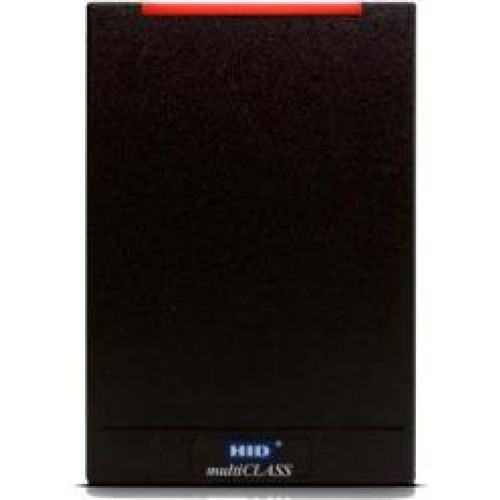
Both the HID 921NWNTEKE00BN (RK40 iClass SE Multiclass Reader) and the HID 920PHRNEK00203 (RP40 Multiclass SE Reader) are wired access control card readers in HID's Multiclass SE family, positioned for multi-credential enterprise and commercial deployments. Both share IP65 ratings and 2-year warranties, making them legitimate cross-shop candidates for integrators evaluating credential technology breadth, output protocol, and encryption capability across new installations or legacy system migrations.
In This Guide
- Which reader supports a broader credential set and which output protocol does each use?
- How does each reader handle on-device security and encryption?
- How do the two readers compare for physical installation, environmental rating, and panel compatibility?
- Which should you choose: the 921NWNTEKE00BN or the 920PHRNEK00203?
- Side-by-Side Specs
- FAQ
Which reader supports a broader credential set and which output protocol does each use?
The 920PHRNEK00203 (RP40) supports a wider credential range: 125kHz Prox, iCLASS, MIFARE, DESFire, SEOS, NFC/13.56MHz, and HID — seven distinct technology families including both low-frequency legacy Prox and modern contactless standards. Its communication output is OSDP over 485FDX, a bidirectional encrypted protocol that supports remote firmware updates and liveness monitoring.
The 921NWNTEKE00BN (RK40) supports iCLASS, SE, HF migration, and low-frequency credentials (noted as disabled by default), with Wiegand 8-bit output at 100µs pulse width and 1000µs spacing. Wiegand is a unidirectional, unencrypted protocol standard on legacy panels. The RK40's HF migration mode is specifically designed to support phased transitions from older card stock, but it does not list Prox, MIFARE, DESFire, or SEOS support.
How does each reader handle on-device security and encryption?
The 920PHRNEK00203 (RP40) specifies a Secure Element with FIPS 75-bit on-reader encryption and Secure Identity Object (SIO) encryption. OSDP's bidirectional channel further enables mutual authentication between reader and panel, reducing vulnerability to skimming and replay attacks. DESFire and SEOS credential support also implies support for card-level encryption.
The 921NWNTEKE00BN (RK40) does not specify an on-reader encryption standard or FIPS rating in the provided specifications. Its Wiegand output is inherently unencrypted and unidirectional. The reader does support iCLASS SE credentials, which carry card-side security, but the transport layer between reader and panel is not encrypted per the listed specs.
How do the two readers compare for physical installation, environmental rating, and panel compatibility?
Both readers carry an IP65 ingress protection rating, making them suitable for outdoor and light industrial environments exposed to dust and water jets. Both are available in black or white with silver trim baseplate configurations. The 920PHRNEK00203 is listed as pigtail wired with a weight of 1 lb and Country of Origin: US; physical dimensions are not specified for either unit.
The 921NWNTEKE00BN connects via Wiegand, which is compatible with virtually all legacy access control panels without rewiring or panel upgrades. It also supports door completion signaling for electromagnetic lock control. The 920PHRNEK00203 uses OSDP over RS-485 full duplex, which requires an OSDP-capable panel or an RS-485-to-Wiegand converter — a consideration for retrofits. Neither unit's keypad configuration is unambiguously resolved from the provided specs (both list 'No Yes (2x6 layout) No Yes (3x4 layout)' without clarification of which SKU variant applies).
Which should you choose: the 921NWNTEKE00BN or the 920PHRNEK00203?
Our take: The 920PHRNEK00203 is the stronger choice when deploying on a modern OSDP-capable panel and requiring the broadest credential coverage or highest on-reader security. It reads seven credential families — including 125kHz Prox, MIFARE, DESFire, SEOS, and NFC — versus the RK40's iCLASS/SE/HF-migration set. Its FIPS 75-bit Secure Element and OSDP encrypted transport provide a materially higher security posture than the RK40's unencrypted Wiegand output, for which no equivalent encryption spec is listed. Conversely, the 921NWNTEKE00BN is the appropriate selection when the existing panel infrastructure is Wiegand-only and replacement is not planned: its 8-bit Wiegand at 100µs pulse drops in without rewiring, and its HF migration mode allows phased credential transitions. Both units share IP65 ratings and 2-year warranties, so environment and lifecycle are not differentiators.
Side-by-Side Comparison
Spec-for-spec, from manufacturer data.
| Specification | HID 921NWNTEKE00BN | HID 920PHRNEK00203 |
|---|---|---|
| Product Family | RK40 iClass SE Multiclass | RP40 Multiclass SE |
| SKU | 921NWNTEKE00BN | 920PHRNEK00203 |
| Output Protocol | Wiegand 8-bit, 100µs pulse, 1000µs spacing | OSDP over 485FDX |
| Credential Support | iCLASS, SE, HF Migration, Low-Freq (disabled) | 125kHz Prox, iCLASS, MIFARE, DESFire, SEOS, NFC/13.56MHz, HID |
| On-Reader Encryption | — | Secure Element, FIPS 75-bit; SIO encryption |
| Communication Direction | Unidirectional (Wiegand) | Bidirectional (OSDP) |
| IP Rating | IP65 | IP65 |
| Warranty | 2-year | 2-year |
| Housing Color | Black | Black |
| Color Options | Black or white with silver trim baseplate | Black or white with silver trim baseplate |
| Wiring | Wired | Pigtail wired |
| Weight | — | 1 lb |
| Country of Origin | — | US |
| Door Lock Integration | Door completion signaling for EM locks | — |
| Remote Firmware Update | — | Supported via OSDP |
| Keypad | Not unambiguously specified in provided specs | Not unambiguously specified in provided specs |
Frequently Asked Questions
Which should you choose: the 921NWNTEKE00BN or the 920PHRNEK00203?
The 920PHRNEK00203 is the stronger choice when deploying on a modern OSDP-capable panel and requiring the broadest credential coverage or highest on-reader security. It reads seven credential families — including 125kHz Prox, MIFARE, DESFire, SEOS, and NFC — versus the RK40's iCLASS/SE/HF-migration set. Its FIPS 75-bit Secure Element and OSDP encrypted transport provide a materially higher security posture than the RK40's unencrypted Wiegand output, for which no equivalent encryption spec is listed. Conversely, the 921NWNTEKE00BN is the appropriate selection when the existing panel infrastructure is Wiegand-only and replacement is not planned: its 8-bit Wiegand at 100µs pulse drops in without rewiring, and its HF migration mode allows phased credential transitions. Both units share IP65 ratings and 2-year warranties, so environment and lifecycle are not differentiators.
Can I use the 920PHRNEK00203 with my existing Wiegand access control panel?
The 920PHRNEK00203 communicates via OSDP over 485FDX, not Wiegand. It requires an OSDP-capable panel or an RS-485 interface module. If your panel only supports Wiegand, the 921NWNTEKE00BN — which outputs standard 8-bit Wiegand at 100µs pulse width — is the drop-in compatible option per the provided specs.
Which reader is better for a site still running 125kHz Prox cards alongside newer credentials?
The 920PHRNEK00203 explicitly lists 125kHz Prox in its credential set alongside iCLASS, MIFARE, DESFire, SEOS, and NFC. The 921NWNTEKE00BN lists low-frequency support but notes it is disabled by default, and does not specifically list 125kHz HID Prox among its active credential types. For a mixed Prox and modern credential environment, the RP40 is the spec-supported choice.
Is the 921NWNTEKE00BN or 920PHRNEK00203 better for a high-security government or regulated facility?
Based on provided specs, the 920PHRNEK00203 carries a FIPS 75-bit Secure Element and Secure Identity Object encryption, and uses OSDP — an encrypted, bidirectional protocol that supports mutual authentication. The 921NWNTEKE00BN does not list a FIPS rating or on-reader encryption standard, and its Wiegand output is unencrypted. For regulated environments prioritizing on-reader encryption and encrypted panel communication, the RP40's stated specifications are stronger.
More Access Control Reader Comparisons
- HID 920PHRNEK00203 vs Kantech KT-SG-MT-KP2
- HID 920PHRNEK00203 vs Kantech KT-SG-MT2
- HID 920PHRNEK00203 vs DMP USB
- HID 920PHRNEK00203 vs HID HID-920-PTNN
- HID 920PHRNEK00203 vs HID 920NWNNEKE00BM
- HID HID-920-PTNN vs Kantech KT-SG-MT-KP2
Access Control Reader Buying Guides
Get a Second Opinion on Your Camera Choice
Share your site layout, coverage goals, and budget. Our team will validate the camera selection, flag anything we would change, and recommend products that match the use case.