
Hanwha XNB-6001 vs i-PRO S71300A-F3: Specification Comparison
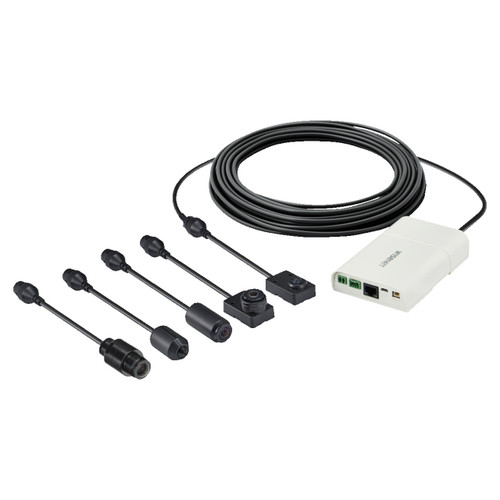
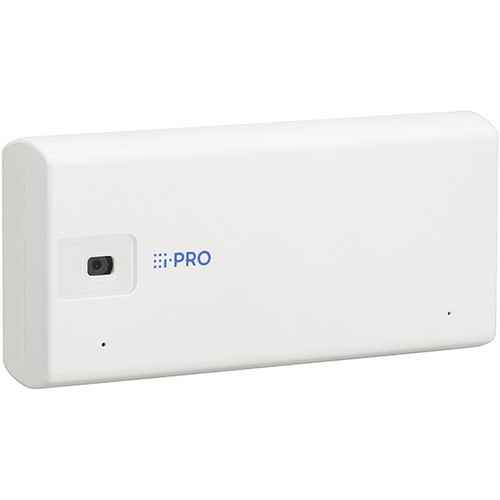
Both the Hanwha XNB-6001 and the i-PRO WV-S71300A-F3 are 2MP (1920×1080) fixed-lens, wired IP box cameras targeting indoor covert or compact surveillance deployments. The XNB-6001 is a lens-interchangeable mini box camera with an outdoor-rated IP66 enclosure and a broad analytics suite, while the S71300A-F3 is an all-in-one compact box with a fixed 3.2mm lens, integrated IR, and an AI inference engine built on the Ambarella CV22 SoC. Buyers choosing between them are typically weighing lens flexibility and environmental rating against integrated AI classification and a simpler single-unit installation footprint.
In This Guide
How do the imaging specs compare?
The XNB-6001's sensor size is not specified in the provided data, whereas the S71300A-F3 uses an approximately 1/2.8-type CMOS with a scanning area of 5.57 mm (H) × 3.13 mm (V). The S71300A-F3 provides a minimum illumination figure of 0.2 lux, while no minimum illumination value is listed in the XNB-6001 spec sheet. The S71300A-F3 also specifies a fixed 3.2 mm focal length at F2.0 with an 81.1° (H) field of view; the XNB-6001 ships without a lens and relies on optional SLA-series lenses (e.g., SLA-T1080F, SLA-T2480, SLA-T4680), so field of view is determined by the installer's lens selection.
On dynamic range, the XNB-6001 explicitly states 120 dB WDR via its SSDR/WDR processing; the S71300A-F3 provides BLC/HLC and Adaptive Black Stretch but no WDR decibel figure is listed in the provided specs. Both cameras deliver 1920×1080 at up to 30 fps in continuous operation; the XNB-6001 additionally lists a 60 fps maximum frame rate (stream profile-dependent), while no higher frame rate is specified for the S71300A-F3. The S71300A-F3 includes an integrated IR illuminator with a 0.5 m stated IR distance, and the XNB-6001 lists night vision as IR in its attribute tags but provides no IR distance or illuminator spec in the supplied data.
What about installation and environment?
The XNB-6001 carries an IP66 ingress protection rating, making it suitable for outdoor or dusty/washdown environments. The S71300A-F3 is rated IP44, which protects against solid objects greater than 1 mm and water splashing from any direction, limiting it to protected indoor installations. Neither camera lists an IK impact rating in the provided specs. Operating temperature for the XNB-6001 is −10 °C to +55 °C (−14 °F to +131 °F); the S71300A-F3 is rated −10 °C to +40 °C (14 °F to 104 °F), a narrower upper-end range by 15 °C.
Both cameras are PoE-powered. The XNB-6001 accepts PoE IEEE 802.3af (Class 3, max 6.5 W) or 12 VDC (max 6 W). The S71300A-F3 is PoE Class 0 with a typical draw of approximately 12 W per the provided data. The XNB-6001 also has a dedicated alarm I/O port (1 input / 1 output) and a CVBS analog output and Micro USB port for on-site installation preview; no equivalent dry-contact I/O or analog output is listed for the S71300A-F3. The XNB-6001 weighs 245 g (0.54 lb per spec, 0.7 lb per attribute tag); the S71300A-F3 weighs approximately 157 g excluding base/cover.
Which fits your VMS and analytics better?
Both cameras support ONVIF and H.265/H.264/MJPEG compression. The XNB-6001 additionally declares ONVIF Profile S, G, and T, SUNAPI (Hanwha HTTP API), and the Wisenet Open Platform for third-party app deployment on-camera. It supports up to 10 simultaneous stream profiles and unicast to 20 users or multicast. The S71300A-F3 supports up to 14 simultaneous users and runs on an Ambarella CV22 SoC; its ONVIF profile levels are not enumerated in the provided specs. The XNB-6001 lists WiseStream II smart codec for bandwidth optimization; no equivalent adaptive codec is listed for the S71300A-F3.
On analytics, the XNB-6001 provides a broad rule-based set: defocus detection, directional detection, fog detection, face detection, motion detection, digital auto-tracking, appear/disappear, enter/exit, loitering, tampering, and virtual line — all listed as camera-native. The S71300A-F3 specifies 8 AI detection types on its CV22 SoC, including audio classification for gunshot, yell, vehicle horn, and glass break, plus scene change detection (SCD) — a forensic trigger not listed for the XNB-6001. The S71300A-F3 also includes two built-in omnidirectional electret condenser microphones; the XNB-6001 provides a selectable mic-in/line-in audio input and a line-out audio output but does not include a built-in microphone. Both cameras support microSD edge storage (XNB-6001 up to 256 GB SDXC; the S71300A-F3 lists microSD support but no stated capacity limit in the provided data). Security protocols on the XNB-6001 include 802.1X (EAP-TLS, EAP-LEAP), IP address filtering, and user access logging in addition to HTTPS and digest authentication; the S71300A-F3 lists user authentication, host authentication, and HTTPS, with signed firmware also noted.
Which should you choose: the XNB-6001 or the S71300A-F3?
Our take: The XNB-6001 is the stronger choice when the installation environment demands outdoor or semi-outdoor use, lens interchangeability, or alarm dry-contact integration. Its IP66 rating versus the S71300A-F3's IP44 is a decisive differentiator for any non-climate-controlled space, and its 120 dB WDR spec addresses high-contrast lighting that the S71300A-F3 does not quantify. Its operating ceiling of 55 °C also outpaces the S71300A-F3's 40 °C limit. Conversely, the S71300A-F3 is the stronger choice for protected indoor environments where AI-driven audio classification (gunshot, glass break, vehicle horn) and a self-contained unit with integrated IR, dual built-in microphones, and a 5-year warranty are priorities. The i-PRO's CV22 SoC delivers structured AI inference that exceeds the XNB-6001's rule-based analytics, and its 5-year warranty surpasses the Hanwha's 3-year coverage. Match the XNB-6001 to outdoor or mixed-light installs on Wisenet/SUNAPI VMSs; match the S71300A-F3 to indoor AI-forward deployments on i-PRO or ONVIF-generic platforms.
Side-by-Side Comparison
Spec-for-spec, from manufacturer data.
| Specification | Hanwha XNB-6001 | i-PRO S71300A-F3 |
|---|---|---|
| Resolution | 1920×1080 (2MP) | 1920×1080 (2MP) |
| Image Sensor | — | Approx. 1/2.8-type CMOS |
| Lens / Focal Length | No built-in lens; optional SLA-series (e.g., 10.8mm, 24mm, 46mm) | 3.2mm fixed, F2.0 |
| Horizontal FoV | — | 81.1° |
| Min. Illumination | — | 0.2 lux |
| IR / Night Vision | IR noted; no distance specified | Integrated IR; 0.5 m stated |
| Wide Dynamic Range | 120 dB (SSDR/WDR) | BLC/HLC/Adaptive Black Stretch; no dB figure listed |
| Max Frame Rate | 60 fps | 30 fps |
| Video Compression | H.265, H.264 (Main/Baseline/High), MJPEG | H.265, H.264, MJPEG |
| IP Rating | IP66 | IP44 |
| Operating Temperature | −10 °C to +55 °C | −10 °C to +40 °C |
| Power Input / PoE Class | PoE 802.3af Class 3 (max 6.5 W) or 12 VDC | PoE Class 0 (~12 W typical) |
| Alarm I/O | 1 input / 1 output | — |
| Edge Storage | microSD/SDHC/SDXC up to 256 GB | microSD (max capacity not specified) |
| Audio | Selectable mic-in/line-in; line-out | 2× built-in omnidirectional ECM microphones |
| AI / Analytics | Rule-based: loitering, virtual line, enter/exit, appear/disappear, face, auto-tracking, +more | AI: 8 detection types; audio classification (gunshot, glass break, yell, vehicle horn); SCD |
| ONVIF Profiles | Profile S, G, T | ONVIF (profile levels not specified in provided data) |
| Dimensions | 131.1(W) × 28(H) × 86(D) mm | Not specified in provided data |
| Weight | 245 g (per spec sheet) | Approx. 157 g (excluding base/cover) |
| Warranty | 3 years | 5 years |
Frequently Asked Questions
Which should you choose: the XNB-6001 or the S71300A-F3?
The XNB-6001 is the stronger choice when the installation environment demands outdoor or semi-outdoor use, lens interchangeability, or alarm dry-contact integration. Its IP66 rating versus the S71300A-F3's IP44 is a decisive differentiator for any non-climate-controlled space, and its 120 dB WDR spec addresses high-contrast lighting that the S71300A-F3 does not quantify. Its operating ceiling of 55 °C also outpaces the S71300A-F3's 40 °C limit. Conversely, the S71300A-F3 is the stronger choice for protected indoor environments where AI-driven audio classification (gunshot, glass break, vehicle horn) and a self-contained unit with integrated IR, dual built-in microphones, and a 5-year warranty are priorities. The i-PRO's CV22 SoC delivers structured AI inference that exceeds the XNB-6001's rule-based analytics, and its 5-year warranty surpasses the Hanwha's 3-year coverage. Match the XNB-6001 to outdoor or mixed-light installs on Wisenet/SUNAPI VMSs; match the S71300A-F3 to indoor AI-forward deployments on i-PRO or ONVIF-generic platforms.
Is the XNB-6001 or WV-S71300A-F3 better for low-light performance?
The WV-S71300A-F3 specifies a minimum illumination of 0.2 lux and includes an integrated IR illuminator, giving buyers a concrete low-light benchmark. The XNB-6001 does not list a minimum illumination figure in the provided specs, and while it notes IR night vision as a feature, no IR distance or illuminator output is specified. Buyers who require a documented low-light threshold should note the S71300A-F3's stated figure; for the XNB-6001, low-light performance will also depend on the optional SLA-series lens chosen.
Can the XNB-6001 be used outdoors while the WV-S71300A-F3 cannot?
Based on the provided specs, yes. The XNB-6001 is rated IP66, meaning it is dust-tight and protected against powerful water jets, making it suitable for outdoor installation. The WV-S71300A-F3 is rated IP44, which provides limited splash protection and is specified for indoor use only. Neither camera lists an IK impact rating in the provided data.
Which camera has more advanced analytics — the XNB-6001 or the WV-S71300A-F3?
They offer different analytics strengths. The XNB-6001 provides a wider set of video-rule-based triggers: virtual line, enter/exit, loitering, appear/disappear, directional detection, digital auto-tracking, defocus, tampering, and fog detection. The S71300A-F3 runs 8 AI detection types on an Ambarella CV22 SoC and uniquely adds AI sound classification (gunshot, yell, vehicle horn, glass break) plus scene change detection — capabilities not listed for the XNB-6001. Buyers on AI-forward or audio-triggered workflows will find the S71300A-F3's inference engine more relevant; buyers needing granular video-rule zones will find the XNB-6001's suite broader.
Get a Second Opinion on Your Camera Choice
Share your site layout, coverage goals, and budget. Our team will validate the camera selection, flag anything we would change, and recommend products that match the use case.