
Datalogic M3410-010200-00403 vs Zebra DS9908: Specification Comparison
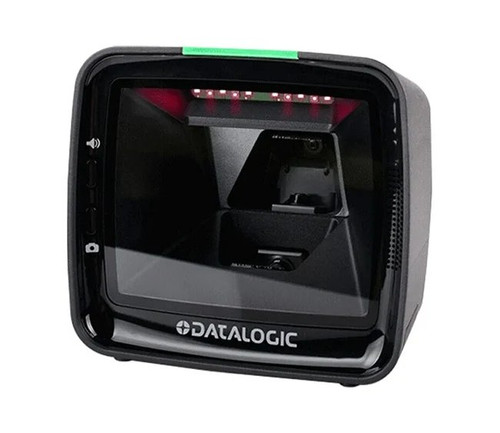
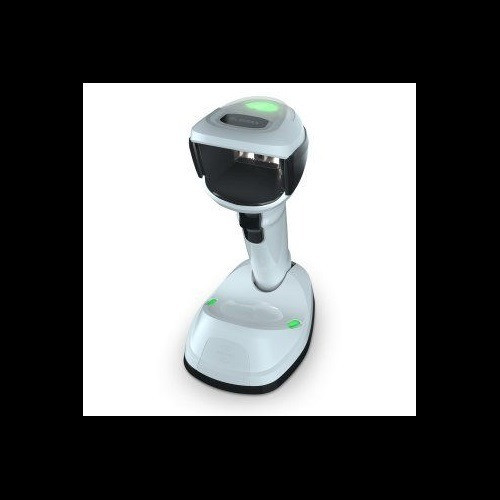
Both the Datalogic Magellan 3410VSi (M3410-010200-00403) and the Zebra DS9908-HD4000WZZWW are corded, on-counter presentation area imagers designed for retail point-of-sale checkout environments. Each reads 1D and 2D barcodes in a hands-free, fixed-mount form factor and shares USB and RS-232 host interfaces. A buyer evaluating either unit is choosing between two vertical/horizontal presentation scanners in the same device class, making a direct specification comparison appropriate.
In This Guide
- Which scanner reads a broader range of symbologies and what imaging specifications back that up?
- How do the two units compare on physical ruggedness, environmental sealing, and operating conditions?
- What host interfaces and power requirements does each scanner support, and how does that affect POS integration?
- Which should you choose: the M3410-010200-00403 or the DS9908?
- Side-by-Side Specs
- FAQ
Which scanner reads a broader range of symbologies and what imaging specifications back that up?
The Zebra DS9908 provides a substantially wider symbology set. Its 1D list includes Code 39, Code 128, Code 93, Codabar/NW7, Code 11, MSI Plessey, UPC/EAN, Interleaved 2 of 5, Korean 3 of 5, GS1 DataBar, and Base 32. Its 2D list adds Aztec, MaxiCode, Micro QR, Han Xin, Micro PDF417, Composite Codes, TLC-39, and Postal Codes on top of the standard PDF417, Data Matrix, and QR Code. It also supports OCR-A, OCR-B, MICR, and US Currency reading — capabilities entirely absent from the Datalogic specification.
The Datalogic M3410VSi specifies Code 128, Code 39, UPC, EAN, QR Code, Data Matrix, and PDF417. No additional 1D, OCR, or postal symbologies are listed in the provided specs. The Zebra further specifies a 1280×800-pixel sensor, a 48°H×30.6°V field of view, a minimum element width of 3.0 mil for Code 39, skew/pitch tolerance of ±60°, roll tolerance of 0°–360°, and a swipe speed up to 240 in./sec. None of these imaging parameters are stated in the Datalogic specification, so direct sensor-level comparisons cannot be made for the M3410VSi.
The Zebra DS9908 also integrates RFID reading (EPC Class 1 Gen2, EPC Gen2 V2, ISO-18000-63) operating across US 902–928 MHz, EU 865–868 MHz, and Japan 916–923 MHz bands at 0 to +25 dBm output. The Datalogic M3410VSi lists no RFID capability.
How do the two units compare on physical ruggedness, environmental sealing, and operating conditions?
Both units carry an IP52 environmental sealing rating, meaning both are protected against dust ingress sufficient to prevent harmful deposits and against dripping water. On this single shared parameter they are equivalent.
The Zebra DS9908 provides considerably more durability data. It is rated for a 5.0 ft./1.5 m drop to concrete and 2,000 tumbles at 1.5 ft./0.5 m. Electrostatic discharge tolerance is specified at ±15 KV Air, ±8 KV Direct, and ±8 KV Indirect — relevant for high-traffic retail lanes. Operating temperature is 0°C to 50°C with storage from -40°C to 70°C and humidity tolerance of 5%–95% RH non-condensing. Ambient light immunity extends to 10,000 foot candles/107,600 lux.
The Datalogic M3410VSi specification does not state a drop rating, tumble rating, ESD tolerance, operating temperature range, storage temperature range, humidity range, or ambient light immunity. Buyers requiring contractual durability commitments will find the Zebra documentation more complete based on the available specs.
What host interfaces and power requirements does each scanner support, and how does that affect POS integration?
The Datalogic M3410VSi supports USB and RS-232, matching the two most common legacy and modern POS interface types. No keyboard wedge, IBM TGCS/RS-485, or additional bus options are listed in the provided specification.
The Zebra DS9908 supports four host interfaces: USB Certified, RS-232, Keyboard Wedge, and TGCS (IBM) 46xx over RS-485. The RS-485/TGCS path is specifically relevant to IBM SurePOS and legacy grocery POS environments where 46xx terminals remain in service. Keyboard Wedge support extends compatibility to older HID-only systems without driver installation.
The Zebra DS9908 further specifies an input voltage range of 4.5–5.5 VDC, 356 mA typical operating current, and 70 mA standby current — data that facilities and POS integration engineers can use directly for power-budget and UPS sizing. The Datalogic M3410VSi specification provides no voltage, current, or power consumption figures, making power-budget planning dependent on external documentation.
Which should you choose: the M3410-010200-00403 or the DS9908?
Our take: The DS9908-HD4000WZZWW is the stronger choice when breadth of symbology coverage, validated ruggedization data, multi-interface flexibility, or integrated RFID capability are decision criteria. The Zebra specifies 11 1D symbologies versus the Datalogic's 4, adds OCR (OCR-A, OCR-B, MICR, US Currency) and RFID (EPC Gen2, ISO-18000-63) not present in the Datalogic spec, and documents a 5.0 ft. concrete drop rating and ±15 KV ESD tolerance that the Datalogic spec does not address. The DS9908 also adds Keyboard Wedge and IBM TGCS/RS-485 interfaces beyond the shared USB and RS-232, directly supporting legacy grocery and hospitality POS terminals. The M3410VSi is a viable candidate where the narrower symbology set is sufficient, where counter-space constraints favor its smaller 152×137×94 mm footprint (versus the DS9908's 203×94×132 mm), or where existing Datalogic infrastructure standardization is a factor — though buyers should obtain the full Datalogic datasheet to confirm power and environmental parameters before final specification.
Side-by-Side Comparison
Spec-for-spec, from manufacturer data.
| Specification | Datalogic M3410-010200-00403 | Zebra DS9908 |
|---|---|---|
| Product Type | Vertical Presentation Scanner | Presentation Area Imager |
| Scan Engine | 2D Area Imager | 2D Area Imager (HD) |
| Host Interfaces | USB, RS-232 | USB, RS-232, Keyboard Wedge, TGCS/IBM 46xx RS-485 |
| RFID | — | EPC Gen2, EPC Gen2 V2, ISO-18000-63 |
| 1D Symbologies | Code 128, Code 39, UPC, EAN | Code 39, 128, 93, Codabar, Code 11, MSI, UPC/EAN, I2of5, Korean 3of5, GS1 DataBar, Base 32 |
| 2D Symbologies | QR Code, Data Matrix, PDF417 | PDF417, Micro PDF417, Composite, TLC-39, Aztec, DataMatrix, MaxiCode, QR, Micro QR, Han Xin, Postal |
| OCR Support | — | OCR-A, OCR-B, MICR, US Currency |
| IP Rating | IP52 | IP52 |
| Drop Rating | — | 5.0 ft. (1.5 m) to concrete |
| Tumble Rating | — | 2,000 tumbles at 1.5 ft. (0.5 m) |
| ESD Tolerance | — | ±15 KV Air, ±8 KV Direct, ±8 KV Indirect |
| Dimensions (H×W×D) | 152 × 137 × 94 mm (6.0 × 5.4 × 3.7 in) | 203 × 94 × 132 mm (8.0 × 3.7 × 5.2 in) |
| Weight | 350 g (0.77 lb) | 330 g (11.6 oz) |
| Image Sensor Resolution | — | 1280 × 800 pixels |
| Swipe Speed | — | Up to 240 in./sec (610 cm/sec) |
| Warranty | 3-year limited | — |
Frequently Asked Questions
Which should you choose: the M3410-010200-00403 or the DS9908?
The DS9908-HD4000WZZWW is the stronger choice when breadth of symbology coverage, validated ruggedization data, multi-interface flexibility, or integrated RFID capability are decision criteria. The Zebra specifies 11 1D symbologies versus the Datalogic's 4, adds OCR (OCR-A, OCR-B, MICR, US Currency) and RFID (EPC Gen2, ISO-18000-63) not present in the Datalogic spec, and documents a 5.0 ft. concrete drop rating and ±15 KV ESD tolerance that the Datalogic spec does not address. The DS9908 also adds Keyboard Wedge and IBM TGCS/RS-485 interfaces beyond the shared USB and RS-232, directly supporting legacy grocery and hospitality POS terminals. The M3410VSi is a viable candidate where the narrower symbology set is sufficient, where counter-space constraints favor its smaller 152×137×94 mm footprint (versus the DS9908's 203×94×132 mm), or where existing Datalogic infrastructure standardization is a factor — though buyers should obtain the full Datalogic datasheet to confirm power and environmental parameters before final specification.
Does either scanner support RFID, or do I need a separate reader?
The Zebra DS9908 (DS9908R variant and the base DS9908 per the provided spec) includes integrated RFID supporting EPC Class 1 Gen2, EPC Gen2 V2, and ISO-18000-63 across US, EU, and Japan frequency bands. The Datalogic M3410VSi specification lists no RFID capability, so a separate RFID reader would be required if that function is needed alongside barcode scanning.
Which unit is better suited to an IBM SurePOS or legacy 46xx terminal?
The Zebra DS9908 explicitly lists TGCS (IBM) 46xx over RS-485 as a supported host interface. The Datalogic M3410VSi specification lists only USB and RS-232; no RS-485 or IBM TGCS interface is stated, making the Zebra the documented choice for that specific legacy platform.
Both units are IP52 — are they equally rugged overall?
They share the same IP52 environmental sealing rating, but the Zebra DS9908 provides additional ruggedness data the Datalogic spec does not: a 5.0 ft. drop-to-concrete rating, 2,000-tumble specification, ±15 KV air ESD tolerance, and a defined operating temperature range of 0°C to 50°C. The Datalogic M3410VSi specification does not state equivalent figures, so IP52 is the only durability parameter that can be directly compared between the two units from the available documentation.
More Barcode Scanner Comparisons
- Zebra DS9308 vs Datalogic M3410-010200-00403
- Zebra DS9308 vs Datalogic M3410-010210-00403
- Zebra DS9308 vs Datalogic M3450-010310-21104
- Zebra DS9308 vs Datalogic M3410-010210-00604
- Zebra DS9308 vs Zebra DS9308
- Zebra DS9308 vs Zebra DS9908
Barcode Scanner Buying Guides
Get a Second Opinion on Your Camera Choice
Share your site layout, coverage goals, and budget. Our team will validate the camera selection, flag anything we would change, and recommend products that match the use case.