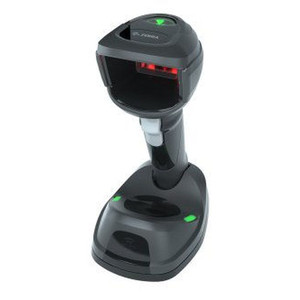
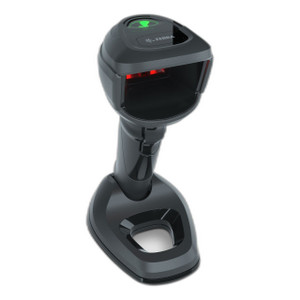
Zebra DS9908-HD4000WZZWW High Density Corded Presentation Area Imager
Overview
The Zebra DS9908-HD4000WZZWW is a purpose-built hybrid presentation imager engineered specifically for laboratory and pharmacy environments where standard scanners regularly fail. Tiny barcodes on microscope slides, curved barcodes on blood vials and medication bottles, color-coded specimen trays, and RFID-tagged blood bags — this is the scenario the DS9908-HD4000WZZWW was designed to handle with first-pass read rates that keep workflow moving. Its high-density focus, 1280x800 megapixel sensor, and Zebra's PRZM Intelligent Imaging technology combine to pull reliable reads off the barcode types that frustrate general-purpose scanners every shift.
The defining capability here is hybrid operation: a patent-pending capacitive touch sensor detects when a worker picks up the scanner and instantly switches from hands-free presentation mode to handheld mode — extending scan range and activating an aim dot automatically. Put it down and it reverts. No button press, no mechanical switch to wear out. For high-throughput lab settings where workers alternate between processing samples at a fixed station and reaching for items on a cart, this matters operationally. Explore the full Zebra scanner catalog for additional form factors in the DS9900 family.
Key Features
- 1280x800 Megapixel Sensor with High Density Focus: The HD optics read barcodes as small as 3.0 mil minimum element width (Code 39) — the level of density found on microscope slide labels and pharmaceutical unit-dose packaging. A general-purpose imager at 5–6 mil minimum will miss these reliably; this one won't.
- PRZM Intelligent Imaging Technology: Zebra's proprietary decode engine handles poorly printed, shiny, faded, dirty, damaged, and color-coded barcodes as well as electronic barcodes on dimly lit displays. In a lab, where biopsy cassettes and specimen trays use color-coded labels, white illumination LEDs make the difference — the imager reads through color where standard red-LED units struggle.
- Up to 240 in./610 cm per Second Swipe Speed: Driven by an 800 MHz microprocessor, the scanner processes barcodes near-instantly. High-volume pharmacy dispensing workflows — where a technician might scan 300+ items per shift — benefit directly from this throughput without creating a bottleneck at the scan point.
- 48° H x 30.6° V Field of View: Described as the widest field of view in its class, this reduces the precision required when positioning items for hands-free scanning. Workers don't need to align items carefully — the scanner's wide cone catches barcodes even at oblique angles, backed by +/-60° skew and pitch tolerance and full 360° roll tolerance.
- Hybrid Hands-Free / Handheld Mode with Auto-Switching: The accelerometer and capacitive sensor eliminate the behavioral overhead of mode-switching. In presentation mode, scan range is intentionally limited to prevent accidental reads of nearby items. Pick up the scanner and it extends range and adds an aiming dot — no configuration required per operator.
- UHF RFID Reading and Writing (DS9908R variant context): The RFID-capable model in this series supports EPC Class 1 Gen2, EPC Gen2 V2, and ISO-18000-63 standards, operating at 902–928 MHz (US), 865–868 MHz (EU), and 916–923 MHz (Japan). RFID output ranges from 0 dBm to +25 dBm. For blood bank and tissue tracking applications, this enables reading multiple RFID-tagged samples in a single pass without requiring line of sight — and complimentary RFID data conversion software outputs tag data as standard barcode strings, so existing lab applications require no modification.
- Broad Symbology Support: Reads all major 1D codes (Code 39, Code 128, Code 93, UPC/EAN, GS1 DataBar, and more), 2D codes (PDF417, DataMatrix, QR Code, Aztec, MaxiCode, Han Xin, and more), and OCR formats including OCR-A, OCR-B, MICR, and US Currency. In a mixed environment handling patient wristbands (PDF417), unit-dose meds (DataMatrix), and legacy reagent bottles (Code 128), a single device handles all without configuration changes.
- IP52 Environmental Sealing and Drop-Rated to 5 ft./1.5 m: IP52 protects against dust ingress and low-angle water spray — adequate for lab bench and pharmacy counter environments where cleaning agents are routinely used nearby. The 5 ft. drop spec to concrete and 2,000-tumble rating at 1.5 ft. provide meaningful protection against the inevitable counter-edge drops in a busy dispensing environment.
- Multi-Interface Support: Connects via USB (certified), RS232, Keyboard Wedge, or TGCS (IBM) 46xx over RS485. Most modern lab and pharmacy workstations will use USB; the RS485/TGCS support means this scanner integrates cleanly with IBM SurePOS and similar legacy healthcare point-of-service terminals that remain common in hospital settings.
- Ambient Light Immunity to 107,600 Lux: Operates without read degradation in direct sunlight conditions (roughly 100,000 lux). Lab environments with bright overhead surgical lighting or near windows won't cause performance issues — the imager's illumination system compensates across the full 0 to 107,600 lux range.
Integration & Compatibility
The DS9908-HD4000WZZWW operates on 4.5–5.5 VDC input and draws 356 mA typical operating current (70 mA standby), making it compatible with standard USB host ports without requiring auxiliary power. The Alpine White color is specified for cleanroom and clinical environments where instrument traceability and infection-control protocols require distinctively colored equipment. Operating range is 32°F to 122°F (0°C to 50°C) with humidity tolerance from 5% to 95% RH non-condensing — appropriate for climate-controlled lab and pharmacy environments. For facilities deploying presentation area barcode scanners across multiple workstations, the USB Certified interface simplifies rollout without driver complexity. ESD tolerance of +/-15 KV air discharge and +/-8 KV direct/indirect protects the device in environments where static buildup is a real concern — particularly relevant near electronic lab equipment. Pair with compatible scanner stands and cradles for fixed workstation deployments. If you're evaluating how density spec affects overall lab barcode strategy, the barcode scanner selection guide covers minimum element width trade-offs in detail.
Frequently Asked Questions
Q: What is the minimum barcode density the DS9908-HD4000WZZWW can read?
A: The high density optics read Code 39 barcodes down to 3.0 mil minimum element width — the density commonly found on microscope slide labels and pharmaceutical unit-dose packaging. This is the primary differentiator from standard-density models in the DS9900 series.
Q: Does the DS9908-HD4000WZZWW support RFID scanning?
A: The base DS9908 model (including the HD4000WZZWW configuration) handles 1D/2D barcode and OCR reading. The RFID capability (EPC Class 1 Gen2, ISO-18000-63, UHF 902–928 MHz US) is available in the DS9908R variant. If blood bag or specimen RFID tracking is required, evaluate the R model.
Q: What interfaces does the DS9908-HD4000WZZWW support?
A: USB Certified, RS232, Keyboard Wedge, and TGCS (IBM) 46xx over RS485. Most lab and pharmacy workstations will connect via USB. The RS485/TGCS interface supports legacy IBM SurePOS and similar healthcare POS terminals.
Q: How does the automatic mode switching work on the DS9908-HD4000WZZWW?
A: A patent-pending combination of capacitive touch sensor (hand detection) and accelerometer (motion detection) switches instantly between hands-free presentation mode and handheld mode when the scanner is picked up or set down. There are no mechanical switching components — the transition is fully sensor-driven and requires no operator input.
Q: What is the environmental rating on the DS9908-HD4000WZZWW?
A: The DS9908 carries an IP52 rating — protected against dust ingress and low-angle water spray. Drop rated to 5.0 ft./1.5 m to concrete, with a 2,000-tumble specification at 1.5 ft./0.5 m. The DS9908R variant is IP42 with a 4.0 ft./1.2 m drop spec.
Q: Can the DS9908-HD4000WZZWW read barcodes on electronic displays?
A: Yes. The PRZM Intelligent Imaging engine and megapixel sensor handle electronic barcodes on dimly lit screens as part of its supported decode capabilities, per Zebra's documented feature set for the DS9900 Series.
The DS9908-HD4000WZZWW is one of the few corded presentation imagers I'd recommend without qualification for clinical lab and pharmacy environments. The 3.0 mil minimum element width at Code 39 is the spec that matters most here — that's dense enough for microscope slide labels that routinely defeat 5–6 mil standard-density units. When you're tracking biopsy cassettes or unit-dose medications, a missed read isn't an inconvenience, it's a patient safety issue.
Technical Highlights:
- 1280x800 Pixel Sensor + PRZM Engine: The megapixel sensor combined with Zebra's PRZM decode handles color-coded labels under white illumination LEDs — critical for specimen trays where color IS the data and standard red-LED illumination creates contrast problems.
- Auto-Mode Switching at 0ms Operator Overhead: The capacitive + accelerometer hybrid switching means no one has to think about which mode they're in. Presentation mode limits scan range to prevent accidental reads of adjacent items; handheld mode extends range automatically when the device is lifted. No mechanical parts to fail mid-shift.
- 240 in./610 cm/sec Swipe Speed via 800 MHz Processor: At a high-volume pharmacy dispensing station processing hundreds of scans per shift, the near-instant capture rate keeps the scanner from being the rate-limiting step in the workflow — which is exactly where it should be.
Deployment Considerations:
- USB Certified interface draws 356 mA typical — verify your host port's available current if deploying on older workstations with marginal USB power rails, particularly if a USB hub is in the chain without its own power supply.
- IP52 is adequate for bench environments with cleaning spray nearby, but it is not a submersion rating. Do not use this in environments where the scanner surface will be regularly wiped down with high-volume liquid disinfectant pooling around ports — evaluate a higher IP-rated device for those conditions.
For hospital lab workstations tracking specimens from accessioning through processing, or pharmacy dispensing stations handling unit-dose barcodes at high volume, the DS9908-HD4000WZZWW is purpose-matched. It is not the right pick for general retail or warehouse scanning where standard density is sufficient and the lab-specific HD optics add cost without deployment benefit.