
CyberPower OL6KRTHW vs Vertiv GXT5-6000MVRT4UXLN: Specification Comparison
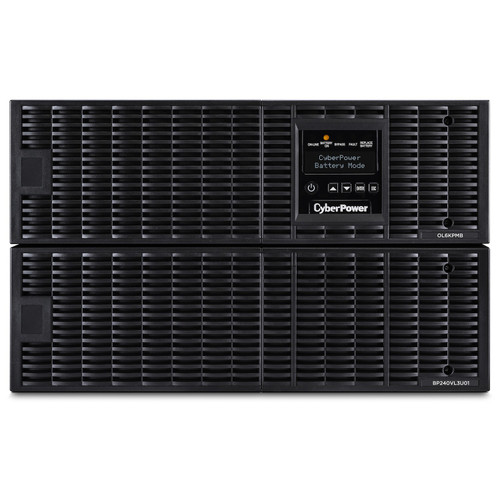
Both units are 6 kVA / 6000 W online double-conversion UPS systems intended for rack or rack-tower deployments powering critical IT and security infrastructure. The CyberPower OL6KRTHW and Vertiv GXT5-6000MVRT4UXLN occupy the same power class and topology, making them direct cross-shop candidates for buyers evaluating a 6 kVA true online UPS. Key differentiators span input voltage architecture, efficiency ratings, management interface depth, and certifications — each of which carries real weight in a B2B procurement decision.
In This Guide
- Which unit better matches your input power environment and output flexibility?
- How do the two units compare on efficiency, output waveform quality, and operating noise?
- Which unit offers deeper remote management and compliance certifications?
- Which should you choose: the OL6KRTHW or the GXT5-6000MVRT4UXLN?
- Side-by-Side Specs
- FAQ
Which unit better matches your input power environment and output flexibility?
The OL6KRTHW accepts a wide single-phase input range of 120–280 V with an input frequency window of 40–70 Hz, giving it broad compatibility across North American single-phase feeds and some international scenarios. Its output spans 120–240 V at 50/60 Hz. The input power factor is specified at 0.99, reducing reactive current draw on the supply circuit.
The GXT5-6000MVRT4UXLN is designed around a nominal 208 VAC input (range 176–280 VAC), typical of North American three-phase-derived or dedicated 208 V circuits in data centers and server rooms. Its output is 208/120 VAC, user-configurable, which suits mixed-voltage rack environments. Input power factor is not stated in the provided specs. Buyers on 120 V single-phase feeds cannot use the GXT5-6000MVRT4UXLN without a step-up transformer; buyers on 208 V feeds will find it the native fit.
How do the two units compare on efficiency, output waveform quality, and operating noise?
The GXT5-6000MVRT4UXLN lists efficiency up to 98% in Active ECO Mode and up to 95% in on-line double-conversion mode. No equivalent efficiency figure is provided in the OL6KRTHW specs. For always-on critical loads where ECO mode is not suitable, 95% on-line efficiency on the Vertiv still represents a strong operating cost posture.
The OL6KRTHW specifies a pure sine wave output, output voltage THD of ≤5%, a crest factor of 3:1, and an output power factor of 1.0 — meaning the full 6000 W is available to loads regardless of load power factor. The GXT5-6000MVRT4UXLN does not provide THD, crest factor, or output power factor figures in the supplied specs. The OL6KRTHW also lists a noise level of 65 dB, relevant for deployments in noise-sensitive spaces; the GXT5-6000MVRT4UXLN does not include a noise rating in the provided specs.
Which unit offers deeper remote management and compliance certifications?
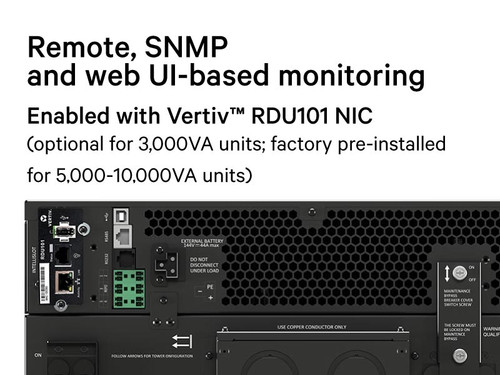
The GXT5-6000MVRT4UXLN ships with a factory pre-installed Vertiv RDU101 SNMP/Webcard, plus USB, RS485, RS232, a terminal block, and an external battery connector. SNMP and web management are enabled out of the box. A full-color graphic LCD with gravity-sensing orientation aids installation and configuration. Supported protocols include SNMP and serial out-of-band management. Certifications listed are ENERGY STAR 2.0, UL1778, c-UL, RoHS2, and REACH — a notable compliance portfolio for regulated environments.
The OL6KRTHW specifies surge protection is included and EMI/RFI noise filtering as 'No.' No management interface, protocol support, LCD, or certification data is provided in the supplied specs for the OL6KRTHW. Buyers requiring SNMP integration, out-of-band management, or ENERGY STAR certification documentation for procurement compliance will find the GXT5-6000MVRT4UXLN fully specified for those needs; the OL6KRTHW's management and compliance posture cannot be confirmed from the available data.
Which should you choose: the OL6KRTHW or the GXT5-6000MVRT4UXLN?
Our take: The GXT5-6000MVRT4UXLN is the stronger choice when the load environment runs on 208 VAC, requires factory-integrated SNMP/web management, and must meet ENERGY STAR 2.0 or UL1778 certification requirements. Three concrete spec deltas drive this: first, the Vertiv's native 208 V input (176–280 VAC range) is purpose-matched to data center power distribution, while the CyberPower's 120–280 V range serves single-phase 120 V environments the Vertiv cannot natively support; second, the Vertiv documents up to 98% ECO / 95% on-line efficiency versus no efficiency figure available for the OL6KRTHW; third, the Vertiv includes a pre-installed RDU101 SNMP card, USB, RS485/232, and ENERGY STAR 2.0 certification, none of which are confirmed in the OL6KRTHW spec set. The OL6KRTHW is better positioned for single-phase 120 V installations where a unity power factor (PF=1) output and a documented ≤5% output THD matter, and where a 40–70 Hz input frequency window adds value.
Side-by-Side Comparison
Spec-for-spec, from manufacturer data.
| Specification | CyberPower OL6KRTHW | Vertiv GXT5-6000MVRT4UXLN |
|---|---|---|
| Topology | Double-conversion (Online) | On-line double conversion |
| Power Rating (VA / W) | 6,000 VA / 6,000 W | 6,000 VA / 6,000 W |
| Output Power Factor | 1.0 | — |
| Input Voltage Range | 120–280 V | 176–280 VAC (typical 208 VAC) |
| Output Voltage Range | 120–240 V | 208/120 VAC (user-configurable) |
| Input Frequency | 40–70 Hz | — |
| Output Frequency | 50/60 Hz | — |
| Input Power Factor | 0.99 | — |
| On-line Efficiency | — | Up to 95% |
| ECO Mode Efficiency | — | Up to 98% |
| Output Voltage THD | ≤5% | — |
| Crest Factor | 3:1 | — |
| Waveform | Sine | — |
| Management Interfaces | — | SNMP/Web (RDU101), USB, RS485, RS232, terminal block |
| Noise Level | 65 dB | — |
| Certifications | — | ENERGY STAR 2.0, UL1778, c-UL, RoHS2, REACH |
| Surge Protection | Yes | — |
| EMI/RFI Filtering | No | — |
| Weight | — | 125.6 lb |
| Dimensions (H × W × D) | — | 6.8 × 16.9 × 25.6 in |
| Operating Temperature | — | +32 to +104 °F (0 to +40 °C) |
| Wiring | — | Hardwired in/out; optional PODs |
Frequently Asked Questions
Which should you choose: the OL6KRTHW or the GXT5-6000MVRT4UXLN?
The GXT5-6000MVRT4UXLN is the stronger choice when the load environment runs on 208 VAC, requires factory-integrated SNMP/web management, and must meet ENERGY STAR 2.0 or UL1778 certification requirements. Three concrete spec deltas drive this: first, the Vertiv's native 208 V input (176–280 VAC range) is purpose-matched to data center power distribution, while the CyberPower's 120–280 V range serves single-phase 120 V environments the Vertiv cannot natively support; second, the Vertiv documents up to 98% ECO / 95% on-line efficiency versus no efficiency figure available for the OL6KRTHW; third, the Vertiv includes a pre-installed RDU101 SNMP card, USB, RS485/232, and ENERGY STAR 2.0 certification, none of which are confirmed in the OL6KRTHW spec set. The OL6KRTHW is better positioned for single-phase 120 V installations where a unity power factor (PF=1) output and a documented ≤5% output THD matter, and where a 40–70 Hz input frequency window adds value.
Can I use either UPS on a standard 120 V North American circuit?
The OL6KRTHW is specified with an input operating range of 120–280 V, so it can accept a standard 120 V single-phase feed. The GXT5-6000MVRT4UXLN has a typical input of 208 VAC and a minimum input of 176 VAC, meaning it cannot operate on a 120 V feed without a step-up transformer. For 120 V environments, only the OL6KRTHW is confirmed compatible based on the provided specs.
Does either UPS include a network management card out of the box?
Yes — the GXT5-6000MVRT4UXLN comes with a factory pre-installed Vertiv RDU101 SNMP/Webcard and supports SNMP, web management, USB, RS485, RS232, and serial out-of-band management with no additional purchase required. The OL6KRTHW specs provided do not mention any network management card, interface ports, or protocol support, so this cannot be confirmed for that model.
Which UPS is more efficient to run continuously in online double-conversion mode?
The GXT5-6000MVRT4UXLN is specified at up to 95% efficiency in on-line double-conversion mode and up to 98% in Active ECO Mode. No efficiency figure is provided in the OL6KRTHW specifications, so a direct numeric comparison cannot be made. Based solely on available data, the Vertiv is the only unit with a documented on-line efficiency rating.
More UPS Comparisons
- APC by Schneider Electric SYH6K6RMT vs CyberPower OL6KRTHW
- APC by Schneider Electric SYH6K6RMT vs CyberPower OL6KRTHD
- APC by Schneider Electric SYH6K6RMT vs Vertiv GXT5-6000MVRT4UXLN
- APC by Schneider Electric SYH6K6RMT vs Vertiv GXT5-6KL630RT5UXLN
- APC by Schneider Electric SYH6K6RMT vs APC by Schneider Electric SYH6K6RMI
- APC by Schneider Electric SYH6K6RMT vs APC by Schneider Electric SYH6K6RMT-TF3
UPS Buying Guides
Get a Second Opinion on Your Camera Choice
Share your site layout, coverage goals, and budget. Our team will validate the camera selection, flag anything we would change, and recommend products that match the use case.