
APC by Schneider Electric SYA8K8I vs Vertiv GXT5-8000HVRT5UXLN: Specification Comparison
Both the APC Symmetra LX SYA8K8I and the Vertiv GXT5-8000HVRT5UXLN are 8 kVA-class online double-conversion UPS units targeting data-center, server-room, and critical-infrastructure installations. They share the same nominal VA rating and hardwired connectivity, making them a natural cross-shop for facilities teams specifying a single high-capacity UPS. The comparison centers on power delivery and efficiency, physical footprint and environmental tolerance, and management and interface depth—the three axes that most often drive specification decisions at this capacity tier.
In This Guide
- How do the SYA8K8I and GXT5-8000HVRT5UXLN compare in real power delivery and efficiency?
- What are the physical, environmental, and installation differences between the two units?
- Which unit offers broader management, interface, and integration options?
- Which should you choose: the SYA8K8I or the GXT5-8000HVRT5UXLN?
- Side-by-Side Specs
- FAQ
How do the SYA8K8I and GXT5-8000HVRT5UXLN compare in real power delivery and efficiency?
At the rated 8 kVA, the two units diverge significantly in watt output. The APC SYA8K8I delivers 5,600 W, yielding a power factor of 0.70. The Vertiv GXT5-8000HVRT5UXLN is rated at 8,000 W at 8,000 VA—a unity (1.0) power factor—meaning it can serve a heavier resistive or modern switched-mode load without derating.
Efficiency data is available only for the Vertiv: up to 98% in Active ECO mode and up to 95% in on-line double-conversion mode. APC does not publish an efficiency figure in the provided specifications, so a direct numerical comparison cannot be made.
Input voltage is also differentiated by region: the SYA8K8I is specified for 220/230/240 V or 380/400/415 V environments (IEC market). The GXT5-8000HVRT5UXLN targets 208 VAC typical (176–288 VAC range) with a user-configurable output of 200–240 VAC, positioning it squarely in the North American single-phase high-voltage market.
What are the physical, environmental, and installation differences between the two units?
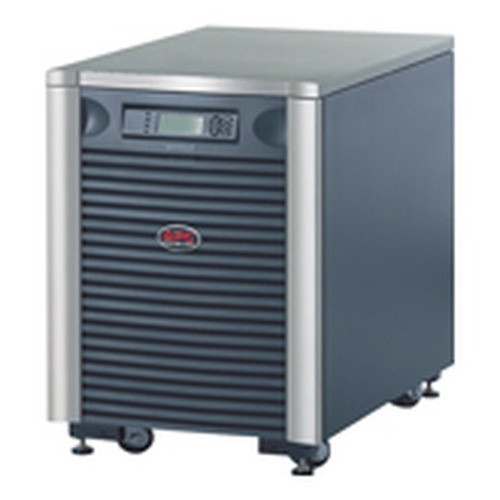
The SYA8K8I is a tower unit weighing 202 kg (approximately 445 lb). No rack-unit height, width, or depth dimensions are provided in the available specifications. Its substantial mass implies dedicated floor placement and potentially a reinforced surface.
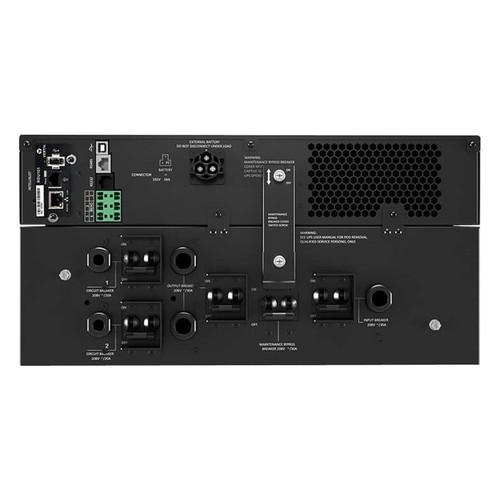
The GXT5-8000HVRT5UXLN is a flexible rack/tower unit measuring 8.5 in H × 16.9 in W × 24.8 in D and weighing 164.2 lb (approximately 74.5 kg)—roughly one-third the mass of the SYA8K8I. This form factor accommodates both rack integration (5U) and tower deployment.
Both units share an operating temperature range of 0–40 °C and operating relative humidity up to 95% (non-condensing implied). The SYA8K8I additionally specifies an operating altitude of 0–3,000 m; the GXT5-8000HVRT5UXLN does not list an altitude rating in the provided specifications. Storage temperature for the SYA8K8I is –15 to 45 °C; the Vertiv's storage conditions are not provided.
Which unit offers broader management, interface, and integration options?
The Vertiv GXT5-8000HVRT5UXLN ships with a factory pre-installed RDU101 SNMP/Webcard, enabling SNMP and web management out of the box. Additional interfaces include USB, RS-485, RS-232, a terminal block, and an external battery connector. A full-color graphic LCD with gravity-sensing orientation (auto-rotates between rack and tower) provides local status and configuration. Certifications include ENERGY STAR 2.0, UL1778, c-UL, RoHS2, and REACH.
The APC SYA8K8I includes one Smart-Slot with the AP9619 card pre-installed, plus a DB-9 RS-232 port. Smart-Slot is an expansion architecture, but SNMP/network management requires a separate compatible card beyond what is pre-installed (the AP9619 is a UPS environmental monitoring card, not a network management card); buyers should verify the card's capabilities against their monitoring requirements. No ENERGY STAR or UL certification data is provided in the available specifications.
Output receptacles also differ: the Vertiv provides two L6-20R and two L6-30R receptacles in addition to hardwired in/out, giving some direct plug-in capacity for maintenance bypass or branch circuits. The SYA8K8I is hardwire-only with a single Hard Wire 3-wire (H N + G) output connection.
Which should you choose: the SYA8K8I or the GXT5-8000HVRT5UXLN?
Our take: The GXT5-8000HVRT5UXLN is the stronger choice when maximizing usable watt capacity, management depth, and installation flexibility within a rack environment. At 8,000 W versus the SYA8K8I's 5,600 W, the Vertiv delivers 43% more real power at the same VA rating—a decisive advantage for modern server loads with high power factors. Its factory-installed SNMP/Webcard, USB, RS-485, RS-232, and color LCD eliminate add-on card purchases required to match equivalent monitoring on the APC. At 164.2 lb in a rack/tower flexible chassis versus 202 kg for the tower-only APC, the Vertiv is also far easier to position and relocate. The SYA8K8I may suit buyers already standardized on APC's Smart-Slot ecosystem or operating in 380/400/415 V European infrastructure where the Vertiv's 208 V primary input does not align; its SYBT5 battery cartridge also offers an established replacement path. Specifiers on 208 V North American circuits with high-power-factor compute loads will find the Vertiv the more capable unit on the available specifications.
Side-by-Side Comparison
Spec-for-spec, from manufacturer data.
| Specification | APC by Schneider Electric SYA8K8I | Vertiv GXT5-8000HVRT5UXLN |
|---|---|---|
| VA Rating | 8,000 VA | 8,000 VA |
| Watt Rating | 5,600 W | 8,000 W |
| Power Factor | 0.70 | 1.00 |
| Topology | Not specified in provided specs | On-line double conversion |
| Input Voltage | 220/230/240 V or 380/400/415 V | Typical 208 VAC; range 176–288 VAC |
| Output Voltage | 220/230/240 V or 380/400/415 V (implied by input) | 200/208/220/230/240 VAC (user-configurable) |
| Efficiency | — | Up to 98% (ECO); up to 95% (on-line) |
| Form Factor | Tower | Rack/Tower (flexible) |
| Weight | 202 kg (approx. 445 lb) | 164.2 lb (approx. 74.5 kg) |
| Dimensions (H×W×D) | — | 8.5 × 16.9 × 24.8 in |
| Output Connections | Hard Wire 3-wire (H N + G) | Hardwired + 2× L6-20R + 2× L6-30R |
| Management Interfaces | DB-9 RS-232, Smart-Slot (AP9619 pre-installed) | SNMP/Webcard (RDU101, factory installed), USB, RS-485, RS-232, terminal block |
| Local Display | — | Full-color graphic LCD with gravity sensing |
| Operating Temperature | 0–40 °C | 0–40 °C |
| Operating Humidity | 0–95% | — |
| Operating Altitude | 0–3,000 m | — |
| Certifications | — | ENERGY STAR 2.0, UL1778, c-UL, RoHS2, REACH |
| Replacement Battery | SYBT5 | — |
| EPO Support | Yes | — |
| Battery Type | Sealed Lead-Acid, leakproof | — |
Frequently Asked Questions
Which should you choose: the SYA8K8I or the GXT5-8000HVRT5UXLN?
The GXT5-8000HVRT5UXLN is the stronger choice when maximizing usable watt capacity, management depth, and installation flexibility within a rack environment. At 8,000 W versus the SYA8K8I's 5,600 W, the Vertiv delivers 43% more real power at the same VA rating—a decisive advantage for modern server loads with high power factors. Its factory-installed SNMP/Webcard, USB, RS-485, RS-232, and color LCD eliminate add-on card purchases required to match equivalent monitoring on the APC. At 164.2 lb in a rack/tower flexible chassis versus 202 kg for the tower-only APC, the Vertiv is also far easier to position and relocate. The SYA8K8I may suit buyers already standardized on APC's Smart-Slot ecosystem or operating in 380/400/415 V European infrastructure where the Vertiv's 208 V primary input does not align; its SYBT5 battery cartridge also offers an established replacement path. Specifiers on 208 V North American circuits with high-power-factor compute loads will find the Vertiv the more capable unit on the available specifications.
Is the SYA8K8I or GXT5-8000HVRT5UXLN better for high-density server loads with modern power supplies?
The GXT5-8000HVRT5UXLN is better suited to high-density modern server loads. It delivers 8,000 W at a unity power factor, meaning it can supply its full rated wattage to loads that present a power factor near 1.0—typical of contemporary switched-mode server power supplies. The SYA8K8I is rated at only 5,600 W at 8 kVA (0.70 power factor), so it will derate under high-power-factor loads and provide less usable power than its VA rating suggests.
Can either unit be monitored remotely over a network without buying additional hardware?
The GXT5-8000HVRT5UXLN includes a factory pre-installed Vertiv RDU101 SNMP/Webcard, enabling network monitoring and web management immediately out of the box. The SYA8K8I ships with an AP9619 Smart-Slot card; the AP9619 is an environmental monitoring card, not a network management card, so remote SNMP/network UPS management would require a separate Smart-Slot network card. Buyers who need ready-to-use network monitoring without additional purchases should factor this into their decision.
Which UPS is easier to install in a standard server rack?
The GXT5-8000HVRT5UXLN is explicitly designed as a flexible rack/tower unit in a 5U chassis (8.5 in H), making it straightforward to mount in a standard 19-inch rack. The SYA8K8I is a tower form factor only—no rack dimensions are provided in the available specifications—and at 202 kg it requires dedicated floor space and careful weight management. For rack-based deployments the Vertiv is the more practical option based on the provided specifications.
More UPS Comparisons
- APC by Schneider Electric SRTL8KRM4UT-5KTF vs Vertiv GXT5-8000HVRT5UXLN
- APC by Schneider Electric SRTL8KRM4UT-5KTF vs Vertiv GXT5-8000MVRT6UXLN
- APC by Schneider Electric SRT8KRMXLT vs Vertiv GXT5-8000HVRT5UXLN
- APC by Schneider Electric SRT8KRMXLT vs Vertiv GXT5-8000MVRT6UXLN
- APC by Schneider Electric SRT8KRMXLT vs APC by Schneider Electric SYA8K16I
- APC by Schneider Electric SYA8K16I vs Vertiv GXT5-8000HVRT5UXLN
UPS Buying Guides
Get a Second Opinion on Your Camera Choice
Share your site layout, coverage goals, and budget. Our team will validate the camera selection, flag anything we would change, and recommend products that match the use case.