
APC by Schneider Electric SRT8KRMXLT vs APC by Schneider Electric SYA8K16I: Specification Comparison
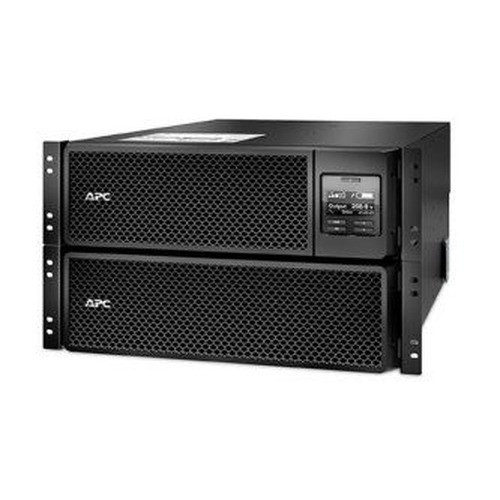
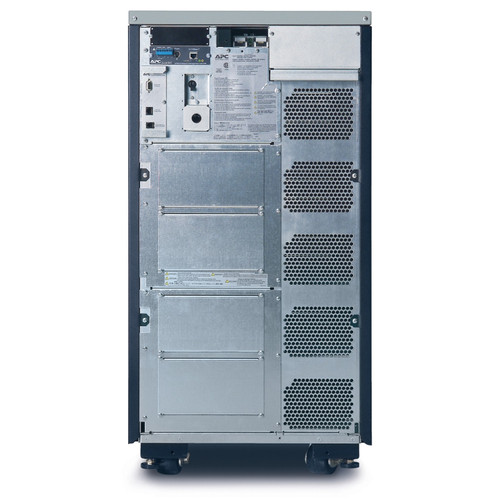
Both the SRT8KRMXLT and SYA8K16I are APC by Schneider Electric uninterruptible power supplies rated at 8 kVA, placing them in the same capacity tier for data center and critical infrastructure protection. However, they represent fundamentally different UPS architectures and deployment philosophies: the SRT8KRMXLT is a 6U rackmount double-conversion online UPS with an 8 kW real-power rating, while the SYA8K16I is a tower-form Symmetra LX modular UPS scalable to 16 kVA with a 5.6 kW real-power output and hardwire-only AC connections. A buyer cross-shopping these must weigh rackmount versus tower form factor, power density, and scalability.
In This Guide
- Which UPS delivers more usable real power and what does the topology mean for load protection?
- How long will each UPS sustain the load, and can capacity be expanded as infrastructure grows?
- What are the installation requirements, physical constraints, and management integration options?
- Which should you choose: the SRT8KRMXLT or the SYA8K16I?
- Side-by-Side Specs
- FAQ
Which UPS delivers more usable real power and what does the topology mean for load protection?
The SRT8KRMXLT is specified as a double-conversion (online) UPS delivering 8,000 W of real output power at 8 kVA — a power factor of 1.0. This topology continuously regenerates clean sine-wave output, isolating connected loads from all input anomalies including sags, surges, frequency variation, and noise. Input THD is specified at 2%, and the crest factor is 3:1, indicating the ability to handle non-linear loads.
The SYA8K16I is rated 8 kVA but delivers only 5,600 W of real power — a power factor of 0.70. Its topology is not explicitly stated in the provided specifications. The 2,400 W gap in real power (8,000 W vs. 5,600 W) is a critical delta for buyers calculating actual load capacity. For a rack of servers drawing close to 8 kW, only the SRT8KRMXLT covers that load at nameplate rating.
How long will each UPS sustain the load, and can capacity be expanded as infrastructure grows?
The SRT8KRMXLT's backup runtime at full or half load is not provided in the supplied specifications. Its battery architecture and runtime extension capability via external battery modules are not detailed in the data provided.
The SYA8K16I provides concrete runtime figures: 7.5 minutes at full load (8 kVA / 5,600 W) and 20.2 minutes at half load. It uses SYBT5 replacement battery cartridges and is described as 'Scalable to 16 kVA N+1,' indicating a modular Symmetra LX architecture that allows both capacity and redundancy expansion beyond the base 8 kVA. The N+1 designation means one additional power module provides redundancy so that failure of a single module does not interrupt output — a significant reliability differentiator for mission-critical environments, though the specs do not quantify the number of modules included at base configuration.
What are the installation requirements, physical constraints, and management integration options?
The SRT8KRMXLT mounts in 6U of rack space and provides four L6-20R receptacles plus two L6-30R receptacles, making it directly compatible with standard NEMA twist-lock power cords without additional distribution hardware. It supports web-based management, auto-restart, audible alarms, and surge protection (480 J). Input voltage range spans 100–275 V at 40–70 Hz, covering wide utility variations. Noise is specified at 55 dB. Form factor and outlet complement suit dense rack deployments.
The SYA8K16I connects via hardwire only — there are no plug-in receptacles. This requires a licensed electrician for installation and limits flexibility for ad-hoc load connections. Management is available via a pre-installed AP9619 SmartSlot card with one additional SmartSlot available. Operating environment is specified: 0–40 °C, 0–95% relative humidity (non-condensing assumed), and up to 3,000 m altitude. The unit weighs 220 kg and is tower form, requiring floor space rather than rack real estate. Input voltage compatibility (220/230/240 V or 480/400/415 V) and carbon footprint (27,705.16 kg CO₂e) are provided; the SRT8KRMXLT lacks equivalent environmental or weight data in the provided specs.
Which should you choose: the SRT8KRMXLT or the SYA8K16I?
Our take: The SRT8KRMXLT is the stronger choice when the deployment is rack-based, requires plug-in NEMA receptacles, and demands the highest real-power density at 8 kVA. Its double-conversion online topology guarantees continuous load isolation, it delivers 8,000 W versus the SYA8K16I's 5,600 W — a 43% real-power advantage — and its NEMA L6-20R/L6-30R outlets eliminate the need for a licensed electrician for load connections. The SYA8K16I is the stronger choice when scalability and N+1 redundancy are primary requirements: its modular Symmetra LX architecture allows capacity expansion to 16 kVA and a redundant module configuration not available on the SRT8KRMXLT per supplied specs. It also provides documented runtime (7.5 min full load, 20.2 min half load) and operates across dual voltage ranges (220–240 V and 400–480 V). Buyers needing a hardwire-fed, floor-standing, scalable modular UPS for a growing data center should favor the SYA8K16I; those populating a standard rack environment should favor the SRT8KRMXLT.
Side-by-Side Comparison
Spec-for-spec, from manufacturer data.
| Specification | APC by Schneider Electric SRT8KRMXLT | APC by Schneider Electric SYA8K16I |
|---|---|---|
| UPS Topology | Double-conversion (Online) | — |
| Output Power Capacity | 8 kVA | 8 kVA |
| Output Real Power (Watts) | 8,000 W | 5,600 W |
| Power Factor | 1.0 | 0.70 |
| Output Waveform | Sine | — |
| Form Factor | Rackmount 6U | Tower |
| AC Output Connections | 4× L6-20R, 2× L6-30R | Hardwire only |
| Input Voltage Range | 100–275 V | 220/230/240 V or 480/400/415 V |
| Input Frequency | 40–70 Hz | — |
| Surge Energy Rating | 480 J | — |
| Input Current THD | 2% | — |
| Runtime at Full Load | — | 7.5 min |
| Runtime at Half Load | — | 20.2 min |
| Scalability / Redundancy | — | Scalable to 16 kVA, N+1 |
| Management Interface | Web-based management | SmartSlot (AP9619 pre-installed, 1 slot available) |
| EPO Support | — | Yes |
| Replacement Battery | — | SYBT5 |
| Operating Temperature | — | 0–40 °C |
| Noise Level | 55 dB | — |
| Weight | — | 220 kg |
| Auto-Restart | Yes | — |
Frequently Asked Questions
Which should you choose: the SRT8KRMXLT or the SYA8K16I?
The SRT8KRMXLT is the stronger choice when the deployment is rack-based, requires plug-in NEMA receptacles, and demands the highest real-power density at 8 kVA. Its double-conversion online topology guarantees continuous load isolation, it delivers 8,000 W versus the SYA8K16I's 5,600 W — a 43% real-power advantage — and its NEMA L6-20R/L6-30R outlets eliminate the need for a licensed electrician for load connections. The SYA8K16I is the stronger choice when scalability and N+1 redundancy are primary requirements: its modular Symmetra LX architecture allows capacity expansion to 16 kVA and a redundant module configuration not available on the SRT8KRMXLT per supplied specs. It also provides documented runtime (7.5 min full load, 20.2 min half load) and operates across dual voltage ranges (220–240 V and 400–480 V). Buyers needing a hardwire-fed, floor-standing, scalable modular UPS for a growing data center should favor the SYA8K16I; those populating a standard rack environment should favor the SRT8KRMXLT.
Is the SRT8KRMXLT or SYA8K16I better for a standard server rack installation?
The SRT8KRMXLT is better suited for rack installation. It occupies 6U of rack space and provides NEMA L6-20R and L6-30R outlets for direct connection of rack PDUs or server power cords. The SYA8K16I is a tower unit with hardwire-only AC output, requiring floor space and a licensed electrician for load connections — it is not designed to mount in a standard equipment rack.
Which unit can support larger deployments as power requirements grow?
The SYA8K16I is explicitly specified as scalable to 16 kVA with N+1 redundancy, meaning its modular Symmetra LX architecture supports capacity expansion and a redundant power module. The SRT8KRMXLT is specified at a fixed 8 kVA/8 kW with no scalability information provided in the supplied specifications. For deployments anticipating growth beyond 8 kVA, the SYA8K16I's architecture is the documented choice.
Does the SRT8KRMXLT or SYA8K16I provide better protection against power quality issues?
The SRT8KRMXLT's double-conversion (online) topology is explicitly specified, meaning output power is continuously regenerated and loads are fully isolated from input disturbances at all times — including sags, surges, frequency shifts, and noise. Its input THD is 2% and crest factor is 3:1. The SYA8K16I's topology is not stated in the provided specifications, so a direct topology comparison cannot be made from available data.
More UPS Comparisons
- APC by Schneider Electric SRTL8KRM4UT-5KTF vs Vertiv GXT5-8000HVRT5UXLN
- APC by Schneider Electric SRTL8KRM4UT-5KTF vs Vertiv GXT5-8000MVRT6UXLN
- APC by Schneider Electric SRT8KRMXLT vs Vertiv GXT5-8000HVRT5UXLN
- APC by Schneider Electric SRT8KRMXLT vs Vertiv GXT5-8000MVRT6UXLN
- APC by Schneider Electric SYA8K16I vs Vertiv GXT5-8000HVRT5UXLN
- APC by Schneider Electric SYA8K16I vs Vertiv GXT5-8000MVRT6UXLN
UPS Buying Guides
Get a Second Opinion on Your Camera Choice
Share your site layout, coverage goals, and budget. Our team will validate the camera selection, flag anything we would change, and recommend products that match the use case.