
APC by Schneider Electric SUA500PDR-H vs APC by Schneider Electric BE500G3: Specification Comparison
Both the APC SUA500PDR-H and the APC BE500G3 are 500VA line-interactive UPS units operating on 120V AC input, placing them in the same capacity class a buyer might consider for protecting small loads. However, they serve fundamentally different deployment contexts: the SUA500PDR-H is a hardwired DIN-rail-mountable industrial UPS designed for panel integration, while the BE500G3 is a plug-in desktop/tower unit with NEMA outlets aimed at office or home environments. This comparison examines topology and installation, runtime and battery characteristics, and connectivity and management.
In This Guide
- How do the installation requirements and physical topology differ between the SUA500PDR-H and BE500G3?
- Which unit delivers more usable watt capacity and how do their battery recharge characteristics compare?
- What remote management, signaling, and connectivity options does each UPS provide to installers and IT staff?
- Which should you choose: the SUA500PDR-H or the BE500G3?
- Side-by-Side Specs
- FAQ
How do the installation requirements and physical topology differ between the SUA500PDR-H and BE500G3?
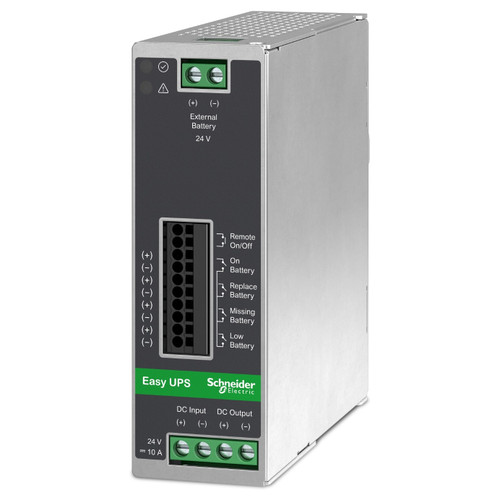
The SUA500PDR-H is a DIN-rail-mountable UPS with hardwired input and output connections (1x hardwire 3-wire 1PH+N+G in, 1x hardwire 3-wire HN+E out). It requires a licensed electrician for installation and is designed to be integrated inside electrical panels or enclosures. It has no plug — it cannot simply be inserted into a wall outlet. Its listed dimension is 14.3 inches and it ships at 29.32 lbs, reflecting a rugged industrial form factor.
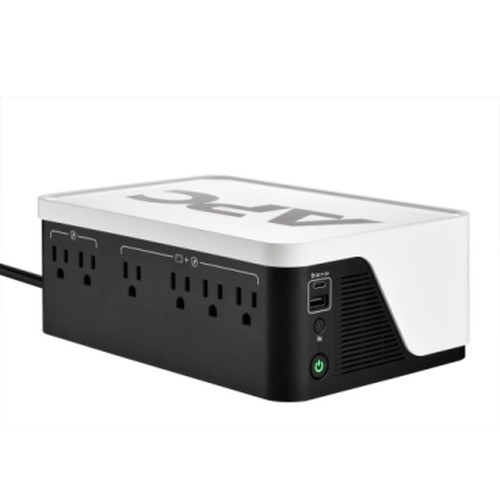
The BE500G3 is a conventional tower UPS with a NEMA 5-15P plug and six NEMA 5-15R outlets (four with battery and surge protection, two with surge only). It weighs 7.185 lbs and measures 9.65 x 3.54 x 6.57 inches — sized for a desk or floor placement. No electrical rough-in is required. These two units cannot be substituted for one another without changing the installation approach entirely.
Which unit delivers more usable watt capacity and how do their battery recharge characteristics compare?
On paper both units share a 500VA load capacity rating. However, the SUA500PDR-H is rated at 325W continuous output, while the BE500G3 is rated at 300W. The SUA500PDR-H therefore supports 25W more real power draw — a modest but measurable advantage for loads that push the watt ceiling.
Battery recharge time diverges significantly. The SUA500PDR-H specifies a 2.5-hour recharge time. The BE500G3 specifies a 10-hour recharge time — four times longer. For installations where rapid return-to-protected-state after a discharge event matters (e.g., high-availability environments with frequent utility anomalies), the SUA500PDR-H's recharge characteristic is a clear operational advantage. Battery chemistry on the BE500G3 is explicitly stated as Lead-Acid; the SUA500PDR-H does not specify chemistry in the provided data.
What remote management, signaling, and connectivity options does each UPS provide to installers and IT staff?
The SUA500PDR-H includes an RS-232 serial management interface (9-pin D-Sub DB-9), an EPO (Emergency Power Off) contact, and an APC SmartSlot expansion bay for optional network management cards. This makes it compatible with APC's broader ecosystem of SmartSlot accessories and enables hard-wired serial UPS monitoring. Its surge energy rating is specified at 540 Joules.
The BE500G3 uses a USB-B communications port for UPS monitoring software connectivity — a common approach for desktop units connecting to a single host PC. It does not list RS-232, EPO, or any expansion slot in the provided specifications. It does include one USB-A charging port (5VDC, 3A, 15W) for device charging, a feature absent from the SUA500PDR-H spec sheet. The BE500G3 carries CEC, ENERGY STAR, and FCC certifications; the SUA500PDR-H lists UL 1449. Neither set of specifications is fully symmetrical.
Which should you choose: the SUA500PDR-H or the BE500G3?
Our take: The SUA500PDR-H is the stronger choice when the application calls for panel-integrated, hardwired power protection in an industrial or control-system environment. It delivers 25W higher continuous output (325W vs 300W), recharges in 2.5 hours versus the BE500G3's 10 hours, and provides RS-232 serial management, an EPO input, and a SmartSlot expansion bay — features that matter in monitored industrial deployments. The BE500G3, by contrast, is suited exclusively to plug-in desktop or small-office environments where NEMA outlets, USB monitoring, and a lightweight 7.2-lb form factor are priorities. A buyer cannot substitute one for the other without a fundamentally different installation. Specify the SUA500PDR-H for DIN-rail panel builds, security control rooms, or industrial automation enclosures; specify the BE500G3 for workstation or small-office UPS protection where a conventional plug-in unit is acceptable and rapid recharge is not a primary concern.
Side-by-Side Comparison
Spec-for-spec, from manufacturer data.
| Specification | APC by Schneider Electric SUA500PDR-H | APC by Schneider Electric BE500G3 |
|---|---|---|
| UPS Topology | Line-interactive | Line-interactive |
| Load Capacity | 500 VA / 325 W | 500 VA / 300 W |
| Input Connection | Hardwire 3-wire (1PH+N+G) | NEMA 5-15P plug |
| Output Connection | Hardwire 3-wire (HN+E) | 6x NEMA 5-15R |
| Battery-Protected Outlets | — | 4x NEMA 5-15R |
| Surge-Only Outlets | — | 2x NEMA 5-15R |
| Mounting / Form Factor | DIN-rail mountable | Desktop/tower |
| Input Voltage Range | AC 82–144 V (adj. 75–154 V) | 120 VAC nominal |
| Output Voltage | AC 120 V, 57–63 Hz | 120 VAC, 50/60 Hz |
| Surge Energy Rating | 540 Joules | — |
| Recharge Time | 2.5 hours | 10 hours |
| Management Interface | RS-232 (DB-9) + EPO | USB-B |
| Expansion | SmartSlot | — |
| USB Charging Port | — | 1x USB-A 5V/3A (15 W) |
| Certifications / Standards | UL 1449 | CEC, ENERGY STAR, FCC |
| Unit Weight | 29.32 lbs | 7.185 lbs |
Frequently Asked Questions
Which should you choose: the SUA500PDR-H or the BE500G3?
The SUA500PDR-H is the stronger choice when the application calls for panel-integrated, hardwired power protection in an industrial or control-system environment. It delivers 25W higher continuous output (325W vs 300W), recharges in 2.5 hours versus the BE500G3's 10 hours, and provides RS-232 serial management, an EPO input, and a SmartSlot expansion bay — features that matter in monitored industrial deployments. The BE500G3, by contrast, is suited exclusively to plug-in desktop or small-office environments where NEMA outlets, USB monitoring, and a lightweight 7.2-lb form factor are priorities. A buyer cannot substitute one for the other without a fundamentally different installation. Specify the SUA500PDR-H for DIN-rail panel builds, security control rooms, or industrial automation enclosures; specify the BE500G3 for workstation or small-office UPS protection where a conventional plug-in unit is acceptable and rapid recharge is not a primary concern.
Can I use the BE500G3 in a DIN-rail electrical panel the way the SUA500PDR-H is used?
No. The BE500G3 uses a NEMA 5-15P plug and requires a standard 120VAC outlet. It has no DIN-rail mounting hardware and no hardwire terminals. The SUA500PDR-H is specifically designed for DIN-rail panel integration with hardwired 3-wire input and output connections that require electrical rough-in.
Is the SUA500PDR-H or BE500G3 better for a deployment where the UPS may discharge frequently and needs to recover quickly?
The SUA500PDR-H is significantly better in that scenario. Its specified recharge time is 2.5 hours versus the BE500G3's 10 hours. In environments with repeated utility anomalies or test/maintenance discharge cycles, the SUA500PDR-H returns to full protection four times faster based on the provided specifications.
Which unit supports integration with network management cards or third-party monitoring systems beyond a single PC?
The SUA500PDR-H supports broader monitoring integration. It includes an RS-232 serial interface, an EPO contact, and an APC SmartSlot expansion bay that accepts optional network management cards. The BE500G3 provides only a USB-B port, which typically connects to a single host running APC's PowerChute software. Neither unit's full software compatibility list is present in the provided specifications.
More UPS Comparisons
- Vertiv GXT5-500LVRT2UXL vs APC by Schneider Electric SUA500PDR-H
- Vertiv GXT5-500LVRT2UXL vs APC by Schneider Electric BE500G3
- Vertiv GXT5-500LVRT2UXL vs APC by Schneider Electric SCL500RM1UC
- Vertiv GXT5-500LVRT2UXL vs APC by Schneider Electric SCL500RMI1UC
- APC by Schneider Electric SUA500PDR-H vs Middle Atlantic S500R
- APC by Schneider Electric SUA500PDR-H vs APC by Schneider Electric SCL500RM1UC
UPS Buying Guides
Get a Second Opinion on Your Camera Choice
Share your site layout, coverage goals, and budget. Our team will validate the camera selection, flag anything we would change, and recommend products that match the use case.