
Vertiv GXT5-500LVRT2UXL vs APC by Schneider Electric BE500G3: Specification Comparison
Both the Vertiv Liebert GXT5-500LVRT2UXL and the APC BE500G3 are 500VA uninterruptible power supplies designed to protect connected equipment from power disturbances. Despite sharing a VA rating, they represent fundamentally different UPS topologies and deployment targets: the GXT5 is an online double-conversion rack/tower unit aimed at IT infrastructure and network closets, while the BE500G3 is a standby desktop unit targeting workstations and consumer-adjacent applications. Buyers cross-shopping these would be weighing enterprise-grade power conditioning against cost-effective desktop backup.
In This Guide
- What protection topology and runtime does each UPS deliver at load?
- How do the two units differ in form factor, outlet configuration, and management connectivity?
- Which unit offers better efficiency, stronger certifications, and more comprehensive warranty coverage?
- Which should you choose: the GXT5-500LVRT2UXL or the BE500G3?
- Side-by-Side Specs
- FAQ
What protection topology and runtime does each UPS deliver at load?
The Vertiv GXT5-500LVRT2UXL uses an online double-conversion topology, meaning connected equipment runs continuously off inverter-synthesized AC power with zero transfer time. Input disturbances — sags, surges, frequency variation — never reach the load. The operating input range is 60–150VAC before battery engagement. At 50% load (250W), Vertiv specifies 15–18 minutes of runtime; at 80% load (400W), 8–10 minutes. Rated output power is 500W.
The APC BE500G3 uses a standby (offline) topology. Under normal conditions, the load runs directly from utility power; the inverter only activates on a power failure, with a specified transfer time of less than 6 ms. Output power is rated at 300W despite the 500VA load capacity, a meaningful derating compared to the GXT5's 500W output. APC does not publish runtime curves in the provided specifications.
For IT loads where voltage regulation and zero transfer time matter — servers, switches, storage — the GXT5's online topology provides continuous power conditioning the BE500G3 cannot match. The BE500G3's sub-6 ms transfer is generally adequate for desktop equipment tolerant of brief switching gaps, but not for loads requiring seamless power.
How do the two units differ in form factor, outlet configuration, and management connectivity?
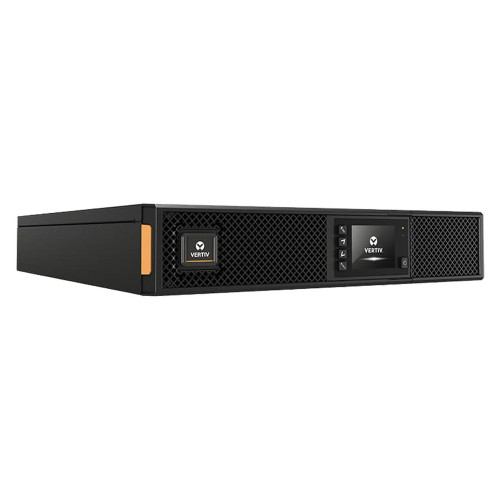
The Vertiv GXT5-500LVRT2UXL is a 2U rack/tower convertible unit measuring 3.5 × 17 × 16 inches and weighing approximately 28 lbs. It provides 6 × NEMA 5-15R outlets, of which 4 are user-programmable for sequenced load shedding. Management interfaces include USB, RS485, and RS232 ports, plus an optional network card slot (RDU101) for SNMP/network management. A color LCD displays real-time load, runtime, voltage, and battery health. The battery is hot-swappable, allowing replacement without powering down connected equipment.
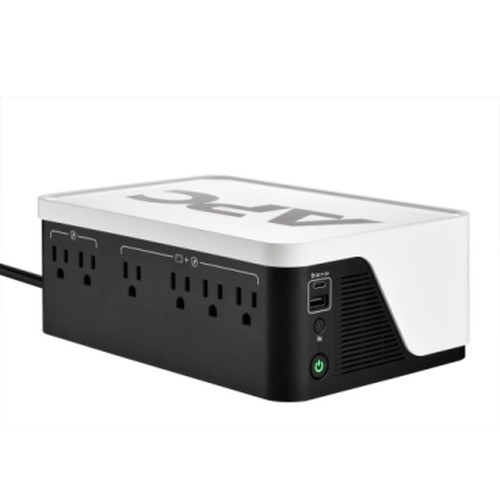
The APC BE500G3 is a desktop tower unit measuring 9.65 × 3.54 × 6.57 inches and weighing 7.185 lbs. It provides 6 × NEMA 5-15R outlets: 4 with battery backup and surge protection, and 2 with surge protection only. A single USB-A charging port (5 VDC, 3A, 15W) is included. Management connectivity is limited to USB-B. No network card slot, RS485, RS232, or LCD display is specified. The battery is not described as hot-swappable.
The GXT5 is purpose-built for rack environments and remote/automated management. The BE500G3 is a lightweight desktop unit with no provision for network management or rack mounting, and its battery replacement requires taking the unit offline per the available specifications.
Which unit offers better efficiency, stronger certifications, and more comprehensive warranty coverage?
The Vertiv GXT5-500LVRT2UXL is rated at greater than 92% efficiency at 50% load and carries Energy Star 2.0 certification alongside UL 1778 (4th edition), CSA 22.2 No. 107.1, WEEE, RoHS2, and REACH. Vertiv provides a 3-year advanced replacement warranty covering both the UPS unit and the battery, with next-business-day shipment. Audible noise is specified at less than 45 dBA at one meter.
The APC BE500G3 carries CEC, Energy Star, and FCC certifications. No efficiency percentage is stated in the provided specifications. APC's warranty terms are not specified in the provided data. Battery recharge time is specified at 10 hours; the GXT5 does not publish a recharge time in the provided specifications.
On certifications, the GXT5 carries a broader set of compliance marks relevant to enterprise IT procurement (UL 1778, CSA, RoHS2, REACH). The GXT5's 3-year advanced replacement warranty with next-business-day shipment is a concrete, documented service commitment; no equivalent warranty data is available for the BE500G3 from the provided specifications.
Which should you choose: the GXT5-500LVRT2UXL or the BE500G3?
Our take: The GXT5-500LVRT2UXL is the stronger choice when protecting IT infrastructure — servers, switches, storage, or network closet equipment — where power-conditioning quality, management depth, and service continuity are non-negotiable. Its online double-conversion topology eliminates the BE500G3's sub-6 ms transfer gap entirely; its output power rating is 500W versus the BE500G3's 300W, a 67% higher usable load ceiling; and its 3-year advanced replacement warranty with next-business-day battery swap provides a documented service SLA the BE500G3 spec sheet does not match. The BE500G3 is a practical, physically compact option for desktop workstations or peripheral protection where rack space is unavailable, budget is constrained, and a standby topology with USB-only management is acceptable. Buyers integrating into a managed rack environment should select the GXT5; buyers protecting a single workstation on a desk should evaluate the BE500G3 on price and footprint.
Side-by-Side Comparison
Spec-for-spec, from manufacturer data.
| Specification | Vertiv GXT5-500LVRT2UXL | APC by Schneider Electric BE500G3 |
|---|---|---|
| UPS Topology | Online Double Conversion | Standby (Offline) |
| VA Capacity | 500 VA | 500 VA |
| Watt Capacity | 500 W | 300 W |
| Form Factor | 2U Rack/Tower Convertible | Desktop Tower |
| Dimensions (H × W × D) | 3.5 × 17 × 16 in | 3.54 × 9.65 × 6.57 in |
| Weight | ~28 lbs | 7.185 lbs |
| Transfer Time | Zero (continuous online) | < 6 ms |
| Total Outlets | 6 × NEMA 5-15R | 6 × NEMA 5-15R |
| Battery-Backed Outlets | 6 (4 programmable) | 4 |
| Surge-Only Outlets | — (not specified separately) | 2 |
| Management Interfaces | USB, RS485, RS232, optional SNMP card slot | USB-B only |
| USB Charging Port | — | 1 × USB-A (5 VDC, 3 A, 15 W) |
| Display | Color LCD (load, runtime, voltage, battery) | — |
| Battery Hot-Swappable | Yes | Not specified |
| Efficiency | > 92% at 50% load (Energy Star 2.0) | Not specified |
| Warranty | 3-year advanced replacement, next-business-day (UPS + battery) | Not specified in provided specs |
Frequently Asked Questions
Which should you choose: the GXT5-500LVRT2UXL or the BE500G3?
The GXT5-500LVRT2UXL is the stronger choice when protecting IT infrastructure — servers, switches, storage, or network closet equipment — where power-conditioning quality, management depth, and service continuity are non-negotiable. Its online double-conversion topology eliminates the BE500G3's sub-6 ms transfer gap entirely; its output power rating is 500W versus the BE500G3's 300W, a 67% higher usable load ceiling; and its 3-year advanced replacement warranty with next-business-day battery swap provides a documented service SLA the BE500G3 spec sheet does not match. The BE500G3 is a practical, physically compact option for desktop workstations or peripheral protection where rack space is unavailable, budget is constrained, and a standby topology with USB-only management is acceptable. Buyers integrating into a managed rack environment should select the GXT5; buyers protecting a single workstation on a desk should evaluate the BE500G3 on price and footprint.
Is the GXT5-500LVRT2UXL or BE500G3 better for protecting a server or network switch?
The GXT5-500LVRT2UXL is the appropriate choice for server and network switch protection. Its online double-conversion topology means connected equipment never sees raw utility power — voltage regulation is continuous with zero transfer time. The BE500G3 uses a standby topology with a transfer time of less than 6 ms, which is sufficient for most desktop equipment but introduces a brief power interruption that sensitive network or storage hardware may not tolerate. The GXT5 also supports SNMP network management via an optional card and provides hot-swappable batteries, both critical for IT infrastructure deployments.
Can either UPS be rack-mounted?
Only the Vertiv GXT5-500LVRT2UXL supports rack mounting. It is a 2U rack/tower convertible unit (3.5 × 17 × 16 inches) designed to install in a standard 19-inch equipment rack or stand vertically as a tower. The APC BE500G3 is a desktop tower unit (9.65 × 3.54 × 6.57 inches) with no rack-mount capability specified in the provided specifications.
How do the two units compare on usable output power — does the 500VA rating mean the same thing for both?
No. Despite both carrying a 500VA load capacity rating, their usable watt output differs significantly. The Vertiv GXT5-500LVRT2UXL is rated at 500W output, meaning the VA and watt ratings are equal (unity power factor). The APC BE500G3 is rated at 300W output against 500VA, reflecting a 0.6 power factor — meaning it can only support 300 watts of real load before overloading, even though the VA figure matches the GXT5. Buyers should size UPS capacity against their equipment's watt draw, not VA alone.
More UPS Comparisons
- Vertiv GXT5-500LVRT2UXL vs APC by Schneider Electric SUA500PDR-H
- Vertiv GXT5-500LVRT2UXL vs APC by Schneider Electric SCL500RM1UC
- Vertiv GXT5-500LVRT2UXL vs APC by Schneider Electric SCL500RMI1UC
- APC by Schneider Electric SUA500PDR-H vs Middle Atlantic S500R
- APC by Schneider Electric SUA500PDR-H vs APC by Schneider Electric BE500G3
- APC by Schneider Electric SUA500PDR-H vs APC by Schneider Electric SCL500RM1UC
UPS Buying Guides
Get a Second Opinion on Your Camera Choice
Share your site layout, coverage goals, and budget. Our team will validate the camera selection, flag anything we would change, and recommend products that match the use case.