
APC by Schneider Electric SRT3000XLW-IEC vs Panduit U03S12V: Specification Comparison
Both the APC by Schneider Electric SRT3000XLW-IEC and the Panduit SteadySine U03S12V are 3000 VA / 2700 W uninterruptible power supplies aimed at protecting critical loads in commercial and enterprise environments. The comparison spans topology and output quality, physical form factor and connectivity, and management depth — three dimensions that typically drive purchasing decisions for UPS equipment at this capacity tier. Neither product is an accessory; both are standalone UPS units of the same rated capacity.
In This Guide
- How do topology, output voltage, and waveform quality differ between the two units?
- How do physical form factor, output receptacles, and input connectivity compare?
- Which unit offers deeper management, runtime flexibility, and broader environmental ratings?
- Which should you choose: the SRT3000XLW-IEC or the U03S12V?
- Side-by-Side Specs
- FAQ
How do topology, output voltage, and waveform quality differ between the two units?
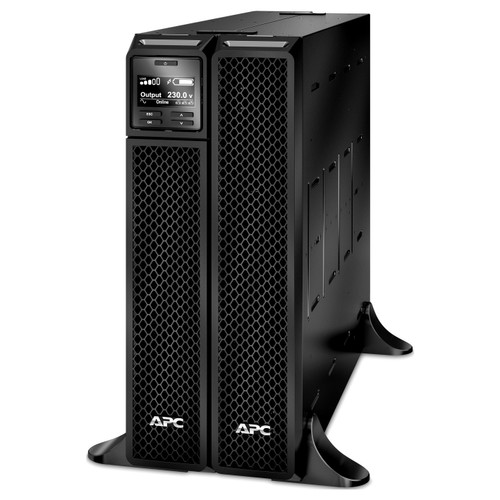
The SRT3000XLW-IEC uses a Double Conversion Online topology, meaning the load runs continuously on inverter-conditioned power with zero transfer time — utility power never reaches the load directly. Output voltage is selectable at 208 V or 230 V (configurable to 220 V or 240 V), targeting international and European 230 V infrastructure. Output voltage distortion is specified at less than 2%, and waveform is sine wave. Load crest factor is rated at 3:1, accommodating non-linear loads. Surge energy rating is 340 joules.
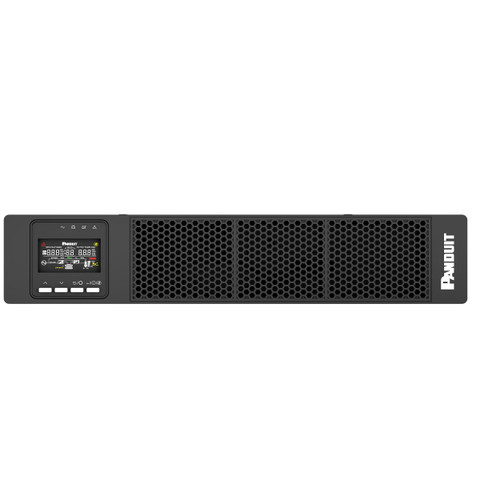
The U03S12V is specified as a line-interactive or standby-with-AVR architecture — the spec sheet lists Automatic Voltage Regulation and a 4 ms typical transfer time, which are characteristic of line-interactive designs, not double-conversion. Output voltage is 120 V AC only, targeting North American single-phase infrastructure. Output waveform is described as True Sine Wave. No output voltage distortion figure, load crest factor, or surge energy rating is provided in the supplied specifications.
For loads requiring absolute zero transfer time and tightly regulated output regardless of utility quality — such as medical equipment, precision test gear, or sensitive switching power supplies — the SRT3000XLW-IEC's double-conversion topology is the stronger architectural choice. The U03S12V's 4 ms transfer time is within the tolerance of most IT equipment but is a meaningful distinction versus zero-transfer online operation.
How do physical form factor, output receptacles, and input connectivity compare?
The SRT3000XLW-IEC is a tower unit measuring 17.0 × 3.3 × 25.0 inches (43.2 × 8.5 × 63.5 cm) and weighing 75 lb packaged. Output connections are 6× IEC 320 C13, 2× IEC 320 C19, and 2× IEC jumpers — all IEC format, appropriate for rack PDUs and international equipment. Input connections include British BS1363A, IEC-320 C20, and Schuko CEE 7/EU1-16P, with an 8-foot (2.4 m) cord. IP rating is IP 20.
The U03S12V is a 2U rack-mount unit measuring 3.4 inches high × 17.3 inches wide (86.5 mm × 440 mm). Output receptacles are 8× NEMA 5-15R (6 battery-backed with surge, 2 surge-only), suited to North American plugs. Input voltage is 120 V AC. Depth and weight are not provided in the supplied specifications. Battery is specified as hot-swappable.
The two units target different physical environments. The SRT3000XLW-IEC is tower-only and uses IEC outlets for international deployments; it does not rack-mount without an optional kit (not specified in the provided data). The U03S12V is purpose-built for 2U rack installation with NEMA receptacles for North American data center environments. Hot-swappable batteries on the U03S12V allow battery replacement without removing load power, a capability not explicitly stated for the SRT3000XLW-IEC in the provided specifications.
Which unit offers deeper management, runtime flexibility, and broader environmental ratings?
The SRT3000XLW-IEC provides RJ45 Serial, SmartSlot (APC's proprietary expansion slot for network management cards), and USB interfaces. It includes a multi-function LCD status and control console. Runtime is extendable via the APC-Smart-UPS-SRT-3000VA-208-230V-IEC extended battery module, with one battery module included. Replacement battery is APCRBC152. Expected battery life is 3–5 years with a 3-hour typical recharge time. Operating range is 0–40°C, 0–95% RH non-condensing, up to 3,000 m elevation. Acoustic noise is 55 dBA at 1 m. Thermal dissipation is 703 BTU/hour. Certifications include UL 1778, CE, FCC Part 15 Class A, ENERGY STAR V1.0 (US and EU), CSA, RCM, VDE, and EAC.
The U03S12V provides USB, 10/100 Ethernet, and SNMP interfaces natively — SNMP is built in without requiring a separate management card. Cold start capability is specified. Operating temperature, humidity range, elevation rating, acoustic noise, thermal dissipation, recharge time, expected battery life, and certifications are not provided in the supplied specifications.
The SRT3000XLW-IEC offers a more fully documented environmental and certification profile, which matters for compliance-driven deployments. Its SmartSlot architecture allows hardware-level network management card upgrades. The U03S12V includes native SNMP and 10/100 Ethernet without an add-on card, which reduces cost and complexity in managed data center environments. Runtime extensibility is documented for the SRT3000XLW-IEC; no equivalent information is present for the U03S12V in the provided specifications.
Which should you choose: the SRT3000XLW-IEC or the U03S12V?
Our take: The SRT3000XLW-IEC is the stronger choice when the deployment requires double-conversion zero-transfer-time protection, international 208/230 V output, or a fully documented compliance and environmental profile. Its Double Conversion Online topology delivers continuous inverter-conditioned output versus the U03S12V's 4 ms transfer time; its output voltage distortion is specified at under 2% while no equivalent figure is provided for the U03S12V; and it carries a published certification stack including UL 1778, ENERGY STAR V1.0, FCC Part 15 Class A, and VDE where the U03S12V's certifications are absent from the provided data. Conversely, the U03S12V is the stronger choice for North American 120 V rack deployments: it is a native 2U rack-mount unit with NEMA 5-15R receptacles, includes built-in SNMP and 10/100 Ethernet without a separate card, and specifies hot-swappable batteries — none of which are offered by the tower-form SRT3000XLW-IEC at this configuration.
Side-by-Side Comparison
Spec-for-spec, from manufacturer data.
| Specification | APC by Schneider Electric SRT3000XLW-IEC | Panduit U03S12V |
|---|---|---|
| UPS Topology | Double Conversion Online | Line-Interactive with AVR (4 ms transfer) |
| Capacity | 3000 VA / 2700 W | 3000 VA / 2700 W |
| Input Voltage | 208 V & 230 V (220/240 V configurable) | 120 V AC |
| Output Voltage | 208 V & 230 V (220/240 V configurable) | 120 V AC |
| Output Waveform | Sine Wave | True Sine Wave |
| Output Voltage Distortion | Less than 2% | — |
| Transfer Time | Zero (online double-conversion) | 4 ms typical |
| Output Connections | 6× IEC 320 C13, 2× IEC 320 C19, 2× IEC Jumpers | 8× NEMA 5-15R (6 battery+surge, 2 surge-only) |
| Form Factor | Tower | 2U Rack-Mount |
| Dimensions (H×W×D) | 3.3 × 17.0 × 25.0 in (8.5 × 43.2 × 63.5 cm) | 3.4 in H × 17.3 in W; depth not specified |
| Battery Type | Sealed Lead-Acid (maintenance-free, leakproof) | Sealed Lead-Acid, hot-swappable |
| Recharge Time | 3 hours typical | — |
| Expected Battery Life | 3–5 years | — |
| Runtime Extendable | Yes (external battery module supported) | — |
| Management Interfaces | RJ45 Serial, SmartSlot, USB | USB, 10/100 Ethernet, SNMP (built-in) |
| Surge Energy Rating | 340 joules | — |
| Operating Temperature | 0 to 40°C | — |
| Certifications | UL 1778, CE, FCC Part 15 Class A, ENERGY STAR V1.0 (US+EU), CSA, RCM, VDE, EAC | — |
Frequently Asked Questions
Which should you choose: the SRT3000XLW-IEC or the U03S12V?
The SRT3000XLW-IEC is the stronger choice when the deployment requires double-conversion zero-transfer-time protection, international 208/230 V output, or a fully documented compliance and environmental profile. Its Double Conversion Online topology delivers continuous inverter-conditioned output versus the U03S12V's 4 ms transfer time; its output voltage distortion is specified at under 2% while no equivalent figure is provided for the U03S12V; and it carries a published certification stack including UL 1778, ENERGY STAR V1.0, FCC Part 15 Class A, and VDE where the U03S12V's certifications are absent from the provided data. Conversely, the U03S12V is the stronger choice for North American 120 V rack deployments: it is a native 2U rack-mount unit with NEMA 5-15R receptacles, includes built-in SNMP and 10/100 Ethernet without a separate card, and specifies hot-swappable batteries — none of which are offered by the tower-form SRT3000XLW-IEC at this configuration.
Can I use either of these UPS units in a standard North American 120 V data center rack?
Only the Panduit U03S12V is specified for 120 V AC input and output with NEMA 5-15R receptacles, making it the appropriate choice for a standard North American 120 V rack environment. The APC SRT3000XLW-IEC is specified for 208 V and 230 V input/output (configurable to 220 V or 240 V) and uses IEC-format receptacles; it is not suitable for direct use on 120 V circuits as configured.
Does the SRT3000XLW-IEC or the U03S12V support SNMP monitoring without buying extra hardware?
The Panduit U03S12V includes 10/100 Ethernet and SNMP interfaces in the base unit per its specifications, requiring no additional hardware for network management. The APC SRT3000XLW-IEC provides a SmartSlot expansion slot and USB/RJ45 Serial ports in the base unit, but SNMP capability typically requires the purchase and installation of a separate APC SmartSlot network management card — the provided specifications do not indicate built-in SNMP.
Which unit is better suited for environments where load power cannot be interrupted during battery replacement?
The Panduit U03S12V specifies hot-swappable batteries, meaning batteries can be replaced without powering down the load. The APC SRT3000XLW-IEC specifications provided do not explicitly state hot-swap battery capability. Buyers for whom zero-downtime battery maintenance is a hard requirement should confirm hot-swap capability directly with APC before specifying the SRT3000XLW-IEC.
More UPS Comparisons
- APC by Schneider Electric SMT3000RMI2U vs Vertiv GXT5-3000LVRT2UXL
- APC by Schneider Electric SMT3000RMI2U vs Panduit U03N11L
- APC by Schneider Electric SMT3000RMI2U vs Panduit U03N12L
- APC by Schneider Electric SMT3000RMI2U vs Panduit U03S12V
- APC by Schneider Electric SMT3000RMI2U vs APC by Schneider Electric SRT3000XLT
- APC by Schneider Electric SMT3000RMI2U vs APC by Schneider Electric SRT3000XLW-IEC
UPS Buying Guides
Get a Second Opinion on Your Camera Choice
Share your site layout, coverage goals, and budget. Our team will validate the camera selection, flag anything we would change, and recommend products that match the use case.