
APC by Schneider Electric SMX3000LVNCUS vs APC by Schneider Electric SMTL3000RM2UCNC: Specification Comparison
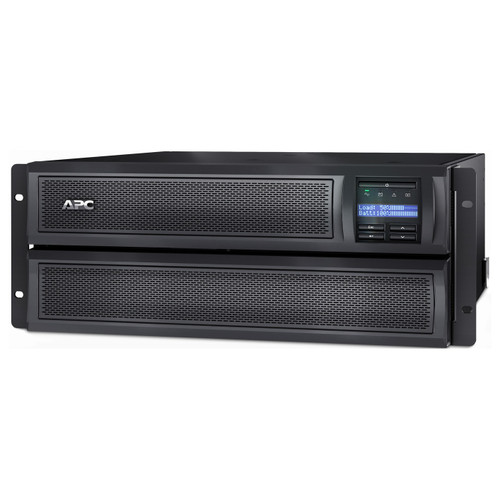
Both the SMX3000LVNCUS and SMTL3000RM2UCNC are APC Smart-UPS line-interactive, sine-wave, 3 kVA-class uninterruptible power supplies designed for rack or tower deployment in IT and light industrial environments. The comparison centers on the SMX3000LVNCUS (a traditional lead-acid-chemistry unit with TAA compliance) against the SMTL3000RM2UCNC (a lithium-ion rackmount model). Key decision axes are power and input tolerance, battery chemistry and efficiency, and outlet configuration with management interfaces.
In This Guide
- Which UPS handles a wider input voltage range and delivers usable output capacity?
- How do battery technology, efficiency, and acoustic footprint compare between these two models?
- Which model offers more flexibility in outlet configuration and management connectivity?
- Which should you choose: the SMX3000LVNCUS or the SMTL3000RM2UCNC?
- Side-by-Side Specs
- FAQ
Which UPS handles a wider input voltage range and delivers usable output capacity?
The SMX3000LVNCUS accepts input from 70 V to 153 V — a 83 V span — while the SMTL3000RM2UCNC operates from 82 V to 144 V, a narrower 62 V span. The lower minimum of 70 V on the SMX3000LVNCUS means it can ride through deeper voltage sags before switching to battery, which is a meaningful advantage in environments with poor power quality or frequent brownouts.
On output capacity, the SMTL3000RM2UCNC is rated at 3.0 kVA versus 2.88 kVA for the SMX3000LVNCUS, though both deliver identical 2700 W real power. The rated output voltage is 120 V for both. Both units support 50/60 Hz input and output frequency, and both produce a true sine waveform — critical for active PFC power supplies common in servers and network equipment.
The SMX3000LVNCUS documents Automatic Voltage Regulation (AVR) and specifies output THD at 5%, providing a concrete power-quality guarantee. The SMTL3000RM2UCNC specifies output voltage regulation at 5% but does not list AVR or THD explicitly in the provided specs. The SMX3000LVNCUS also documents a surge energy rating of 540 J versus 459 J for the SMTL3000RM2UCNC — an 18% advantage in surge absorption capacity.
How do battery technology, efficiency, and acoustic footprint compare between these two models?
The most structurally significant difference between these two units is battery chemistry. The SMTL3000RM2UCNC uses lithium-ion (Li-ion) cells, as indicated by its product name and SKU designation ('LI'). The SMX3000LVNCUS uses traditional valve-regulated lead-acid (VRLA) battery technology, which is the conventional choice but carries a heavier weight profile and typically shorter service intervals. The provided specs for the SMX3000LVNCUS do not state battery chemistry explicitly; lithium-ion is confirmed only for the SMTL3000RM2UCNC.
The SMTL3000RM2UCNC specifies a rated efficiency of 96%, which is a strong figure for line-interactive topology at this power level. The SMX3000LVNCUS does not include an efficiency figure in the provided specifications, so a direct numeric comparison cannot be made.
Both units list a 55 dB acoustic figure, though the context differs: the SMX3000LVNCUS lists it as EMI/RFI noise filtering attenuation (55 dB), while the SMTL3000RM2UCNC lists 55 dB as audible noise level. These are measuring different phenomena — EMI filtering depth versus operational sound pressure level — and should not be treated as equivalent values.
Which model offers more flexibility in outlet configuration and management connectivity?
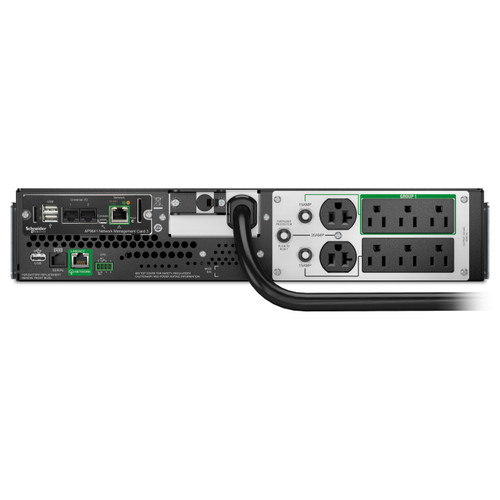
The SMTL3000RM2UCNC explicitly lists 8 AC outlets comprising NEMA 5-15R and NEMA 5-20R receptacles, supporting both standard 15 A and higher-density 20 A loads. It also documents USB and serial (RS-232) interface ports. The SMX3000LVNCUS does not specify outlet count, outlet types, or individual interface ports in the provided specifications.
The SMX3000LVNCUS documents web-based management capability, Emergency Power Off (EPO), and overload protection. None of these three features are confirmed in the SMTL3000RM2UCNC's provided specs. EPO is particularly relevant in data center and raised-floor environments where a single switch must cut power to an entire rack or room under emergency conditions.
The SMX3000LVNCUS carries TAA (Trade Agreements Act) compliance per its product title, making it eligible for US federal government procurement. TAA status is not stated for the SMTL3000RM2UCNC in the provided specifications. Buyers with government contracts or GSA schedule requirements should treat TAA compliance as a hard filter.
Which should you choose: the SMX3000LVNCUS or the SMTL3000RM2UCNC?
Our take: The SMX3000LVNCUS is the stronger choice when input voltage tolerance, surge protection margin, EPO capability, and TAA compliance are the primary requirements — particularly for government, mission-critical, or poor-power-quality environments. Its 70 V minimum input versus 82 V on the SMTL3000RM2UCNC provides substantially more brownout ride-through, and its 540 J surge rating exceeds the SMTL3000RM2UCNC's 459 J by 18%. It also explicitly supports EPO and web-based management, which the SMTL3000RM2UCNC does not confirm in the provided specs. Conversely, the SMTL3000RM2UCNC is the stronger choice for space-constrained rack deployments where lithium-ion battery advantages — longer service life, lighter weight, and the documented 96% efficiency rating — outweigh the SMX3000LVNCUS's broader input tolerance. Its 8 documented AC outlets with mixed NEMA 5-15R/5-20R coverage also offer concrete load-connection flexibility the SMX3000LVNCUS specs do not confirm.
Side-by-Side Comparison
Spec-for-spec, from manufacturer data.
| Specification | APC by Schneider Electric SMX3000LVNCUS | APC by Schneider Electric SMTL3000RM2UCNC |
|---|---|---|
| UPS Topology | Line-Interactive | Line-Interactive |
| Output Power Capacity | 2.88 kVA | 3.0 kVA |
| Output Power (Watts) | 2700 W | 2700 W |
| Waveform | Sine | Sine |
| Input Voltage Min | 70 V | 82 V |
| Input Voltage Max | 153 V | 144 V |
| Input Frequency | 50/60 Hz | 50/60 Hz |
| Output Voltage | 120 V | 120 V |
| Surge Energy Rating | 540 J | 459 J |
| Efficiency | — | 96% |
| Battery Chemistry | — | Lithium-ion |
| AC Outlets | — | 8 (NEMA 5-15R, NEMA 5-20R) |
| USB Port | — | Yes |
| Serial Interface | — | Yes |
| Web-Based Management | Yes | — |
| Emergency Power Off (EPO) | Yes | — |
| TAA Compliant | Yes | — |
| AVR | Yes | — |
| Output THD | 5% | — |
Frequently Asked Questions
Which should you choose: the SMX3000LVNCUS or the SMTL3000RM2UCNC?
The SMX3000LVNCUS is the stronger choice when input voltage tolerance, surge protection margin, EPO capability, and TAA compliance are the primary requirements — particularly for government, mission-critical, or poor-power-quality environments. Its 70 V minimum input versus 82 V on the SMTL3000RM2UCNC provides substantially more brownout ride-through, and its 540 J surge rating exceeds the SMTL3000RM2UCNC's 459 J by 18%. It also explicitly supports EPO and web-based management, which the SMTL3000RM2UCNC does not confirm in the provided specs. Conversely, the SMTL3000RM2UCNC is the stronger choice for space-constrained rack deployments where lithium-ion battery advantages — longer service life, lighter weight, and the documented 96% efficiency rating — outweigh the SMX3000LVNCUS's broader input tolerance. Its 8 documented AC outlets with mixed NEMA 5-15R/5-20R coverage also offer concrete load-connection flexibility the SMX3000LVNCUS specs do not confirm.
Is the SMX3000LVNCUS or SMTL3000RM2UCNC better for a data center with unstable utility power?
Based on the provided specs, the SMX3000LVNCUS tolerates a lower minimum input voltage of 70 V versus 82 V for the SMTL3000RM2UCNC, giving it a wider brownout tolerance. It also carries a higher surge energy rating of 540 J versus 459 J. For environments with frequent voltage sags or surges, the SMX3000LVNCUS holds a spec-documented advantage on both counts.
Does either UPS qualify for US federal government purchases?
The SMX3000LVNCUS is explicitly described as TAA (Trade Agreements Act) compliant in its product title, which is a requirement for most US federal government and GSA schedule procurement. TAA compliance is not stated in the provided specifications for the SMTL3000RM2UCNC. Buyers with federal procurement requirements should verify TAA status directly with the supplier before ordering the SMTL3000RM2UCNC.
Which model is a better fit for a high-density rackmount installation with multiple server loads?
The SMTL3000RM2UCNC documents 8 AC outlets with both NEMA 5-15R and NEMA 5-20R receptacle types, supporting a mix of standard and higher-current devices. It is a 2U rackmount form factor and uses lithium-ion batteries, which are lighter than lead-acid and can reduce rack weight. It also specifies 96% efficiency, reducing heat load in dense installations. The SMX3000LVNCUS does not confirm outlet count or types in the provided specs, making the SMTL3000RM2UCNC the more documentably suited option for dense rackmount scenarios based on available data.
More UPS Comparisons
- APC by Schneider Electric SMT3000RMT2U vs Panduit U03S12L
- APC by Schneider Electric SMT3000RMT2U vs Vertiv GXT5-3KL620RT2UXL
- APC by Schneider Electric SMT3000RMT2U vs Vertiv GXT5-3KL630RT2UXL
- APC by Schneider Electric SMT3000RMT2U vs Panduit U03N11V
- APC by Schneider Electric SMT3000RMT2U vs APC by Schneider Electric SMTL3000RM2UCNC
- APC by Schneider Electric SMT3000RMT2U vs APC by Schneider Electric SMX3000HV
UPS Buying Guides
Get a Second Opinion on Your Camera Choice
Share your site layout, coverage goals, and budget. Our team will validate the camera selection, flag anything we would change, and recommend products that match the use case.