
APC by Schneider Electric SMX3000HV vs Vertiv GXT5-3KL630RT2UXL: Specification Comparison
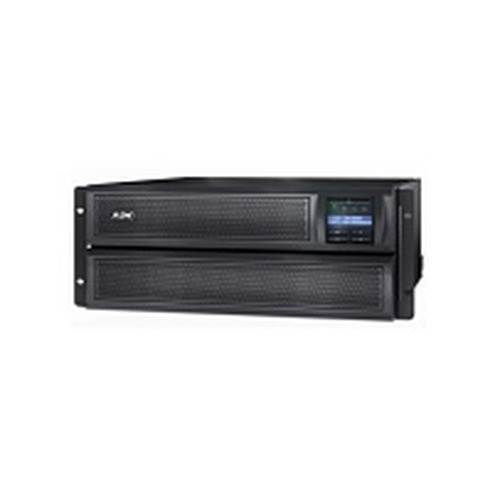
Both the APC SMX3000HV and the Vertiv GXT5-3KL630RT2UXL are 3 kVA rack/tower UPS units aimed at IT closets, edge deployments, and small data center rows requiring conditioned power for servers, networking gear, and storage. The comparison spans topology, power conditioning quality, physical footprint, management interfaces, and certifications — the dimensions that most directly drive purchasing decisions in a B2B infrastructure context.
In This Guide
- Which UPS topology and output power quality best matches the load's criticality requirements?
- How do efficiency, input voltage range, and hold-time specs affect operating costs and ride-through capability?
- Which unit offers broader management integration and carries the certifications needed for the deployment environment?
- Which should you choose: the SMX3000HV or the GXT5-3KL630RT2UXL?
- Side-by-Side Specs
- FAQ
Which UPS topology and output power quality best matches the load's criticality requirements?
The SMX3000HV is a Line-Interactive UPS. Under normal utility conditions it passes conditioned power through AVR (Automatic Voltage Regulation is listed as Yes) without inverting; the inverter only engages on transfer to battery. It delivers a true sine-wave output and lists a crest factor of 3:1, which supports non-linear loads such as switched-mode power supplies. Rated output is 3 kVA / 2,700 W, giving a power factor of 0.90.
The GXT5-3KL630RT2UXL uses an On-line double-conversion topology. In this architecture, the inverter is always active: incoming utility power is continuously rectified and re-inverted, producing a fully regenerated output waveform at all times. There is no transfer time to battery because the inverter never disengages. Rated output is 3,000 VA / 3,000 W, yielding a unity (1.0) power factor. Waveform type is not explicitly stated in the provided specs, but double-conversion topology inherently produces a sine-wave output.
The topology difference is the most consequential spec in this comparison. Line-Interactive suits moderately sensitive loads where a short transfer window (the SMX3000HV specifies 2–10 ms hold time) is acceptable. On-line double conversion, as in the GXT5, eliminates transfer time entirely and provides continuous isolation from all utility anomalies — frequency deviations, voltage distortion, and switching transients — making it the specification of choice for highly sensitive or always-on loads.
How do efficiency, input voltage range, and hold-time specs affect operating costs and ride-through capability?
The SMX3000HV specifies 98.5% efficiency (mode not qualified in the provided specs). Its input operational voltage range is 140 V to 280 V, giving it broad tolerance for fluctuating utility supply. Input frequency accepts 50/60 Hz. Surge energy absorption is rated at 645 J. Hold time on transfer is listed as a minimum of 2 ms and a maximum of 10 ms; actual battery runtime at load is not provided in the supplied specs.
The GXT5-3KL630RT2UXL specifies up to 98% efficiency in Active ECO Mode and up to 95% efficiency in on-line (double-conversion) mode. ECO Mode periodically bypasses the inverter to save energy; whether this is acceptable depends on site power quality and IT policy. Input voltage range is listed as '208 VAC nominal; variable based on output load' — a narrower, less precisely bounded specification than the APC's 140–280 V window. No surge joule rating, hold time, or battery runtime figure is provided in the supplied specs.
At full on-line efficiency, the SMX3000HV's 98.5% edges the GXT5's 95% on-line figure, translating to measurably lower heat dissipation and operating cost over multi-year deployments. However, if the GXT5 is run in ECO Mode, its up-to-98% rating narrows that gap significantly — at the cost of reduced isolation. The SMX3000HV's explicitly bounded 140–280 V input range provides a concrete tolerance specification; the GXT5's input range description is qualified and load-dependent, limiting direct comparison.
Which unit offers broader management integration and carries the certifications needed for the deployment environment?
The SMX3000HV provides Emergency Power Off (EPO) capability, which is listed in the specs. Noise level is specified at 55 dB. No network interface, communications card, protocol, or connector wiring detail is present in the supplied specifications for the SMX3000HV.
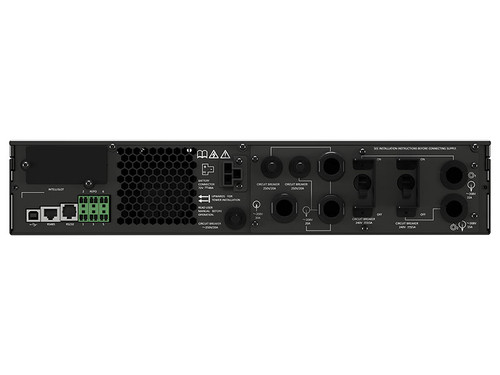
The GXT5-3KL630RT2UXL lists a substantially more detailed management profile. Interfaces include USB, RS485, RS232, a terminal block, and an external battery connector. An optional Vertiv RDU101 SNMP/Web card enables SNMP and web-based management. The control panel is described as a full-color graphic LCD with gravity-sensing orientation. Certifications listed are ENERGY STAR 2.0, UL1778, c-UL, RoHS2, and REACH. Input wiring is L6-30P; outputs are 2× L6-15R and 2× L6-30R. EPO capability is not mentioned in the provided GXT5 specs.
For deployments requiring remote power monitoring, DCIM integration, or green-building compliance, the GXT5's documented interface set and ENERGY STAR 2.0 / UL1778 certifications provide explicit, verifiable evidence. The SMX3000HV's EPO feature is valuable for facilities with emergency shutdown requirements, but its management interface details and certifications are absent from the supplied specifications and cannot be assumed.
Which should you choose: the SMX3000HV or the GXT5-3KL630RT2UXL?
Our take: The GXT5-3KL630RT2UXL is the stronger choice when load criticality demands zero transfer time and a continuously regenerated output waveform, while the SMX3000HV is the stronger choice for cost-sensitive deployments where line-interactive protection is sufficient and a broader input voltage window (140–280 V vs. a nominally stated 208 V) matters. Three concrete spec deltas: (1) topology — on-line double-conversion (GXT5) vs. line-interactive (SMX3000HV), with a 2–10 ms transfer gap on the APC; (2) on-line efficiency — 98.5% (SMX3000HV, unqualified) vs. 95% on-line / up to 98% ECO Mode (GXT5); (3) output power factor — 1.0 / 3,000 W (GXT5) vs. 0.90 / 2,700 W (SMX3000HV). Buyers powering virtualization hosts, storage arrays, or medical-adjacent gear should favor the GXT5's double-conversion isolation; buyers prioritizing efficiency and wide input tolerance for general IT closets should evaluate the SMX3000HV.
Side-by-Side Comparison
Spec-for-spec, from manufacturer data.
| Specification | APC by Schneider Electric SMX3000HV | Vertiv GXT5-3KL630RT2UXL |
|---|---|---|
| UPS Topology | Line-Interactive | On-line double conversion |
| Power Rating (VA) | 3,000 VA | 3,000 VA |
| Power Rating (W) | 2,700 W | 3,000 W |
| Output Power Factor | 0.90 | 1.00 |
| Output Waveform | Sine wave | Not stated in provided specs |
| Efficiency (primary mode) | 98.5% | Up to 95% (on-line) |
| Efficiency (ECO/alt mode) | — | Up to 98% (Active ECO Mode) |
| Input Voltage Range | 140–280 V | 208 VAC nominal; variable by load |
| Output Voltage Range | 208–240 V | 208 VAC |
| Input Frequency | 50/60 Hz | — |
| AVR (Auto Voltage Regulation) | Yes | Inherent (double-conversion) |
| Transfer / Hold Time | 2–10 ms | 0 ms (on-line; no transfer) |
| Surge Energy Rating | 645 J | — |
| Emergency Power Off (EPO) | Yes | Not stated in provided specs |
| Management Interfaces | Not stated in provided specs | USB, RS485, RS232, terminal block; optional SNMP/Web card |
| Certifications | Not stated in provided specs | ENERGY STAR 2.0, UL1778, c-UL, RoHS2, REACH |
| Noise Level | 55 dB | — |
| Weight | — | 65.1 lb |
| Dimensions (H × W × D) | — | 3.4 × 16.9 × 21.3 in |
| Operating Temperature | — | +32 to +122 °F (0 to +50 °C) |
Frequently Asked Questions
Which should you choose: the SMX3000HV or the GXT5-3KL630RT2UXL?
The GXT5-3KL630RT2UXL is the stronger choice when load criticality demands zero transfer time and a continuously regenerated output waveform, while the SMX3000HV is the stronger choice for cost-sensitive deployments where line-interactive protection is sufficient and a broader input voltage window (140–280 V vs. a nominally stated 208 V) matters. Three concrete spec deltas: (1) topology — on-line double-conversion (GXT5) vs. line-interactive (SMX3000HV), with a 2–10 ms transfer gap on the APC; (2) on-line efficiency — 98.5% (SMX3000HV, unqualified) vs. 95% on-line / up to 98% ECO Mode (GXT5); (3) output power factor — 1.0 / 3,000 W (GXT5) vs. 0.90 / 2,700 W (SMX3000HV). Buyers powering virtualization hosts, storage arrays, or medical-adjacent gear should favor the GXT5's double-conversion isolation; buyers prioritizing efficiency and wide input tolerance for general IT closets should evaluate the SMX3000HV.
Does the APC SMX3000HV or the Vertiv GXT5-3KL630RT2UXL provide better protection against power disturbances like sags, surges, and frequency shifts?
The Vertiv GXT5-3KL630RT2UXL provides stronger isolation from all utility anomalies because its on-line double-conversion topology continuously re-generates the output waveform regardless of what is happening on the input. The APC SMX3000HV uses line-interactive topology with AVR, which corrects voltage sags and surges without switching to battery, but a transfer window of 2–10 ms exists when utility power fails entirely. For loads sensitive to any power event — including frequency deviations and switching transients — the double-conversion architecture of the GXT5 is the more protective specification.
Which UPS is more energy-efficient to run continuously in a rack environment?
Based on the provided specifications, the SMX3000HV lists 98.5% efficiency (mode not qualified). The GXT5 lists up to 95% efficiency in on-line double-conversion mode and up to 98% in Active ECO Mode. If both units are compared in their primary protective operating mode, the SMX3000HV's 98.5% figure is higher than the GXT5's 95% on-line figure. The GXT5 can approach 98% in ECO Mode, but ECO Mode periodically engages bypass and reduces isolation. The GXT5 also carries an ENERGY STAR 2.0 certification; no equivalent certification is listed in the SMX3000HV's provided specs.
Can either UPS be monitored and managed remotely over a network?
The GXT5-3KL630RT2UXL's provided specifications document USB, RS485, RS232, a terminal block, and an optional Vertiv RDU101 SNMP/Web card that enables SNMP and web management. Remote network monitoring is therefore a documented, available capability for the GXT5. The SMX3000HV's provided specifications do not list any network interface, communications card, or SNMP capability. No conclusion about remote management for the SMX3000HV can be drawn from the supplied data.
More UPS Comparisons
- APC by Schneider Electric SMT3000RMT2U vs Panduit U03S12L
- APC by Schneider Electric SMT3000RMT2U vs Vertiv GXT5-3KL620RT2UXL
- APC by Schneider Electric SMT3000RMT2U vs Vertiv GXT5-3KL630RT2UXL
- APC by Schneider Electric SMT3000RMT2U vs Panduit U03N11V
- APC by Schneider Electric SMT3000RMT2U vs APC by Schneider Electric SMTL3000RM2UCNC
- APC by Schneider Electric SMT3000RMT2U vs APC by Schneider Electric SMX3000HV
UPS Buying Guides
Get a Second Opinion on Your Camera Choice
Share your site layout, coverage goals, and budget. Our team will validate the camera selection, flag anything we would change, and recommend products that match the use case.