
APC by Schneider Electric SMTL3000RM2UCNC vs APC by Schneider Electric SMX3000HV: Specification Comparison
Both the SMTL3000RM2UCNC and SMX3000HV are APC Smart-UPS Line-Interactive units rated at 3 kVA / 2700 W with true sine-wave output — the same capacity class and topology a buyer would legitimately cross-shop. The critical fork is voltage domain: the SMTL3000RM2UCNC targets North American 120 V single-phase loads in a compact 2U rackmount, while the SMX3000HV is built for 208–240 V environments in a 4U rack/tower chassis. This comparison examines input/output voltage compatibility, protective features and efficiency, and physical/interface fit for the intended rack environment.
In This Guide
- Which unit matches your facility's input voltage and protected-load voltage requirements?
- How do the two units compare on surge protection, efficiency, and additional protective features?
- Which unit better fits your rack space, battery chemistry, and management interface needs?
- Which should you choose: the SMTL3000RM2UCNC or the SMX3000HV?
- Side-by-Side Specs
- FAQ
Which unit matches your facility's input voltage and protected-load voltage requirements?
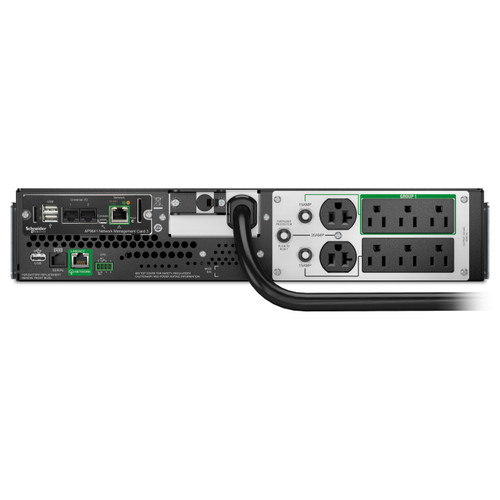
The SMTL3000RM2UCNC accepts a 120 V North American single-phase feed with an operating input window of 82–144 V, and delivers regulated 120 V output via eight outlets (NEMA 5-15R and NEMA 5-20R). Its wide low-end input tolerance — accepting as low as 82 V — gives strong brownout ride-through before the battery engages. All protected loads must be 120 V NEMA-compatible.
The SMX3000HV is engineered for higher-voltage environments, accepting 140–280 V input and delivering 208–240 V output. This positions it for international deployments, North American 208 V two-phase circuits common in data centers, or regions with 230 V utility standards. Output voltage range (208–240 V) and outlet configuration are not specified in the provided data beyond the voltage window. Buyers feeding 120 V North American circuits cannot use this unit without a transformer.
How do the two units compare on surge protection, efficiency, and additional protective features?
The SMX3000HV leads on efficiency at 98.5% versus the SMTL3000RM2UCNC's 96%. Over continuous near-full-load operation, a 2.5-percentage-point efficiency gap translates to measurable heat and energy cost differences at scale. The SMX3000HV also carries the higher surge energy rating at 645 J, compared to 459 J for the SMTL3000RM2UCNC — a 40% advantage in transient absorption capacity.
The SMX3000HV adds two features absent from the SMTL3000RM2UCNC's spec sheet: Emergency Power Off (EPO), which is a code requirement in many data-center and raised-floor environments, and a documented hold time of 2–10 ms, confirming seamless transfer. The SMX3000HV also lists a 3:1 crest factor, indicating tolerance for nonlinear load peaks. Automatic Voltage Regulation (AVR) is explicitly called out for the SMX3000HV; it is not listed as a discrete spec for the SMTL3000RM2UCNC, though its line-interactive topology implies active AVR. Output voltage regulation of ±5% is specified for the SMTL3000RM2UCNC; this figure is not provided for the SMX3000HV.
Which unit better fits your rack space, battery chemistry, and management interface needs?
The SMTL3000RM2UCNC occupies 2U of rack space and uses lithium-ion battery chemistry — a significant operational differentiator. Lithium-ion typically offers longer service life, reduced weight, and faster recharge versus traditional VRLA. The SMX3000HV is a 4U rack/tower unit; battery chemistry is not specified in the provided data.
For connectivity, the SMTL3000RM2UCNC specifies both a USB port and a serial interface, enabling direct management integration with servers and network management cards. The SMX3000HV's management interface options are not captured in the provided specifications. Noise level is identical at 55 dB for both units. The SMTL3000RM2UCNC explicitly lists eight AC outlets; outlet count and type for the SMX3000HV are not provided in the available spec data.
Which should you choose: the SMTL3000RM2UCNC or the SMX3000HV?
Our take: The SMTL3000RM2UCNC is the stronger choice when protecting 120 V North American loads in space-constrained racks where lithium-ion battery longevity and a compact 2U footprint matter. Its input window drops to 82 V — far lower than the SMX3000HV's 140 V floor — providing superior brownout tolerance on marginal utility circuits. Conversely, the SMX3000HV is the only viable option for 208–240 V load environments, and it outperforms on efficiency (98.5% vs. 96%), surge absorption (645 J vs. 459 J), and adds EPO — a hard requirement in many data-center build-outs. These are not competing substitutes for the same circuit: voltage domain determines which unit is even applicable. Within their respective voltage classes, the SMX3000HV's efficiency and protection depth favor high-density data-center rows, while the SMTL3000RM2UCNC suits 120 V IT closets and SMB server rooms where lithium-ion chemistry reduces maintenance cycles.
Side-by-Side Comparison
Spec-for-spec, from manufacturer data.
| Specification | APC by Schneider Electric SMTL3000RM2UCNC | APC by Schneider Electric SMX3000HV |
|---|---|---|
| UPS Topology | Line-Interactive | Line-Interactive |
| Output Power Capacity | 3 kVA | 3 kVA |
| Output Power (Watts) | 2700 W | 2700 W |
| Output Waveform | Sine | Sine |
| Input Voltage Range | 82–144 V | 140–280 V |
| Input Frequency | 50/60 Hz | 50/60 Hz |
| Output Voltage | 120 V | 208–240 V |
| Output Frequency | 50/60 Hz | 50/60 Hz |
| Efficiency | 96% | 98.5% |
| Surge Energy Rating | 459 J | 645 J |
| Noise Level | 55 dB | 55 dB |
| Output Voltage Regulation | ±5% | — |
| Battery Chemistry | Lithium-ion | — |
| Form Factor / Rack Height | Rackmount 2U | Rack/Tower 4U |
| AC Outlets | 8 (NEMA 5-15R, NEMA 5-20R) | — |
| Emergency Power Off (EPO) | — | Yes |
| USB / Serial Interface | USB + Serial | — |
| Crest Factor | — | 3:1 |
| Hold Time | — | 2–10 ms |
Frequently Asked Questions
Which should you choose: the SMTL3000RM2UCNC or the SMX3000HV?
The SMTL3000RM2UCNC is the stronger choice when protecting 120 V North American loads in space-constrained racks where lithium-ion battery longevity and a compact 2U footprint matter. Its input window drops to 82 V — far lower than the SMX3000HV's 140 V floor — providing superior brownout tolerance on marginal utility circuits. Conversely, the SMX3000HV is the only viable option for 208–240 V load environments, and it outperforms on efficiency (98.5% vs. 96%), surge absorption (645 J vs. 459 J), and adds EPO — a hard requirement in many data-center build-outs. These are not competing substitutes for the same circuit: voltage domain determines which unit is even applicable. Within their respective voltage classes, the SMX3000HV's efficiency and protection depth favor high-density data-center rows, while the SMTL3000RM2UCNC suits 120 V IT closets and SMB server rooms where lithium-ion chemistry reduces maintenance cycles.
Can I use the SMX3000HV to protect standard 120 V North American servers and network gear?
No. The SMX3000HV's specified input range starts at 140 V and its output is 208–240 V, making it incompatible with 120 V NEMA loads without an additional step-down transformer. The SMTL3000RM2UCNC, with its 82–144 V input window and 120 V NEMA output, is the correct unit for standard North American single-phase circuits.
Is the SMTL3000RM2UCNC or SMX3000HV better for a high-density data-center row with 208 V PDUs and an EPO requirement?
The SMX3000HV is the appropriate choice. It is designed for 208–240 V infrastructure, carries a higher surge rating (645 J vs. 459 J), delivers better efficiency (98.5% vs. 96%), and explicitly includes Emergency Power Off (EPO) — which is frequently mandated by electrical codes for raised-floor data-center installations. EPO is not listed in the SMTL3000RM2UCNC specifications.
What is the battery chemistry difference between these two models, and does it affect replacement cycles?
The SMTL3000RM2UCNC uses lithium-ion batteries, which typically offer longer service life, lighter weight, and faster recharge compared to traditional valve-regulated lead-acid (VRLA) batteries. Battery chemistry for the SMX3000HV is not specified in the available product data, so a direct comparison on replacement interval cannot be made from the provided specifications alone.
More UPS Comparisons
- APC by Schneider Electric SMT3000RMT2U vs Panduit U03S12L
- APC by Schneider Electric SMT3000RMT2U vs Vertiv GXT5-3KL620RT2UXL
- APC by Schneider Electric SMT3000RMT2U vs Vertiv GXT5-3KL630RT2UXL
- APC by Schneider Electric SMT3000RMT2U vs Panduit U03N11V
- APC by Schneider Electric SMT3000RMT2U vs APC by Schneider Electric SMTL3000RM2UCNC
- APC by Schneider Electric SMT3000RMT2U vs APC by Schneider Electric SMX3000HV
UPS Buying Guides
Get a Second Opinion on Your Camera Choice
Share your site layout, coverage goals, and budget. Our team will validate the camera selection, flag anything we would change, and recommend products that match the use case.