
APC by Schneider Electric G35T15KH4B4S vs APC by Schneider Electric SURT15KRMXLT-1TF10K: Specification Comparison
Both the APC MGE Galaxy 3500 G35T15KH4B4S and the APC Smart-UPS RT SURT15KRMXLT-1TF10K are three-phase/high-power UPS systems rated at 15 kVA / 12 kW, placing them squarely in the same capacity class for data-center and critical-infrastructure power protection. The Galaxy 3500 targets 400 V three-phase European/international installations, while the Smart-UPS RT targets North American 208 V environments with a bundled step-down transformer. Both are online double-conversion candidates, though topology is explicitly confirmed only for Product B.
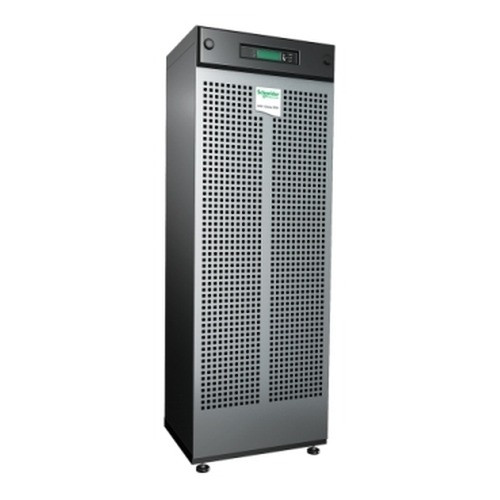
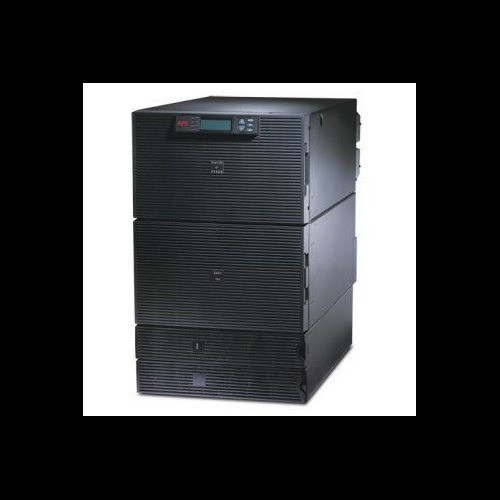
In This Guide
- How do the power architecture and electrical specifications differ between these two 15 kVA UPS systems?
- Which unit offers better battery recharge performance and how do their battery subsystems compare?
- How do the two units compare on physical footprint, output connectivity, and remote management capabilities?
- Which should you choose: the G35T15KH4B4S or the SURT15KRMXLT-1TF10K?
- Side-by-Side Specs
- FAQ
How do the power architecture and electrical specifications differ between these two 15 kVA UPS systems?
Both units share an identical kVA/kW rating: 15 kVA output capacity and 12,000 W real power. Input frequency acceptance is identical at 40–70 Hz on both models, confirming compatibility with both 50 Hz and 60 Hz utility grids.
The G35T15KH4B4S is specified for a 400 V input environment (three-phase European/international), with a maximum input current of 20 A per phase. The SURT15KRMXLT-1TF10K is built for 208 V North American infrastructure, with a substantially higher maximum input current of 83 A per phase — consistent with single-phase or split-phase 208 V feeds at equivalent power levels. The Smart-UPS RT spec explicitly states a Double Conversion Online topology, sine-wave output, and output frequency of 50/60 Hz ±3 Hz (user-adjustable). Topology is not stated in the G35T15KH4B4S spec data provided.
The SURT15KRMXLT-1TF10K declares full-load efficiency of 93%, online thermal dissipation of 2,610 Btu/h, input THD of less than 5% at full load, and a crest factor of 3:1. None of these electrical performance figures appear in the G35T15KH4B4S spec data provided. The Smart-UPS RT also includes a built-in static bypass and overload ride-through: 60 seconds at 125% load and 30 seconds at 150% load — no equivalent overload spec is listed for the Galaxy 3500.
Which unit offers better battery recharge performance and how do their battery subsystems compare?
Both units ship with four battery modules (RBC quantity: 4 for the SURT15KRMXLT-1TF10K; replacement battery cartridge quantity: 4 for the G35T15KH4B4S) and use sealed lead-acid (VRLA / Lead-Acid) chemistry.
Recharge time differs meaningfully: the G35T15KH4B4S specifies a 5-hour recharge time, while the SURT15KRMXLT-1TF10K specifies a faster 2.5-hour typical recharge time — a 2× advantage for the Smart-UPS RT in recovering full runtime capacity after a discharge event. The Smart-UPS RT also states battery charge power of 1,530 W rated, battery voltage of ±192 V (split, referenced to neutral), and end-of-discharge voltage of ±154 V; none of these battery-circuit figures are provided for the Galaxy 3500.
The SURT15KRMXLT-1TF10K specifies a battery life expectancy of 3–5 years. No battery life expectancy figure is provided for the G35T15KH4B4S. The Smart-UPS RT also confirms one extendable run-time slot and zero empty battery slots in the base configuration, indicating a fully populated out-of-box runtime. Runtime extension capability for the Galaxy 3500 is not stated in the provided specs.
How do the two units compare on physical footprint, output connectivity, and remote management capabilities?
Physical dimensions are provided only for the SURT15KRMXLT-1TF10K: 27.87 in H × 17.01 in W × 30.43 in D (70.8 × 43.2 × 77.3 cm), 16U rack-mount form factor, net weight 347.73 kg. The G35T15KH4B4S is significantly heavier at 627 kg — nearly 1.8× the weight of the Smart-UPS RT — and no rack-unit height or dimensional data is provided in its spec sheet, suggesting a tower or floor-standing enclosure consistent with its MGE Galaxy 3500 product line.
Output connectivity is detailed only for the SURT15KRMXLT-1TF10K: 2× NEMA L5-20R, 4× NEMA L6-20R, 2× NEMA L6-30R, 2× NEMA L14-30R receptacles, plus one hard-wire 4-wire (2PH+N+G) output connector. The main output voltages are 120 V and 208 V, with 220 V and 240 V also listed. Output connector types for the G35T15KH4B4S are not specified in the provided data.
Remote management is confirmed for the SURT15KRMXLT-1TF10K via a pre-installed Network Management Card 2 (SmartSlot), full-time multi-pole noise filtering, IEEE surge let-through of 0.3%, and zero-clamping response time. The G35T15KH4B4S lists Emergency Power Off (EPO) capability and certifications including CE, EN 50091-2, EN/IEC 62040-3, EN/IEC 62040-1-1, IEC 61000-3-2, IEC 61000-3-3, ISO 14001, ISO 9001, and VFI-SS-111. No management card or network interface is mentioned in the Galaxy 3500 spec data provided. IP protection rating (IP20) is stated only for the Smart-UPS RT.
Which should you choose: the G35T15KH4B4S or the SURT15KRMXLT-1TF10K?
Our take: The SURT15KRMXLT-1TF10K is the stronger choice when the installation is a North American 208 V rack-based data center requiring fast battery recovery, confirmed double-conversion online topology, and out-of-box remote monitoring. Key spec deltas: the Smart-UPS RT recharges in 2.5 hours versus 5 hours for the Galaxy 3500 — a 2× advantage for sites with frequent power events; it ships with a pre-installed Network Management Card 2 while no equivalent management interface is listed for the Galaxy 3500; and its 16U rack-mount form factor and 347.73 kg weight make it far more practical for server-room deployment than the Galaxy 3500's 627 kg floor-standing mass. Conversely, the G35T15KH4B4S is the appropriate selection for 400 V three-phase European or international infrastructure where its certification suite (CE, IEC 62040, ISO 14001/9001, VFI-SS-111) and EPO capability align with local regulatory and facility requirements.
Side-by-Side Comparison
Spec-for-spec, from manufacturer data.
| Specification | APC by Schneider Electric G35T15KH4B4S | APC by Schneider Electric SURT15KRMXLT-1TF10K |
|---|---|---|
| SKU / Model | G35T15KH4B4S | SURT15KRMXLT-1TF10K |
| Product Line | MGE Galaxy 3500 | Smart-UPS RT |
| Output Capacity | 15 kVA | 15,000 VA |
| Real Power Output | 12,000 W | 12,000 W |
| Input Voltage | 400 V (3-phase) | 208 V / 240 V |
| Input Frequency | 40–70 Hz | 40–70 Hz auto-sensing |
| Max Input Current | 20 A | 83 A per phase |
| Topology | — | Double Conversion Online |
| Output Frequency | — | 50/60 Hz ±3 Hz (user-adjustable) |
| Full-Load Efficiency | — | 93% |
| Acoustic Noise Level | 51.3 dB | 50 dBA |
| Battery Technology | Sealed Lead Acid (VRLA) | Lead-Acid |
| Included Battery Modules | 4 | 4 |
| Battery Recharge Time | 5 h | 2.5 h (typical) |
| Battery Life Expectancy | — | 3–5 years |
| Form Factor / Weight | 627 kg (form factor not stated) | 16U rack-mount, 347.73 kg |
| Dimensions (H × W × D) | — | 70.8 × 43.2 × 77.3 cm |
| Output Connectors | — | 2× L5-20R, 4× L6-20R, 2× L6-30R, 2× L14-30R |
| Emergency Power Off (EPO) | Yes | — |
| Network Management | — | Pre-installed NMC2 (SmartSlot) |
| Static Bypass | — | Built-in |
| IP Protection Rating | — | IP20 |
| Operating Temperature | 0–40 °C | 0–40 °C |
| Storage Temperature | -15–45 °C | -15–45 °C |
| Operating Humidity | 0–95% | 0–95% non-condensing |
| Warranty | — | 2 years repair or replace |
| Certifications | CE, EN 50091-2, EN/IEC 62040-3, EN/IEC 62040-1-1, IEC 61000-3-2, IEC 61000-3-3, ISO 14001, ISO 9001, VFI-SS-111 | — |
Frequently Asked Questions
Which should you choose: the G35T15KH4B4S or the SURT15KRMXLT-1TF10K?
The SURT15KRMXLT-1TF10K is the stronger choice when the installation is a North American 208 V rack-based data center requiring fast battery recovery, confirmed double-conversion online topology, and out-of-box remote monitoring. Key spec deltas: the Smart-UPS RT recharges in 2.5 hours versus 5 hours for the Galaxy 3500 — a 2× advantage for sites with frequent power events; it ships with a pre-installed Network Management Card 2 while no equivalent management interface is listed for the Galaxy 3500; and its 16U rack-mount form factor and 347.73 kg weight make it far more practical for server-room deployment than the Galaxy 3500's 627 kg floor-standing mass. Conversely, the G35T15KH4B4S is the appropriate selection for 400 V three-phase European or international infrastructure where its certification suite (CE, IEC 62040, ISO 14001/9001, VFI-SS-111) and EPO capability align with local regulatory and facility requirements.
Is the G35T15KH4B4S or SURT15KRMXLT-1TF10K better for a North American rack-mount data center?
The SURT15KRMXLT-1TF10K is the purpose-built choice for North American rack environments. It is rated for 208 V input, occupies 16U of rack space, ships with NEMA receptacles (L5-20R, L6-20R, L6-30R, L14-30R), and includes a pre-installed Network Management Card 2. The G35T15KH4B4S is specified for 400 V three-phase input and its provided specs list no rack-unit height or NEMA output connectors, indicating it is designed for a different electrical infrastructure.
Which UPS gets back to full battery charge faster after a power outage?
The SURT15KRMXLT-1TF10K specifies a typical recharge time of 2.5 hours, compared to 5 hours for the G35T15KH4B4S — making the Smart-UPS RT twice as fast at restoring full runtime capacity. Both units include four battery modules, but the Smart-UPS RT's faster recharge is a meaningful advantage in environments that experience repeated or prolonged utility disturbances.
Does either unit include built-in remote monitoring or network management out of the box?
Yes — the SURT15KRMXLT-1TF10K ships with a pre-installed APC Network Management Card 2 in its SmartSlot, enabling remote monitoring and management without additional hardware. The G35T15KH4B4S spec data provided does not list any network management card or interface, though it does include Emergency Power Off (EPO) capability. Buyers requiring out-of-box SNMP or web-based UPS monitoring should note this distinction.
More UPS Comparisons
- APC by Schneider Electric E3SUPS15KFBS vs Vertiv GXT5-15KMVRT11UXLN
- APC by Schneider Electric E3SUPS15KFBS vs APC by Schneider Electric SURT15KRMXLT-1TF10K
- APC by Schneider Electric E3SUPS15KFBS vs APC by Schneider Electric SUVTP15KF2B2S
- APC by Schneider Electric SURT15KRMXLT-1TF10K vs Vertiv GXT5-15KMVRT11UXLN
- APC by Schneider Electric SURT15KRMXLT-1TF10K vs APC by Schneider Electric SUVTP15KF2B2S
- APC by Schneider Electric SUVTP15KF2B2S vs Vertiv GXT5-15KMVRT11UXLN
UPS Buying Guides
Get a Second Opinion on Your Camera Choice
Share your site layout, coverage goals, and budget. Our team will validate the camera selection, flag anything we would change, and recommend products that match the use case.