
APC by Schneider Electric G35T15KH4B4S vs APC by Schneider Electric E3SUPS15KFBS: Specification Comparison
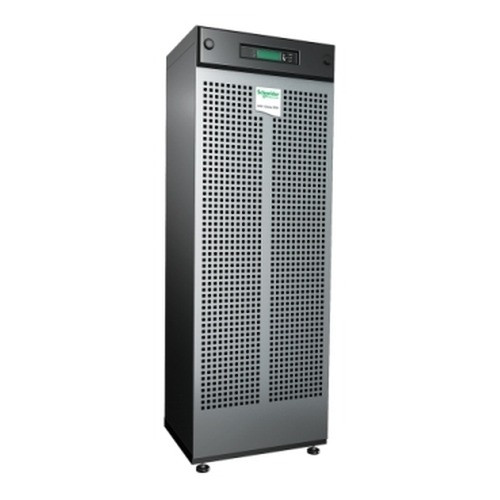
The G35T15KH4B4S (MGE Galaxy 3500) and E3SUPS15KFBS (Easy UPS 3S) are both three-phase, 15 kVA uninterruptible power supply systems from APC by Schneider Electric, targeting data center electrical rooms and critical infrastructure. Both employ double-conversion or online UPS topologies at the same power tier, making them genuine cross-shop candidates for facilities engineers and IT buyers specifying three-phase UPS protection for server rooms, network closets, or industrial environments requiring consistent runtime and power conditioning at the 15 kVA class.
In This Guide
- How do the two UPS units compare on real power delivery, output voltage, and load handling?
- What are the differences in battery design, recharge capability, and expandability between these two units?
- How do the two units differ in weight, environmental ratings, acoustic output, and installation footprint?
- Which should you choose: the G35T15KH4B4S or the E3SUPS15KFBS?
- Side-by-Side Specs
- FAQ
How do the two UPS units compare on real power delivery, output voltage, and load handling?
The G35T15KH4B4S is rated at 15 kVA / 12,000 W output, implying an output power factor of 0.80. Its output voltage is not explicitly stated in the provided specs, but its input is documented at 400 V. The E3SUPS15KFBS is rated at 15 kVA / 15,000 W, reflecting a unity (1.0) output power factor—confirmed by the rated power parity between VA and W figures. Its output voltage is specified as 208 V AC (with 380 V and 415 V listed as other output voltages), and it supports a load power factor range of 0.9 leading to 0.9 lagging with a cos phi of 0.99.
For buyers whose loads demand maximum watt delivery within a 15 kVA frame, the E3SUPS15KFBS provides 15,000 W versus the G35T15KH4B4S's 12,000 W—a 25% real-power advantage at the same VA rating. Input harmonic distortion on the E3SUPS15KFBS is less than 3% at full load, and output harmonic distortion is less than 3% for linear loads; the G35T15KH4B4S does not provide equivalent THD figures in the supplied specs.
What are the differences in battery design, recharge capability, and expandability between these two units?
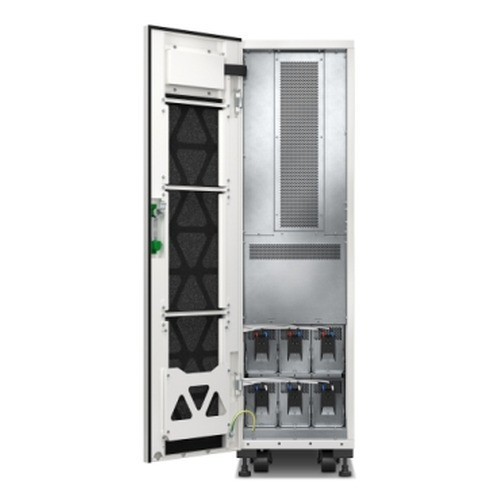
The G35T15KH4B4S uses sealed lead-acid (VRLA) technology with four replacement battery cartridges specified and a documented recharge time of 5 hours. The E3SUPS15KFBS also uses VRLA batteries (battery voltage 240 V DC system; DC system voltage 120 V), includes zero internal battery modules at shipment, and provides three empty battery slots for user-installed battery modules—making it a shell-and-slot architecture rather than a pre-populated system.
This architectural difference is critical for buyers: the G35T15KH4B4S ships with its battery complement included and a defined 5-hour recharge window, whereas the E3SUPS15KFBS requires separate battery module procurement to achieve any runtime. No recharge time is specified for the E3SUPS15KFBS in the provided data. Buyers who need an immediately operational unit with predictable runtime should note this distinction; those who prefer to right-size battery capacity separately may favor the E3SUPS15KFBS's modular approach.
Neither unit's runtime duration at specific load levels is provided in the supplied specifications.
How do the two units differ in weight, environmental ratings, acoustic output, and installation footprint?
The G35T15KH4B4S is substantially heavier at 627 kg versus the E3SUPS15KFBS at 112 kg (145 kg packaged). This difference—more than 5:1—has direct implications for floor loading, logistics, and installation crew requirements. The G35T15KH4B4S is rated for operation at 0–40 °C with operating altitude up to 999.9 m (approximately 3,280 ft); the E3SUPS15KFBS supports operation to 40 °C (104 °F) and up to 3,333 ft (approximately 1,016 m), making the two essentially equivalent on thermal and altitude operating envelopes.
Acoustic output differs: the G35T15KH4B4S measures 51.3 dB, while the E3SUPS15KFBS is rated at 60 dBA—nearly 9 dB louder, which is perceptible in noise-sensitive environments. Storage altitude for the E3SUPS15KFBS reaches 15,240 m (49,213 ft) versus 15,000 m for the G35T15KH4B4S, a negligible practical difference. Both carry IP20 ingress protection (stated for E3SUPS15KFBS; not specified for G35T15KH4B4S). The E3SUPS15KFBS includes an Emergency Power Off feature not mentioned in its specs; the G35T15KH4B4S explicitly documents EPO support. The E3SUPS15KFBS dissipates 852 W of heat; no equivalent figure is provided for the G35T15KH4B4S. The E3SUPS15KFBS supports an optional network management card (NMC3) for remote monitoring; no network management option is specified for the G35T15KH4B4S in the provided data.
Which should you choose: the G35T15KH4B4S or the E3SUPS15KFBS?
Our take: The E3SUPS15KFBS is the stronger choice when maximum real-power delivery, manageable physical weight, and network management capability are the primary requirements. Its 15,000 W output versus the G35T15KH4B4S's 12,000 W represents a 25% real-power advantage within the same 15 kVA frame—directly impacting how much IT load can be protected. At 112 kg versus 627 kg, the E3SUPS15KFBS is dramatically easier to install and relocate, reducing rigging and structural costs. The G35T15KH4B4S, however, ships with four battery cartridges installed and a documented 5-hour recharge time, making it immediately deployable with known runtime characteristics—the E3SUPS15KFBS ships with zero batteries and requires separate module procurement. The G35T15KH4B4S also runs quieter at 51.3 dB versus 60 dBA. Specify the G35T15KH4B4S for sites needing an integrated, ready-to-run system with lower acoustic output; specify the E3SUPS15KFBS where higher watt capacity, easier installation, and optional remote monitoring via NMC3 are prioritized.
Side-by-Side Comparison
Spec-for-spec, from manufacturer data.
| Specification | APC by Schneider Electric G35T15KH4B4S | APC by Schneider Electric E3SUPS15KFBS |
|---|---|---|
| Rated Power (VA) | 15 kVA | 15 kVA |
| Rated Power (W) | 12,000 W | 15,000 W |
| Output Power Factor | 0.80 (derived) | 1.00 (15 kW / 15 kVA) |
| Input Voltage | 400 V | 380 / 400 / 415 V AC 3-phase |
| Output Voltage | Not specified | 208 V AC (also 380 / 415 V) |
| Input Frequency | 40–70 Hz | 70 Hz |
| Maximum Input Current | 20 A | 28 A |
| Input Harmonic Distortion | — | < 3% at full load |
| Battery Technology | Sealed Lead Acid (VRLA) | VRLA |
| Included Batteries | 4 cartridges | 0 modules (3 empty slots) |
| Battery Recharge Time | 5 h | — |
| Noise Level | 51.3 dB | 60 dBA |
| Weight | 627 kg | 112 kg |
| Operating Temperature | 0–40 °C | 0–40 °C (104 °F) |
| Operating Altitude | 0–999.9 m (~3,280 ft) | 0–3,333 ft (~1,016 m) |
| Network Management | — | Optional NMC3 |
| EPO Support | Yes | — |
| Heat Dissipation | — | 852 W |
| Certifications | CE, EN 50091-2, EN/IEC 62040-3, IEC 61000-3-2, ISO 14001, ISO 9001, VFI-SS-111 | CE, EAC, RCM |
| Color | Black | White (RAL 9003) |
Frequently Asked Questions
Which should you choose: the G35T15KH4B4S or the E3SUPS15KFBS?
The E3SUPS15KFBS is the stronger choice when maximum real-power delivery, manageable physical weight, and network management capability are the primary requirements. Its 15,000 W output versus the G35T15KH4B4S's 12,000 W represents a 25% real-power advantage within the same 15 kVA frame—directly impacting how much IT load can be protected. At 112 kg versus 627 kg, the E3SUPS15KFBS is dramatically easier to install and relocate, reducing rigging and structural costs. The G35T15KH4B4S, however, ships with four battery cartridges installed and a documented 5-hour recharge time, making it immediately deployable with known runtime characteristics—the E3SUPS15KFBS ships with zero batteries and requires separate module procurement. The G35T15KH4B4S also runs quieter at 51.3 dB versus 60 dBA. Specify the G35T15KH4B4S for sites needing an integrated, ready-to-run system with lower acoustic output; specify the E3SUPS15KFBS where higher watt capacity, easier installation, and optional remote monitoring via NMC3 are prioritized.
Which unit can support heavier watt loads — the G35T15KH4B4S or the E3SUPS15KFBS?
The E3SUPS15KFBS supports 15,000 W at its 15 kVA rating (unity power factor), while the G35T15KH4B4S delivers 12,000 W at 15 kVA (0.80 power factor). If your load approaches or exceeds 12 kW, the E3SUPS15KFBS has the margin; the G35T15KH4B4S would be overloaded at those levels within the same VA class.
Does the E3SUPS15KFBS come with batteries included, or do I need to buy them separately?
Per the provided specifications, the E3SUPS15KFBS ships with zero included battery modules and has three empty battery slots. Batteries must be procured and installed separately. The G35T15KH4B4S, by contrast, specifies four replacement battery cartridges and a 5-hour recharge time, indicating batteries are part of the unit's defined configuration.
Is the G35T15KH4B4S or E3SUPS15KFBS easier to install in an existing electrical room?
The E3SUPS15KFBS is substantially easier to handle physically, weighing 112 kg (145 kg packaged) versus the G35T15KH4B4S at 627 kg. The weight difference has significant implications for floor load ratings, rigging requirements, and installation labor. If your facility has floor load constraints or limited rigging access, the E3SUPS15KFBS is the more practical choice from a logistics standpoint.
More UPS Comparisons
- APC by Schneider Electric E3SUPS15KFBS vs Vertiv GXT5-15KMVRT11UXLN
- APC by Schneider Electric E3SUPS15KFBS vs APC by Schneider Electric SURT15KRMXLT-1TF10K
- APC by Schneider Electric E3SUPS15KFBS vs APC by Schneider Electric SUVTP15KF2B2S
- APC by Schneider Electric SURT15KRMXLT-1TF10K vs Vertiv GXT5-15KMVRT11UXLN
- APC by Schneider Electric SURT15KRMXLT-1TF10K vs APC by Schneider Electric SUVTP15KF2B2S
- APC by Schneider Electric SUVTP15KF2B2S vs Vertiv GXT5-15KMVRT11UXLN
UPS Buying Guides
Get a Second Opinion on Your Camera Choice
Share your site layout, coverage goals, and budget. Our team will validate the camera selection, flag anything we would change, and recommend products that match the use case.