
Allied Telesis IE340-20GP-980 vs Allied Telesis GS970M/18PS-R-10: Specification Comparison
Both the AT-IE340-20GP-980 and the AT-GS970M/18PS-R-10 are Allied Telesis 16-port Gigabit PoE switches with four-port SFP uplinks reduced to two on the GS970M, sharing the same copper port count and similar PoE power budgets. Installers evaluating either for IP camera, access control, or wireless AP deployments will find the core port density identical but diverge sharply on form factor, enclosure rating, cooling method, input power, and uplink count — making the choice primarily about deployment environment and infrastructure architecture rather than raw port capacity.
In This Guide
- Which switch delivers more usable PoE power and how do their uplink options compare?
- Which switch is better suited to harsh or space-constrained installation environments?
- How do the two switches compare on throughput performance and total power consumption?
- Which should you choose: the IE340-20GP-980 or the GS970M/18PS-R-10?
- Side-by-Side Specs
- FAQ
Which switch delivers more usable PoE power and how do their uplink options compare?
The AT-GS970M/18PS-R-10 edges out the AT-IE340-20GP-980 on raw PoE budget: 247W versus 240W — a 7W difference that is unlikely to be decisive in practice. Both switches support 16 PoE-enabled copper ports, both can power up to 16 devices at 15W simultaneously, and both can power up to 8 devices at 30W simultaneously. The IE340-20GP-980 spec sheet designates its PoE capability as PoE++ (the 'POE++: 16' and 'POE+: 16' entries), while the GS970M/18PS-R-10 spec sheet designates PoE+. Whether the IE340's PoE++ designation extends to 60W or 90W per-port IEEE 802.3bt delivery is not confirmed in the provided specs beyond the 240W aggregate budget, so installers requiring high-wattage single-port delivery (e.g., pan-tilt cameras or PoE-powered APs above 30W) should verify per-port maximums against the full datasheet before specifying.
On uplinks, the IE340-20GP-980 provides four 100/1000X SFP ports, doubling the GS970M/18PS-R-10's two SFP ports. For deployments requiring dual-fiber redundancy plus two additional uplinks — or aggregation to a core switch via multiple fiber runs — the IE340's four-port SFP array is a meaningful structural advantage. The GS970M's two SFP ports support standard redundant uplink configurations but leave no headroom for additional trunk links without additional switching hardware.
Which switch is better suited to harsh or space-constrained installation environments?
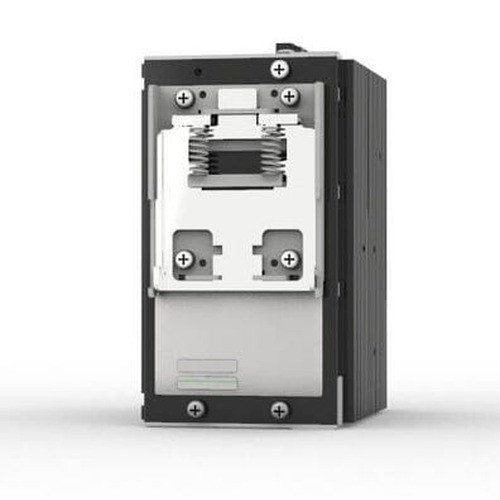
The AT-IE340-20GP-980 is purpose-built for industrial and field deployments. Its aluminum/sheet metal enclosure carries an IP30 ingress protection rating, it is entirely fanless, and it accepts a wide 18–57V DC input — accommodating battery-backed DC plant, solar power systems, or 24V/48V industrial power rails common in transportation, utility, and outdoor-cabinet applications. Its DIN rail mount (also wall-mountable per the weight entries) and compact 91×139×153mm footprint make it viable inside control cabinets, junction boxes, and equipment enclosures where rack space is unavailable. The DIN rail configuration weighs 2.34 kg; wall-mount configuration 2.23 kg.
The AT-GS970M/18PS-R-10 is a conventional rack-mount unit at 341×231×44mm (approximately 1U), drawing standard AC power (input voltage type not specified in the provided specs). It is actively cooled, rated at 34 dBA noise — audible but within normal IT-room tolerance. Its packaged dimensions are 43×36×15cm. The GS970M is suited to wiring closets, server rooms, and structured-cabling environments where conditioned AC power and rack infrastructure are available. It is not rated for harsh environments, and no IP rating is provided in the supplied specs. The IE340's fanless design also eliminates a mechanical failure point relevant in unmanned remote sites.
How do the two switches compare on throughput performance and total power consumption?
The IE340-20GP-980 posts a 40Gbps switching fabric and 29.7Mpps forwarding rate. The GS970M/18PS-R-10 posts 36Gbps and 26.8Mpps. For 16-port Gigabit deployments the theoretical non-blocking line-rate requirement is 32Gbps; both switches exceed it, though the IE340's 40Gbps fabric provides a larger headroom margin. The 2.9Mpps forwarding rate difference (29.7 vs 26.8) is measurable but unlikely to be a bottleneck in camera or access-control traffic profiles.
On total power consumption the picture reverses: the GS970M/18PS-R-10 draws up to 330W maximum versus the IE340-20GP-980's 271W — a 59W difference. Heat dissipation follows the same pattern: 169 BTU/hr for the GS970M against 105.8 BTU/hr for the IE340. For deployments with tight power budgets, limited cooling capacity in enclosures, or UPS runtime constraints, the IE340's lower consumption is a tangible operational advantage. Installers sizing UPS or DC power plant should note these maximum figures represent worst-case full-PoE-load draw.
Which should you choose: the IE340-20GP-980 or the GS970M/18PS-R-10?
Our take: The IE340-20GP-980 is the stronger choice when the installation environment demands industrial robustness, DC power compatibility, or DIN rail mounting. Its IP30-rated fanless aluminum enclosure, 18–57V DC wide-range input, and 91×139×153mm DIN rail form factor address deployment scenarios — outdoor cabinets, transit shelters, utility sites, or cramped field enclosures — where the GS970M/18PS-R-10's rack-mount AC-powered design simply does not fit. The IE340 also delivers four SFP uplinks versus two, a 40Gbps versus 36Gbps fabric, and 29.7Mpps versus 26.8Mpps forwarding at 59W lower maximum consumption and 63.2 BTU/hr less heat dissipation. The GS970M/18PS-R-10 edges ahead on raw PoE budget (247W vs 240W) and is the appropriate specification for standard wiring-closet or server-room rack deployments with conditioned AC power. Platform qualifier: confirm PoE++ per-port wattage limits on the IE340 datasheet if powering devices above 30W.
Side-by-Side Comparison
Spec-for-spec, from manufacturer data.
| Specification | Allied Telesis IE340-20GP-980 | Allied Telesis GS970M/18PS-R-10 |
|---|---|---|
| Copper RJ-45 Ports (10/100/1000T) | 16 | 16 |
| SFP Uplink Ports | 4 × 100/1000X | 2 × 100/1000X |
| Total Ports | 20 | 18 |
| PoE-Enabled Ports | 16 | 16 |
| PoE Standard | PoE++ | PoE+ |
| Max PoE Power Budget | 240W | 247W |
| Max PoE Ports at 15W | 16 | 16 |
| Max PoE Ports at 30W | 8 | 8 |
| Switching Fabric | 40Gbps | 36Gbps |
| Forwarding Rate | 29.7Mpps | 26.8Mpps |
| Max Power Consumption | 271W | 330W |
| Max Heat Dissipation | 105.8 BTU/hr | 169 BTU/hr |
| Cooling | Fanless | Active fan (34 dBA) |
| Input Voltage | 18–57V DC | Not specified in provided specs |
| Enclosure / IP Rating | Aluminum, IP30 | Not specified in provided specs |
| Form Factor / Mount | DIN Rail (also wall-mount) | Rack-mount (1U, 341×231×44mm) |
| Weight | 2.34 kg (DIN) / 2.23 kg (wall) | 4.35 kg |
Frequently Asked Questions
Which should you choose: the IE340-20GP-980 or the GS970M/18PS-R-10?
The IE340-20GP-980 is the stronger choice when the installation environment demands industrial robustness, DC power compatibility, or DIN rail mounting. Its IP30-rated fanless aluminum enclosure, 18–57V DC wide-range input, and 91×139×153mm DIN rail form factor address deployment scenarios — outdoor cabinets, transit shelters, utility sites, or cramped field enclosures — where the GS970M/18PS-R-10's rack-mount AC-powered design simply does not fit. The IE340 also delivers four SFP uplinks versus two, a 40Gbps versus 36Gbps fabric, and 29.7Mpps versus 26.8Mpps forwarding at 59W lower maximum consumption and 63.2 BTU/hr less heat dissipation. The GS970M/18PS-R-10 edges ahead on raw PoE budget (247W vs 240W) and is the appropriate specification for standard wiring-closet or server-room rack deployments with conditioned AC power. Platform qualifier: confirm PoE++ per-port wattage limits on the IE340 datasheet if powering devices above 30W.
Is the IE340-20GP-980 or the GS970M/18PS-R-10 better for an outdoor cabinet or transit shelter installation?
The IE340-20GP-980 is the appropriate choice. It carries an IP30 enclosure rating, operates on 18–57V DC (compatible with battery-backed or solar DC power plant), is fanless (no moving parts to fail in unmanned sites), and mounts on DIN rail inside a compact 91×139×153mm footprint. The GS970M/18PS-R-10 is a rack-mount unit with active cooling and no IP rating listed in its provided specs, making it suited to conditioned indoor environments rather than field enclosures.
Which switch gives me more fiber uplink capacity for trunk or redundancy runs?
The IE340-20GP-980 provides four 100/1000X SFP ports, while the GS970M/18PS-R-10 provides two SFP ports. If your design requires dual-redundant fiber trunks plus additional uplink capacity — for example, linking to two separate core switches or adding a monitoring tap — the IE340's four-port SFP array accommodates that without additional hardware. For a single redundant fiber pair, either switch meets the requirement.
Which switch has the higher PoE power budget, and does it matter for my camera deployment?
The GS970M/18PS-R-10 has a marginally higher PoE budget at 247W versus 240W for the IE340-20GP-980 — a 7W difference. In practice, both switches power 16 devices at 15W or 8 devices at 30W simultaneously, so for standard IP camera and access-point mixes the difference is unlikely to be decisive. If you are powering devices above 30W per port (IEEE 802.3bt class), verify the IE340's per-port PoE++ maximum against its full datasheet, as that figure is not confirmed in the provided specs beyond the 240W aggregate.
More Network Switch Comparisons
- Vivotek GEL-205A-260 vs TP-Link SL1218MP
- Vivotek GEL-205A-260 vs Allied Telesis AT-x530L-18GHXm-10
- Vivotek GEL-205A-260 vs Ubiquiti USW-LITE-16-POE
- Vivotek GEL-205A-260 vs Ubiquiti USW-16-POE
- TP-Link SL1218MP vs Allied Telesis AT-x530L-18GHXm-10
- TP-Link SL1218MP vs Ubiquiti USW-LITE-16-POE
Network Switch Buying Guides
Get a Second Opinion on Your Camera Choice
Share your site layout, coverage goals, and budget. Our team will validate the camera selection, flag anything we would change, and recommend products that match the use case.