
Allied Telesis AT-x530L-28GPX-901 vs Ubiquiti USW-ENTERPRISE-24-POE: Specification Comparison
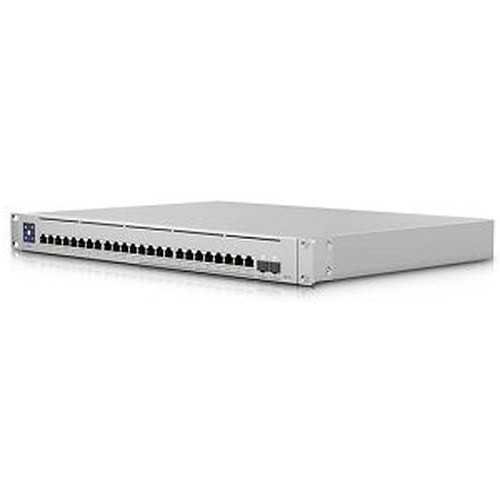
Both the Allied Telesis AT-x530L-28GPX-901 and the Ubiquiti USW-ENTERPRISE-24-POE are 1U rack-mount, 24-port managed PoE switches targeting enterprise LAN edge deployments—cameras, APs, and IP endpoints. The Allied Telesis unit leads on raw PoE power budget and switching fabric, while the Ubiquiti unit introduces 2.5G copper ports and NDAA compliance. This comparison covers PoE capacity, switching performance, and management/compliance attributes to help installers and IT buyers place the right switch for their specific deployment.
In This Guide
- Which switch delivers more PoE headroom for powering cameras, APs, and other edge devices?
- How do the two switches compare on throughput, forwarding rate, and uplink architecture?
- Which switch better supports enterprise management, stacking, compliance, and environmental requirements?
- Which should you choose: the AT-x530L-28GPX-901 or the USW-ENTERPRISE-24-POE?
- Side-by-Side Specs
- FAQ
Which switch delivers more PoE headroom for powering cameras, APs, and other edge devices?
The AT-x530L-28GPX-901 provides a 740 W total PoE budget across all 24 ports, with per-port support for 802.3af (7.5 W and 15.4 W) and 802.3at PoE+ (30 W). No PoE++ (60 W or 90 W) is listed in the provided specs. At a full 30 W per port, the 740 W budget supports up to approximately 24 simultaneous PoE+ devices before hitting the ceiling.
The USW-ENTERPRISE-24-POE provides a 400 W total PoE budget across 24 ports, also rated at IEEE 802.3af/at (up to 30 W per port). No PoE++ capability is listed in the provided specs. The 400 W budget supports fewer simultaneous high-draw devices; at 30 W per port, roughly 13 ports can run at full PoE+ load simultaneously.
For deployments with high-density PTZ cameras, multi-radio APs, or other 25–30 W endpoints, the AT-x530L-28GPX-901's 740 W budget—85% greater than the USW-ENTERPRISE-24-POE's 400 W—provides substantially more headroom before power budgeting constrains port assignments. The Ubiquiti unit's 400 W budget remains adequate for moderate-density AP or fixed-camera deployments where average per-port draw is well below the 30 W ceiling.
How do the two switches compare on throughput, forwarding rate, and uplink architecture?
The AT-x530L-28GPX-901 is specced at a 128 Gbps switching fabric with a 95.2 Mpps forwarding rate. Latency is documented at 6.06 µs at 100 Mbps, 3.98 µs at 1 Gbps, and 1.63 µs at 10 Gbps. Uplinks consist of 4 × 10G SFP+ ports. The 24 copper ports are all 10/100/1000T (RJ-45); no multi-gig copper (2.5G/5G) is listed in the provided specs.
The USW-ENTERPRISE-24-POE is specced at a 124 Gbps switching capacity with a stated non-blocking throughput of 62 Gbps and a 92 Mpps forwarding rate. No latency figures are provided in the supplied specs. Uplinks consist of 2 × 10G SFP+ ports. Critically, all 24 PoE copper ports support 2.5G/1G speeds—providing up to 2.5 Gbps per edge port versus 1 Gbps on the Allied Telesis unit.
The AT-x530L-28GPX-901 edges out the USW-ENTERPRISE-24-POE on switching fabric (128 Gbps vs. 124 Gbps) and forwarding rate (95.2 Mpps vs. 92 Mpps), and offers twice the SFP+ uplink count (4 vs. 2). However, the USW-ENTERPRISE-24-POE's 2.5G copper ports are a meaningful differentiator for endpoints that can leverage multi-gig speeds—such as Wi-Fi 6/6E APs or high-resolution NVRs with 2.5G NICs—where 1G copper on the AT-x530L-28GPX-901 would be the bottleneck.
Which switch better supports enterprise management, stacking, compliance, and environmental requirements?
The AT-x530L-28GPX-901 includes 2 stacking ports, enabling switch stacking for unified management of multiple units—a capability not listed in the USW-ENTERPRISE-24-POE specs. The Allied Telesis unit is described as a managed switch. Housing color is listed as white. Operating temperature range and certifications are not provided in the supplied specs. Max noise is listed at 42 dBA.
The USW-ENTERPRISE-24-POE is explicitly listed as NDAA compliant and carries CE, FCC, IC, and Anatel certifications—all documented in the provided specs. It supports up to 1,000 VLANs. Management is via Ethernet. Operating temperature is specified at -5 to 40 °C. Enclosure is SGCC steel. The unit is managed via Ubiquiti's UniFi controller ecosystem (implied by the product line; management interface is listed as 'Ethernet' in the provided specs). Noise level and stacking capability are not listed in the provided specs.
For federal, government, or regulated-sector deployments where NDAA compliance is a hard requirement, the USW-ENTERPRISE-24-POE satisfies that criterion as stated in its specs; the AT-x530L-28GPX-901 has no NDAA compliance claim in the provided specs. The AT-x530L-28GPX-901's stacking ports add value in multi-switch deployments where a single management plane across stacked units is operationally important. VLAN count is specified only for the Ubiquiti unit (1,000); the Allied Telesis figure is not provided in the supplied specs.
Which should you choose: the AT-x530L-28GPX-901 or the USW-ENTERPRISE-24-POE?
Our take: The AT-x530L-28GPX-901 is the stronger choice when maximizing PoE power delivery and uplink density are the primary requirements. Its 740 W PoE budget is 85% greater than the USW-ENTERPRISE-24-POE's 400 W, its switching fabric is marginally higher (128 Gbps vs. 124 Gbps), and it provides twice the 10G SFP+ uplink ports (4 vs. 2) plus stacking capability not listed for the Ubiquiti unit. However, the USW-ENTERPRISE-24-POE holds clear advantages in two areas: its 24 × 2.5G copper ports future-proof edge connections for multi-gig endpoints such as Wi-Fi 6E APs, and it carries explicit NDAA compliance—a hard requirement for many government and federal deployments. Choose the AT-x530L-28GPX-901 for high-density PoE camera or legacy-GbE device deployments where budget headroom and uplink count matter most. Choose the USW-ENTERPRISE-24-POE where NDAA compliance is mandatory or where multi-gig edge ports are needed for the installed endpoint base.
Side-by-Side Comparison
Spec-for-spec, from manufacturer data.
| Specification | Allied Telesis AT-x530L-28GPX-901 | Ubiquiti USW-ENTERPRISE-24-POE |
|---|---|---|
| Device Type | Managed Switch | Managed Switch (Layer 3) |
| Form Factor | 1U Rack-mount | 1U Rack-mount |
| PoE Copper Ports | 24 × 1G (RJ-45) | 24 × 2.5G/1G (RJ-45) |
| SFP+ Uplink Ports | 4 × 10G SFP+ | 2 × 10G SFP+ |
| Stacking Ports | 2 | — |
| PoE Standard | 802.3af/at (up to 30W per port) | 802.3af/at (up to 30W per port) |
| Total PoE Budget | 740 W | 400 W |
| Switching Fabric | 128 Gbps | 124 Gbps |
| Forwarding Rate | 95.2 Mpps | 92 Mpps |
| 1G Latency | 3.98 µs | — |
| 10G Latency | 1.63 µs | — |
| Max Power Consumption | 890 W | 60 W (excl. PoE output) |
| Internal Power Supply | — | 550 W AC/DC |
| VLAN Support | — | 1,000 VLANs |
| NDAA Compliant | — | Yes |
| Certifications | — | CE, FCC, IC, Anatel |
| Operating Temperature | — | -5 to 40 °C |
| Dimensions (W×D×H) | 441 × 421 × 44 mm | 442 × 325 × 44 mm |
| Weight (unpackaged) | 6.2 kg (13.67 lb) | 5.1 kg (11.3 lb) |
| Noise Level | 42 dBA | — |
| Enclosure Material | — | SGCC Steel |
| Housing Color | White | — |
Frequently Asked Questions
Which should you choose: the AT-x530L-28GPX-901 or the USW-ENTERPRISE-24-POE?
The AT-x530L-28GPX-901 is the stronger choice when maximizing PoE power delivery and uplink density are the primary requirements. Its 740 W PoE budget is 85% greater than the USW-ENTERPRISE-24-POE's 400 W, its switching fabric is marginally higher (128 Gbps vs. 124 Gbps), and it provides twice the 10G SFP+ uplink ports (4 vs. 2) plus stacking capability not listed for the Ubiquiti unit. However, the USW-ENTERPRISE-24-POE holds clear advantages in two areas: its 24 × 2.5G copper ports future-proof edge connections for multi-gig endpoints such as Wi-Fi 6E APs, and it carries explicit NDAA compliance—a hard requirement for many government and federal deployments. Choose the AT-x530L-28GPX-901 for high-density PoE camera or legacy-GbE device deployments where budget headroom and uplink count matter most. Choose the USW-ENTERPRISE-24-POE where NDAA compliance is mandatory or where multi-gig edge ports are needed for the installed endpoint base.
Is the AT-x530L-28GPX-901 or USW-ENTERPRISE-24-POE better for powering a large number of PTZ cameras simultaneously?
The AT-x530L-28GPX-901 is better suited for high-density PTZ deployments. Its 740 W PoE budget is 85% larger than the USW-ENTERPRISE-24-POE's 400 W, allowing all 24 ports to operate at higher average draw levels before hitting the power ceiling. Both switches support up to 30 W per port (PoE+, 802.3at); neither lists PoE++ (60 W/90 W) support in the provided specs.
Does either switch support NDAA compliance for government or federal installations?
Yes—the USW-ENTERPRISE-24-POE is explicitly listed as NDAA compliant in its provided specifications. No NDAA compliance claim is present in the AT-x530L-28GPX-901's provided specs. For any deployment with a federal or NDAA mandate, the USW-ENTERPRISE-24-POE satisfies that requirement as documented; the Allied Telesis unit cannot be confirmed compliant based on the available spec data.
Which switch is better for a site already running Wi-Fi 6E access points that have 2.5G uplink ports?
The USW-ENTERPRISE-24-POE is the better fit. All 24 of its PoE copper ports support 2.5G speeds, allowing Wi-Fi 6E APs with 2.5G NICs to operate at their full uplink capacity. The AT-x530L-28GPX-901's 24 copper ports are rated at 10/100/1000T (1 Gbps maximum) per the provided specs, which would cap throughput from any 2.5G-capable AP at 1 Gbps.
More Network Switch Comparisons
- Vivotek GEV-288A-370 vs Axis T8524
- Vivotek GEV-288A-370 vs Cradlepoint SW2400P-GN
- Vivotek GEV-288A-370 vs Allied Telesis AT-x530L-28GPX-901
- Vivotek GEV-288A-370 vs Ubiquiti USW-ENTERPRISE-24-POE
- Axis T8524 vs Cradlepoint SW2400P-GN
- Axis T8524 vs Allied Telesis AT-x530L-28GPX-901
Network Switch Buying Guides
Get a Second Opinion on Your Camera Choice
Share your site layout, coverage goals, and budget. Our team will validate the camera selection, flag anything we would change, and recommend products that match the use case.