
ACTi E217 vs ACTi KCM-5611: Specification Comparison
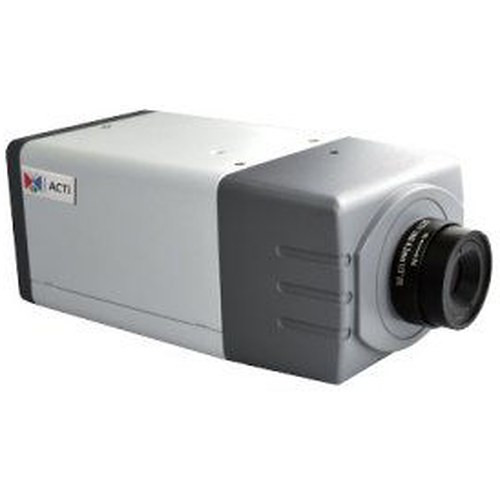
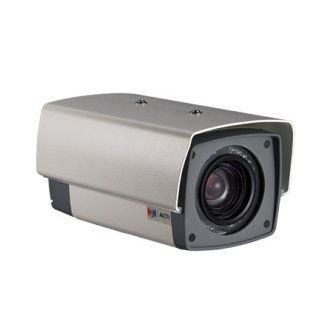
Both the ACTi E217 and ACTi KCM-5611 are 2 MP (1080p) box-form-factor IP cameras powered via PoE 802.3af and aimed at professional surveillance integrators. The comparison turns on imaging flexibility versus environmental hardening: the E217 offers higher frame rates, Advanced WDR, and H.265 compression in an indoor-oriented package, while the KCM-5611 brings an 18× motorized varifocal lens and an IP66-rated enclosure suited for outdoor or harsh-environment deployments.
In This Guide
How do the imaging specs compare?
Both cameras deliver 2 MP (1080p) resolution, but their imaging capabilities diverge significantly in two areas: frame rate and WDR. The E217 is rated at 1080p/60 fps, making it the stronger choice for capturing fast motion without blur. The KCM-5611 spec sheet does not state a maximum frame rate beyond what is implied by its H.264/MJPEG codec list, and no fps figure is provided in the supplied specifications.
On optics and dynamic range, the gap is equally clear. The E217 carries a fixed lens and Advanced WDR, which is explicitly specified for handling backlit or high-contrast scenes. The KCM-5611 features a motorized 4.7–84.6 mm varifocal lens (18× optical zoom range), giving installers remote focus and zoom adjustment to cover standoff distances from roughly 15 m to 30 m or more without a site revisit — a major operational advantage for perimeter or long-corridor deployments. The KCM-5611 spec sheet does not list a WDR specification. Both cameras include IR night vision and Day/Night operation; no minimum illumination figures or IR range distances are provided in the supplied specifications for either model.
What about installation and environment?
The KCM-5611 carries an IP66 ingress-protection rating, confirming it is sealed against high-pressure water jets and total dust ingress — appropriate for outdoor perimeter, loading dock, or washdown environments. The E217 has no IP rating listed in the supplied specifications, indicating it is intended for indoor or sheltered installations. No IK impact rating, operating temperature range, or dimensional/weight data is provided for either model in the supplied specifications.
Both cameras are powered by PoE 802.3af (under 15.4 W), so either integrates cleanly into a standard PoE switch infrastructure with no separate power run. The KCM-5611 specifies wall and ceiling mount styles; the E217 mount type is not detailed in the supplied specifications beyond its box form factor.
Which fits your VMS and analytics better?
Both cameras declare ONVIF compliance. The KCM-5611 specifically cites ONVIF Profile S, which defines a baseline interoperability profile for video streaming and PTZ control — directly relevant because its motorized lens can be controlled over the network. The E217 lists ONVIF and ACTi-native VMS compatibility but does not specify a Profile designation in the supplied specifications.
For edge analytics, the E217 lists 2D+3D DNR (digital noise reduction) as an analytics feature. The KCM-5611 does not list any edge analytics in the supplied specifications. The E217 also supports H.265 compression in addition to H.264 and MJPEG, which can reduce storage and bandwidth demands materially compared to H.264-only encoding. The KCM-5611 is limited to H.264 and MJPEG per the supplied specifications. Neither model lists audio input/output, on-board SD card storage, or alarm I/O in the supplied specifications.
Which should you choose: the E217 or the KCM-5611?
Our take: The E217 is the stronger choice when the installation is indoors or sheltered, motion clarity is a priority, and storage efficiency matters. It delivers 1080p at 60 fps versus no stated fps for the KCM-5611, adds Advanced WDR for high-contrast scenes that the KCM-5611 does not list, and supports H.265 compression — a codec absent on the KCM-5611 — which can reduce bitrate by roughly 40–60% at equivalent quality. Conversely, the KCM-5611 is the only option here for outdoor or harsh environments, backed by its IP66 rating where the E217 has no listed IP protection. Its motorized 4.7–84.6 mm lens also eliminates manual focus adjustments across variable standoff distances, a practical advantage on large perimeter sites. Choose the E217 for indoor, high-frame-rate, H.265-driven deployments on ACTi or ONVIF VMS platforms; choose the KCM-5611 for outdoor or semi-outdoor fixed positions requiring remote zoom and environmental sealing.
Side-by-Side Comparison
Spec-for-spec, from manufacturer data.
| Specification | ACTi E217 | ACTi KCM-5611 |
|---|---|---|
| Resolution | 2 MP (1080p) | 2 MP (1080p) |
| Form Factor | Box | Box |
| Lens Type | Fixed | Motorized varifocal |
| Focal Length | — | 4.7–84.6 mm (18× zoom) |
| Max Frame Rate | 1080p / 60 fps | — |
| WDR | Advanced WDR | — |
| Night Vision | IR; Day/Night | IR; Day/Night |
| Video Compression | H.265; H.264; MJPEG | H.264; MJPEG |
| ONVIF | Yes | Yes — Profile S |
| VMS Compatibility | ONVIF; ACTi | ONVIF Profile S |
| IP Rating | — | IP66 |
| Power Input | PoE 802.3af | PoE 802.3af |
| Edge Analytics | 2D+3D DNR | — |
| Mount Type | — | Wall; Ceiling |
Frequently Asked Questions
Which should you choose: the E217 or the KCM-5611?
The E217 is the stronger choice when the installation is indoors or sheltered, motion clarity is a priority, and storage efficiency matters. It delivers 1080p at 60 fps versus no stated fps for the KCM-5611, adds Advanced WDR for high-contrast scenes that the KCM-5611 does not list, and supports H.265 compression — a codec absent on the KCM-5611 — which can reduce bitrate by roughly 40–60% at equivalent quality. Conversely, the KCM-5611 is the only option here for outdoor or harsh environments, backed by its IP66 rating where the E217 has no listed IP protection. Its motorized 4.7–84.6 mm lens also eliminates manual focus adjustments across variable standoff distances, a practical advantage on large perimeter sites. Choose the E217 for indoor, high-frame-rate, H.265-driven deployments on ACTi or ONVIF VMS platforms; choose the KCM-5611 for outdoor or semi-outdoor fixed positions requiring remote zoom and environmental sealing.
Is the E217 or KCM-5611 better for low-light performance?
Both cameras include IR illumination and Day/Night operation, so both transition to monochrome IR imaging in darkness. However, neither model's supplied specifications include a minimum illumination figure or an IR range distance, making a direct low-light comparison impossible from the available data. Request those datasheets from ACTi for a definitive answer.
Can the KCM-5611 be used outdoors where the E217 cannot?
Yes. The KCM-5611 carries an IP66 rating, confirming protection against dust and high-pressure water — suitable for outdoor perimeter, loading docks, and washdown areas. The E217 has no IP rating listed in its supplied specifications and should be treated as an indoor or sheltered-installation camera only.
Does it matter that the E217 supports H.265 but the KCM-5611 does not?
It can matter significantly at scale. H.265 typically reduces bitrate by 40–60% versus H.264 at equivalent visual quality, which directly lowers NVR storage capacity requirements and network bandwidth consumption. If you are deploying multiple cameras on a bandwidth-constrained network or sizing storage for long retention periods, the E217's H.265 support is a concrete cost and infrastructure advantage over the KCM-5611's H.264/MJPEG-only encoding.
Get a Second Opinion on Your Camera Choice
Share your site layout, coverage goals, and budget. Our team will validate the camera selection, flag anything we would change, and recommend products that match the use case.