
Turret vs Dome vs Bullet Cameras for Commercial Use
Commercial cameras come in three main form factors — turret, dome, and bullet — with real performance, aesthetic, and mounting differences that drive selection. This guide walks through when each form factor is the right choice.
Bottom Line
Dome cameras for indoor discreet positions (office, retail, healthcare), bullet cameras for outdoor and long-distance perimeter, turret cameras as a middle-ground with dome aesthetics and bullet IR performance. Each form factor has specific trade-offs that matter for the position.
Our team specs cameras across indoor, outdoor, industrial, and retail positions daily.
Best For
- Integrators evaluating camera selection
- Facility managers reviewing proposals
- Anyone specifying cameras for a specific position
Not For
- Consumer or residential buyers
In This Guide
Dome Cameras
Strengths: Discreet aesthetic (blends with ceilings); vandal-rated variants (IK10); 360-degree housing makes it hard for someone to tell where the camera is pointed; fits drop-ceiling tile mounting naturally.
Weaknesses: IR reflection off the dome bubble can cause glare in low-light scenarios; pan/tilt adjustment inside the housing limits mount options; slightly higher cost than equivalent bullet.
Best for: Lobby, corridor, conference room, retail sales floor, office general, dispensary sales floor, anywhere aesthetics matter.
Top picks: Hanwha QND-7082R (4MP workhorse), PND-A9081RF (4K AI premium), PNF-9010RV (12MP fisheye for full-space coverage).
Bullet Cameras
Strengths: Strongest IR performance (direct LED, no bubble reflection); long focal lengths for perimeter distance; intuitive aim point for installers; weather-sealed for outdoor; typically lower cost than equivalent dome.
Weaknesses: Visible form factor draws attention; harder to blend into aesthetically-sensitive spaces; direction of aim is obvious; single-axis mount limits flex.
Best for: Outdoor perimeter, parking lots, fence lines, long corridor ends, dock doors, construction sites, industrial environments.
Top picks: Hanwha ANO-L7012R (perimeter workhorse), XNO-9082R (4K perimeter), XNO-6120R/LPR (LPR bullet).
Turret Cameras (Eyeball / Mini-Ball)
Strengths: Dome aesthetic without the bubble (no IR reflection); wider adjustable mount range than traditional dome; less obvious than a bullet; compact size.
Weaknesses: Not as discreet as a fixed-bubble dome; aim direction visible; less vandal-rated housings typically.
Best for: Indoor positions where IR matters (stairwells, dim corridors, secondary entries); outdoor eaves where perimeter distance is moderate.
Top picks: Market has more turret options from Hikvision and Dahua (NDAA-blocked) than from compliant brands. For NDAA-compliant turrets, the Hanwha XND-6081RV or i-PRO WV-S2xxx series approximate the form factor with dome housings.
When to Use Which Form Factor
Indoor aesthetic-first positions (lobbies, office, retail, healthcare): Dome. Low-profile white housing blends into drop-ceiling.
Outdoor perimeter and long-distance coverage: Bullet. IR and focal-length advantage.
Indoor where IR matters (stairwells, low-light corridors): Turret or open-box dome (not closed-bubble). Avoid IR reflection.
Vandal-prone positions (parking deck, schools, loading docks): Vandal-rated dome (IK10). Bullet housings are more exposed to impact.
Conference rooms, break rooms, large spaces needing full coverage: Fisheye (360-degree dome). One camera replaces a cluster.
High-value identification positions (POS, vestibule, vault): Either 4K dome or bullet; specific angle requirements drive the choice.
Recommended Cameras by Form Factor
Six cameras spanning dome, bullet, and fisheye variants for commercial positions.
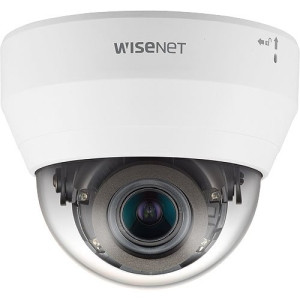
Hanwha
Hanwha QND-7082R 4MP Indoor IR Dome Camera
QND-7082R
4MP dome for most indoor positions.
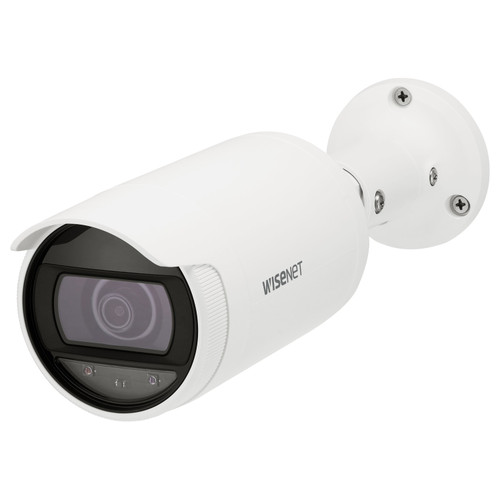
Hanwha
Hanwha ANO-L7012R 4MP Wide-Angle Low Light Outdoor Bullet IP Camera
ANO-L7012R
Workhorse bullet for perimeter and outdoor.
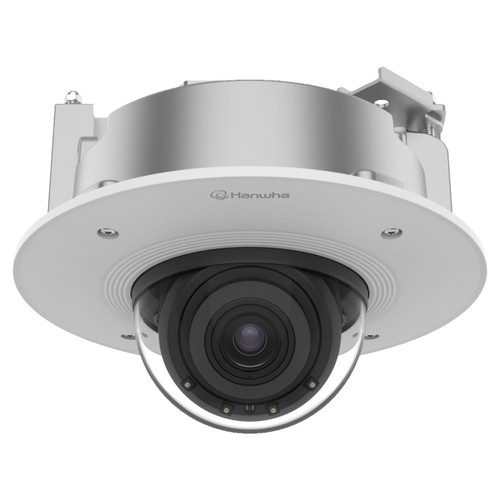
Hanwha
Hanwha PND-A9081RF 4K Indoor AI IR Dome IP Camera
PND-A9081RF
4K AI dome for executive and high-value.
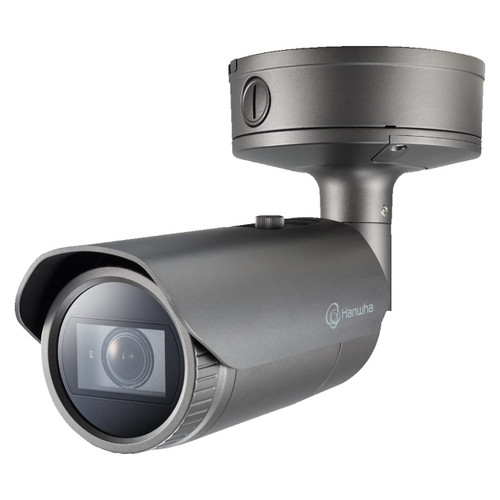
Hanwha
Hanwha XNO-9082R 4K Outdoor IR Bullet Network Camera
XNO-9082R
Premium outdoor bullet for long perimeter runs.
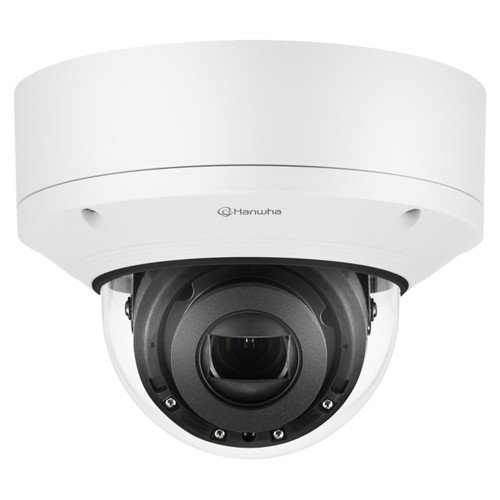
Hanwha
Hanwha XND-6081RV 2MP Vandal-Resistant Dome Camera
XND-6081RV
IK10 vandal-rated for high-traffic indoor.
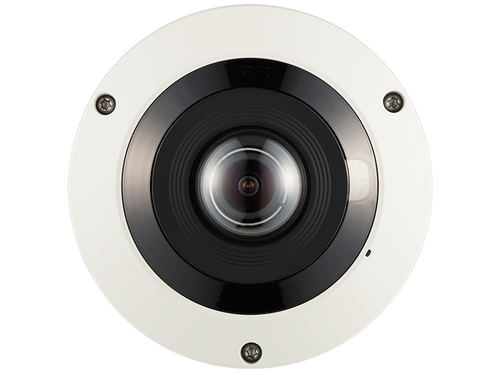
Hanwha
Hanwha PNF-9010RV 12MP 360˚ Fisheye Camera
PNF-9010RV
12MP fisheye for full-space indoor.
Also Consider
Axis outdoor dome variant.
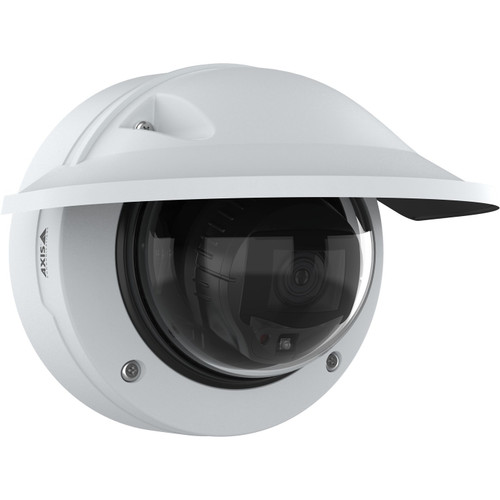
Axis
Axis P3277-LVE 5MP Outdoor AI IR Dome Camera - 03153-001
03153-001
Axis P3277-LVE AI outdoor dome for entries.
Frequently Asked Questions
What's the difference between a dome and a turret camera?
Dome has a bubble housing covering the lens; turret (eyeball) has the lens exposed on a ball mount. Dome is more vandal-resistant; turret eliminates IR reflection off the bubble.
Are bullet cameras better for outdoor?
Usually yes. Bullets have stronger IR illumination and longer-focal-length options for perimeter distance. Outdoor domes work at shorter range with less IR need.
Should I use a dome or bullet at a dock door?
Vandal-rated dome (IK10). Dock doors see occasional impact; dome housing handles it better than bullet.
What about PTZ cameras?
Different form factor entirely. PTZ is for specific use cases (large lot overview, event coverage, active monitoring). Not a general-purpose form factor.
When should I choose turret over dome?
When you need strong IR in a dome-aesthetic form factor. Turrets eliminate IR reflection off the dome bubble. Common in stairwells and low-light indoor positions.
No Bots, Just Experts
No bots, just experts. Free pre-sales support for every customer — product questions, BOM quotes, compatibility checks, price confirmation — typically answered within one business day. Paid services available like full system design, remote installation, and more. Got a list of products? Free BOM quote. Need help figuring out what to buy? Buy engineering time by the hour — $175/hour, qty 1 = 1 hour. Tell us about your project, we scope how many hours it needs, you purchase that quantity. Hardware buyers get up to one hour ($175) credited back against their order as a thank-you.