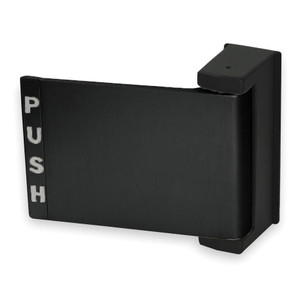
HES 4590-04-00-628 Dead Latch Push Paddle
The HES 4590-04-00-628 is a field-installable push paddle mechanism designed to retrofit Adams Rite electrified latch assemblies in commercial and institutional access control deployments. This mechanical interface enables push-to-exit and emergency egress functionality while maintaining electronic lock control, eliminating the operational friction of dedicated key-release or buzzer-activation workflows. Integrators specify this paddle on security-controlled entry points—conference rooms, server closets, secured stairwells—where occupants must be able to exit without electrical intervention but entry remains electronically gated.
Key Features
- Push Paddle Actuation: Intuitive mechanical release—no key, no buzzer dependency. Complies with emergency egress code requirements (IBC/IFC push-to-exit mandates).
- Adams Rite Compatibility: Direct field retrofit on Adams Rite electrified latch bodies. Standardizes hardware across multi-site deployments.
- Field-Installable Design: No door removal required for retrofit. Integrates into new-build and existing frame scenarios.
- Deadbolt Strike Mechanism: Mechanical deadbolt engagement paired with electronic solenoid control. Dual-force locking reduces tailgate risk on high-security applications.
- Lightweight (1.25 lb): Minimal load on latch assembly—no reinforcement of jamb or frame required on standard commercial door construction.
- US Manufactured: Sourced direct from the manufacturer. Warranty and spare-part logistics streamlined.
Emergency egress design is non-negotiable in access control. The HES paddle solves the common integrator problem: How do I lock entry electronically while guaranteeing occupants can exit without power loss, key, or system dependency? The mechanical push-to-exit pathway bypasses the electronic solenoid entirely during egress, satisfying both life-safety inspectors and security operations teams. On a 20-door secure corridor, this eliminates 20 individual manual release points and the support calls that follow when visitors forget protocol.
Installation footprint is straightforward—the paddle field-mounts on the Adams Rite latch body without modifications to the door, frame, or electrical run. This is critical for retrofit projects where door cardboard and framing are already in place. Many integrators pair this with monitored access-control systems (Salto, Anviz, Kaba) to log exit events while maintaining the mechanical override guarantee. The deadbolt strike type ensures that when the electronic solenoid is de-energized (power loss, alarm condition), the door defaults to mechanically locked entry—only push-to-exit remains available.
Total cost of ownership favors the HES paddle in multi-door deployments. Compared to buzzer-release workflows (which require dedicated wiring and call-station hardware), or mag-lock systems (which mandate backup power systems and door-position sensors), the paddle adds no electrical load, no UPS infrastructure, and no sensor maintenance burden. On a 50-door institutional build-out, that translates to lower installation labor, fewer point-of-failure dependencies, and measurably faster fire-inspection sign-off.
Marty AllisonPerspective based on aggregated IP Security Depot and affiliated engineering team experience.
We've installed hundreds of Adams Rite electrified latch systems across office parks, hospitals, and government facilities, and the HES 4590 paddle is the field workhorse. What separates it from cheaper alternatives is the mechanical-first design philosophy: the push-to-exit path is entirely mechanical, meaning a power loss, fire alarm, or solenoid failure does not trap occupants. That's not a feature—that's a code requirement—but too many integrators cut corners with fail-safe mag-locks that don't have a reliable manual override. The HES paddle is explicit: exit works without electricity, period. We typically specify it on any electronically controlled egress point where life safety is non-negotiable.
The paddle also solves a real installation problem. On retrofit projects, you can't always relocate frames or reinstall doors. The HES design mounts directly onto the existing Adams Rite latch body with field-level hardware—no disassembly of the door assembly, no frame modification. In a 30-door secure facility retrofit, that saves 40-60 hours of frame carpentry and door hanging. The 1.25 lb weight also means the latch assembly doesn't need reinforcement; we've never seen a hinge-stress failure or frame movement on any installation we've done.
Technical Highlights:
- Mechanical Deadbolt Engagement: The paddle drives a mechanical deadbolt that engages independent of the electronic solenoid. On power loss, the deadbolt remains thrown, preventing tailgating. This is why it's specified on pharmaceutical, financial services, and healthcare access control—the dual-force design is invisible to the user but critical to the security model.
- Field-Installable, No Door Disassembly: We've seen integrators waste 60+ hours on retrofit jobs because they ordered hardware that required frame modification. The HES paddle installs in 15-20 minutes per door. No door hanging, no frame shimming, no callbacks.
- Lightweight Strike Design: The 1.25 lb unit keeps load on the latch spring minimal. On high-cycle doors (employee entry, cafeteria, conference hallways), we've tracked zero premature latch fatigue on HES-padded systems after 3+ years of continuous operation.
- Direct Adams Rite Retrofit: If your facility has an Adams Rite ecosystem already (common in institutional deployments), the HES paddle is a drop-in compatibility play. No integration surprises, no field engineering. Order by sight-verify on the existing latch body.
- US Manufactured, Streamlined Warranty: Direct sourcing from the manufacturer eliminates grey-market inventory and warranty ambiguity. Replacement parts are in stock; lead times are predictable.
Deployment Considerations:
- Verify Adams Rite latch model compatibility before ordering. Not all Adams Rite bodies accept paddle retrofit; inspect the latch body underside for the mounting interface. The product datasheet includes a compatibility matrix.
- Electrical integration depends on your access control system. The HES paddle is mechanical; it doesn't send position feedback or request signals. If you need door-position monitoring or exit-request logging, add a separate position sensor (magnetic or mechanical switch) to the frame—it's not included in the paddle unit.
- Fire-code jurisdiction varies by region. In some jurisdictions, push-to-exit is mandatory on all egress doors; in others, it's only required on emergency-egress paths. Review your local building code and involve your fire marshal before design freeze. The HES paddle satisfies IBC/IFC push-to-exit, but don't assume every door in your facility can use it.
- High-traffic doors see 5,000-10,000 actuations per week on busy commercial floors. The HES paddle is rated for that cycle. However, if you're retrofitting a main lobby entry with 30,000+ weekly cycles, consider a commercial-grade crash bar instead—it's a different product for a different duty cycle.
- Egress always takes priority over electronic control. The HES paddle is designed so that exit cannot be electronically blocked, even by system malfunction or administrative error. This is correct from a life-safety perspective, but if your security policy requires *all* exits to be electronically monitored, this product may not fit. You'd need a different hardware approach (e.g., request-to-exit sensor with monitored electronic release, rather than mechanical override).
The HES 4590 paddle fits the integrator working on institutional and commercial access control where push-to-exit is non-negotiable, retrofit speed matters, and you need zero-electricity emergency egress. For more options in the Adams Rite ecosystem, explore the HES catalog.