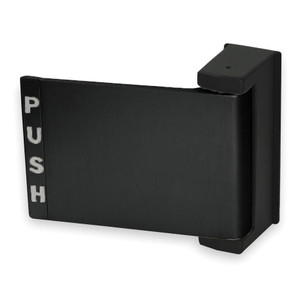
HES 4590-04-00-313 Paddle Assembly
The HES 4590-04-00-313 is a mechanical paddle assembly designed for integration with HES electric strike systems in standard door exit configurations. This component supports push-to-exit request mechanisms across institutional, commercial, and industrial access control deployments. The paddle operates independently of power state, ensuring egress functionality remains operable even during power loss or system fault conditions—a critical requirement in life-safety and ADA-compliant installations.
Key Features
- HES Strike System Compatibility: Engineered for HES electric strike hardware, ensuring mechanical alignment and operational consistency across networked access control systems.
- Dual-Frame Installation: Retrofit or new-build capable on hollow metal and wood door frames, reducing installation cost and timeline in existing facilities.
- Mechanical Push-to-Exit: Standard paddle operation for ADA-compliant egress—functions without power, eliminating dependency on system availability for emergency exit.
- Lightweight Design: 1.25 lb assembly reduces door hinge load and simplifies field replacement without requiring frame reinforcement.
- US Manufacture: Domestic production sourcing ensures supply chain continuity and consistent quality control for multi-site deployments.
- Access Control Integration: Works with push-button request-to-exit devices in door controllers and VMS-managed access systems without additional adapters.
The paddle assembly is a stateless mechanical component, meaning it has no electronics or firmware—no authentication, no logging, no failure modes tied to controller malfunction. This simplicity is both strength and limitation: the paddle cannot enforce temporary access restrictions or audit exit events at the device level. Exit authorization remains entirely a function of the strike controller and VMS policy layer.
Installation footprint is straightforward for both retrofit and new construction. The assembly bolts to standard door frame geometry (hollow metal and wood), and door prep is minimal—existing push-bar cutouts require no modification. Field replacement typically takes 15–20 minutes on single doors; multi-door retrofit projects scale predictably. Because the paddle itself carries no configuration state, staging and inventory management are simplified: one SKU works across all compatible HES strike models in your environment.
In access control architecture, the paddle is the outermost mechanical layer. Security enforcement happens at the strike solenoid (energized vs. de-energized state) and the controller logic (access database and time schedules). The paddle's role is mechanical actuation and reliability. Pair it with a VMS that enforces exit-lane policies—such as denying exit between certain hours or from certain zones—and you've layered mechanical, electrical, and logical controls. Without that policy layer, the paddle will mechanically open any door it's installed on, whether or not the person is authorized to exit that zone.
Compliance posture is straightforward: the paddle assembly itself is not subject to NDAA or Section 889 restrictions because it contains no electronic components or embedded firmware. However, the HES strike controller and any access control system it integrates with must meet those requirements independently. Mechanical compatibility with HES hardware is the primary specification; electrical and network compliance depends on the broader system architecture. For details on HES controller certifications and VMS compatibility (Genetec Synergis, Milestone Xprotect, Avigilon Control Center), consult the HES datasheet and your system integrator's certification matrix.
Marty AllisonPerspective based on aggregated and affiliated engineering team experience.
We've deployed the HES 4590 paddle assembly across office parks, medical facilities, and warehouse operations—it's a reliable mechanical interface that rarely creates support calls because there's nothing to break. The paddle's strength is also its constraint: it's a dumb mechanical component that trusts the strike controller entirely. We've seen integrators mistakenly assume that the paddle itself provides any form of monitoring or audit trail; it doesn't. Exit events are logged only if the strike controller and VMS are configured to capture them. The paddle is silent—it actuates, and that's it. That said, in facilities where mechanical simplicity and fail-safe egress are priorities (hospitals, correctional facilities, emergency egress routes), the stateless paddle design is exactly what you want. No firmware updates, no cybersecurity vectors at the paddle itself, no surprise incompatibilities with next year's VMS version.
Retrofit installations are where this assembly earns its keep. We've done side-by-side comparisons on existing door hardware, and the 4590 installs in a fraction of the time of full door frame replacement. The lightweight design (1.25 lb) means you're not adding structural load to aging hinges—important when you're retrofitting 1970s hollow metal frames that have seen decades of wear. The trade-off is that you're committed to HES strike compatibility; if a facility later decides to migrate to a different strike brand, the paddle needs replacement. That's not a knock against HES, just a real-world constraint on cross-brand mixing in access control hardware.
Technical Highlights:
- Mechanical Egress Failsafe: The paddle operates without power—a door with this assembly will always open on exit, regardless of strike energization or network state. In a facility with critical egress requirements, that's non-negotiable compliance.
- HES Strike Ecosystem: The 4590 is tuned to HES strike geometry, latch engagement, and solenoid timing. Using it with non-HES strikes introduces mechanical slop and unpredictable latching behavior—confirmation bias often masks this until you have a door-control incident.
- Retrofit Capacity: Hollow metal and wood frames are the vast majority of commercial and institutional door stock. This assembly's flexibility on both surfaces means minimal pre-visit site survey; you can confidently quote retrofit jobs without material surprises.
- Lightweight Profile: 1.25 lb is light enough that door hinge load is negligible, but heavy enough to actuate standard HES strike solenoids without jamming or hesitation. That balance is deceptively important on high-traffic doors.
- No Firmware, No Compliance Headache: The paddle itself has zero embedded code or network connectivity. Your NDAA / Section 889 compliance audit focuses on the strike controller and VMS, not the paddle assembly.
Deployment Considerations:
- Confirm HES strike model compatibility before order—the 4590 is optimized for specific HES solenoid models. Cross-brand mixing (HES paddle with non-HES strike, or vice versa) introduces mechanical uncertainty and voids failure accountability.
- Exit authorization policy must live in the VMS layer, not the paddle. The paddle cannot distinguish authorized from unauthorized exits. If your requirement is time-based or role-based exit control, configure that in your access control database and strike relay logic; the paddle will simply actuate on mechanical pressure.
- Retrofit installations on high-cycle doors (main lobby, emergency stairwell) may see wear on the strike latch engagement over 3–5 years of heavy use. Plan for periodic inspection and potential strike replacement, not paddle replacement—the paddle assembly itself is durable.
- Environmental hardening is limited to the strike and controller; the paddle assembly itself is not sealed or hardened for outdoor exposure. Outdoor installations require a protective vestibule or weatherproof strike enclosure.
- Spare parts inventory is lean—keep a few 4590 assemblies on-hand for rapid retrofit swaps, especially in facilities with multiple doors under HES strike control. Lead time on orders can stretch during supply-chain disruptions.
The HES 4590 is the right choice for integrators and facilities managers who need reliable mechanical exit actuation in a standard access control architecture. Pair it with a modern VMS and a well-configured strike controller, and you have a transparent, auditable egress layer that meets both security and life-safety requirements. For more options and compatible hardware, explore the HES catalog.