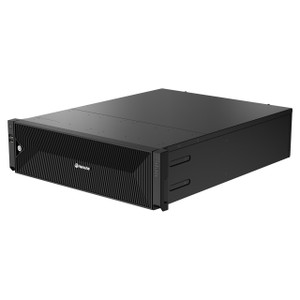
Hanwha XRN-6420DB4-16TB 64-Channel 8K Network Video Recorder
The Hanwha XRN-6420DB4-16TB is a large-footprint network video recorder engineered for enterprise surveillance deployments where channel density, processing headroom, and forensic-quality retention cannot be compromised. Built on 12th-generation Intel processor architecture, this 64-channel system records 32MP resolution across all channels simultaneously — every connected camera streams at full fidelity without frame-rate compromise or quality degradation during peak load. For integrators managing critical infrastructure, transportation hubs, or multi-site retail chains, this density-to-performance ratio eliminates a common bottleneck: undersized recorders that force resolution trade-offs or channel-sharing schemes.
Key Features
- 64-channel 32MP simultaneous recording: All 64 channels stream at 32MP resolution without load-balancing penalties. This means forensic-quality footage across a sprawling campus or facility — no channel falls back to lower resolution during simultaneous playback or backup operations. Critical when you need to zoom into a face or license plate weeks after an incident.
- 520 Mbps distributed bandwidth; 300 Mbps normal mode: The multi-threaded Intel architecture distributes processing across channels instead of funneling all streams through a single processor bottleneck. You can saturate this recorder with high-bitrate H.265 streams from dozens of 4K and 8K cameras without throttling or frame-drop — a real advantage when deploying premium sensors that are expensive to underutilize.
- H.265, H.264, and MJPEG codec flexibility: H.265 cuts storage consumption roughly 40–60% versus H.264 depending on scene complexity and bitrate settings — a material cost reduction on 16TB+ deployments where retention runs weeks or months. Mixed codec support lets you optimize each camera independently: use H.265 for high-bitrate scenes, H.264 for legacy cameras, MJPEG for motion-only zones.
- 16 SATA HDD bays, up to 10TB per drive; expandable to 160TB total: The included 16TB capacity is a starting point; you can upgrade individual drives without replacing the system. RAID mode ensures a single drive failure doesn't halt recording — the system degrades gracefully while rebuild operations continue at full bandwidth. Essential for 24/7 operations where downtime is unacceptable.
- Two-way audio across all 64 channels: Built-in bidirectional audio support enables real-time incident response, access control coordination, and emergency communication without external audio cards. Simplifies integration with Hanwha IP cameras and compatible third-party endpoints.
- PoE compatibility for simplified network deployment: Eliminates the need for separate 12VDC power supplies to individual cameras. Network switches handle camera power delivery directly, reducing cable runs and power infrastructure complexity. Pair with a managed PoE switch and you've standardized both data and power onto a single infrastructure.
Integration & Compatibility
The XRN-6420DB4-16TB runs embedded Linux, supporting ONVIF Profile S/T/G for broad third-party camera compatibility. This means you're not locked into Hanwha cameras alone — you can mix vendors without integration headaches. RAID-enabled storage ensures business continuity: drive failure triggers automatic redundancy without operator intervention. The 520 Mbps capability sustains simultaneous high-bitrate recording and playback, critical when forensic searches coincide with live monitoring. If you're upgrading from single-processor NVR designs or consolidating multiple smaller systems into one deployment, this unit's distributed architecture handles the transition without performance cliff.
When to Choose a Different Model
If your deployment requires fewer than 30 channels or doesn't justify the 16TB footprint, consider a smaller-capacity variant in the Hanwha NVR family. If you need sub-second failover or geographic redundancy across multiple sites, pair this recorder with a secondary unit and implement RAID replication across your network infrastructure — consult a network video recorder and VMS buying guide for distributed architecture patterns. If your cameras are primarily 1080p or 2MP and retention is under two weeks, a lower-channel-count system will cost less without sacrificing performance.
Frequently Asked Questions
Q: Can the XRN-6420DB4-16TB record from non-Hanwha cameras?
A: Yes. ONVIF Profile S/T/G support means any IP camera meeting these profiles — Axis, Hikvision, Uniview, Bosch, Dahua, and others — will integrate without proprietary drivers. Verify your third-party camera's ONVIF compliance before deployment.
Q: What happens if a drive fails in the middle of recording?
A: RAID redundancy automatically activates. Recording continues uninterrupted while the failed drive is replaced. Rebuild operations happen in the background without stopping active streams — no downtime.
Q: Does H.265 compression work with older VMS software?
A: Not necessarily. If your VMS doesn't decode H.265 (HEVC), configure the XRN-6420DB4-16TB to record in H.264 or MJPEG instead. You can also mix codecs per-channel — some cameras in H.265, others in H.264 — to match your playback infrastructure.
Q: How much network bandwidth does 64 channels at 32MP actually consume?
A: That depends entirely on compression settings, frame rate, and scene complexity. The 520 Mbps distributed bandwidth is the recorder's processing ceiling, not the network requirement. A 4K camera at 15 fps in H.265 might use 10–15 Mbps; a high-bitrate 8K stream could approach 80–100 Mbps. Plan your switch and uplink accordingly — a managed PoE switch with gigabit uplinks is the baseline.
Q: Can I expand storage from 16TB to 160TB without downtime?
A: You can upgrade individual drives, but it's not a hot-swap operation for all drive slots. Plan this during maintenance windows. Hanwha's RAID implementation allows gradual drive replacement while the system remains active, but confirm with your integrator that the specific RAID tier (RAID 5 vs. RAID 6) meets your availability requirements.
Q: What's the power consumption of the XRN-6420DB4-16TB itself (not counting cameras)?
A: Evidence does not specify the recorder's AC power consumption. Contact the integrator or Hanwha directly for the exact wattage to size your UPS and facility power budget.
Ted PerryPerspective based on aggregated IP Security Depot and affiliated engineering team experience.
The XRN-6420DB4-16TB represents a meaningful step up from smaller 32- or 16-channel recorders — you're buying distributed processing and sustained throughput that doesn't collapse under load. That 520 Mbps figure isn't marketing; it translates to real simultaneous recording and playback without frame-drop, and the H.265 codec support cuts your storage footprint by half compared to legacy H.264 deployments. For large campuses or multi-location integrations, this density matters operationally.
Technical Highlights:
- 12th-gen Intel processor + multi-threaded architecture: Unlike older single-CPU recorders, this system distributes the encoding and decoding load across cores, so one high-bitrate 8K stream doesn't starve the other 63 channels. Real impact: 64 simultaneous 32MP streams with zero quality compromise.
- H.265 codec support (40–60% storage reduction): If you deploy cameras that output H.265, record directly in that codec and cut your HDD requirements nearly in half. On a 16TB system recording 24/7, that's weeks of additional retention without buying extra drives.
- 16 independent SATA bays, RAID-protected: You're not locked into a fixed storage capacity. Upgrade drives one at a time — 8TB today, 10TB in two years — without replacing the entire system. RAID ensures a single drive failure doesn't trigger catastrophic downtime.
Deployment Considerations:
- Network infrastructure must match recorder capability: A 520 Mbps recorder backed by a 100 Mbps uplink is a bottleneck waiting to happen. Pair this system with a managed PoE switch (minimum gigabit uplinks) and ensure your core network can sustain 300+ Mbps sustained throughput without congestion.
- ONVIF compliance varies by vendor: While the recorder supports ONVIF Profile S/T/G, not every third-party camera fully implements every profile feature. Test audio interop and two-way communication with your chosen camera brand before full deployment — some vendors limit two-way audio to their own hardware.
- Codec mismatch with legacy VMS: If you're running an older Milestone or AXIS Camera Station instance that doesn't decode H.265, you'll be forced to record in H.264 or downgrade to MJPEG, defeating half the storage efficiency. Verify your VMS roadmap before committing to H.265 workflows.
Position the XRN-6420DB4-16TB where you need forensic-quality multi-camera recording across a single consolidated platform — transportation hubs, large-format warehouses, multi-building healthcare or education campuses. If your deployment is under 30 channels or retention is less than two weeks, a smaller system saves capital without real performance loss. If you need geographic failover or distributed recording across multiple sites, this recorder is the local platform; pair it with a secondary system and VMS replication logic.