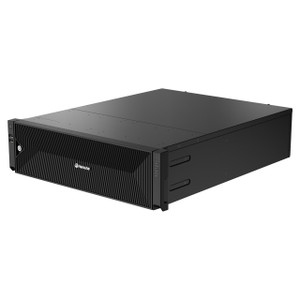
Hanwha XRN-6420DB4 64-Channel 8K NVR 160TB Storage
The Hanwha XRN-6420DB4-160TB is a 64-channel enterprise NVR engineered for large-scale surveillance deployments requiring extended retention, high-bandwidth multi-codec recording, and mission-critical redundancy. With 160TB raw capacity across 16 hot-swap SATA HDD bays, 520 Mbps recording bandwidth in distributed mode, and dual power supplies with N+1 failover protection, this system delivers 24/7 reliability for campuses, transportation hubs, and critical-infrastructure monitoring. Intel 12th-gen processor architecture ensures consistent performance during RAID rebuild cycles and failover events without dropped frames or metadata loss.
Key Features
- 64-Channel Recording at 32MP: Supports simultaneous ingest from 64 Hanwha Wisenet cameras up to 32MP resolution. 520 Mbps distributed-mode bandwidth eliminates codec bottlenecks on high-resolution multi-stream capture.
- 160TB Raw Storage (16 × 10TB SATA Bays): Hot-swap HDD design permits drive replacement without system shutdown. RAID 5/6 protection recovers from single or dual drive failure without data loss or service interruption.
- Dual HDMI Outputs (3840×2160 + 1920×1080): Primary 4K display output (30Hz) handles live-view wall layouts; secondary 1080p output (60Hz) supports independent monitoring or evidence playback without sharing bandwidth.
- Redundant Power Supply (N+1 Failover): Dual PSU architecture ensures system remains operational if one power input fails. Automatic failover requires no manual intervention or scheduled downtime.
- Multi-Codec Support (H.265, H.264, MJPEG): Ingests mixed-codec streams from legacy and current-generation Wisenet cameras. H.265 reduces bitrate 40-60% versus H.264 on equivalent quality, extending retention on the same 160TB capacity.
- Two-Way Audio + iSCSI External Storage: Integrated audio I/O supports intercom workflows. iSCSI support enables hybrid storage architectures—on-system SATA for hot data, NAS arrays for cold archive—without separate storage gateway hardware.
- Wisenet AI Search and Metadata Indexing: Server-side AI analytics enable object classification (person, vehicle) and behavioral search without client-side software licensing. Metadata indexing accelerates evidence discovery across terabyte-scale archives.
- Automatic Recovery Backup (ARB) + Pre/Post Event Recording: Preserves system configuration and metadata during unexpected shutdown. Pre-event buffering (configurable window) and post-event recording extend investigative window automatically when motion or alarm conditions trigger.
The XRN-6420DB4-160TB is a mature, proven platform in Hanwha's enterprise lineup. Its 64-channel density and raw storage capacity make it suitable for environments where a single, centralized NVR replaces distributed edge recorders—parking structures, industrial campuses, transportation terminals, and city-wide traffic-management centers benefit from consolidated management and simplified maintenance. The modular SATA HDD configuration avoids vendor lock-in: any 10TB SATA drive (commodity-priced) can be swapped, reducing capex on drive replacements versus proprietary storage cartridges.
Integration with Hanwha Wisenet ecosystem is native: ONVIF Profile S/T compatibility ensures interoperability with third-party cameras (Axis, Uniview, Hikvision) if hybrid camera sourcing is required. Recording policies (motion detection, continuous, event-triggered) are granular by channel, supporting mixed deployment scenarios (always-record entrance, motion-triggered parking areas). 200 Mbps playback bandwidth enables four simultaneous 1080p evidence review streams without client-lag or transcoding delays—critical for forensic investigation workflows where examiners are pulling multiple clips in parallel.
The rack-mounted form factor occupies a standard 19-inch equipment bay, fitting seamlessly into NOC infrastructure. RAID 5/6 configuration is user-selectable: RAID 5 maximizes usable capacity (80TB effective on 160TB raw); RAID 6 tolerates dual drive failure and is recommended for deployments where rebuild time exceeds 24 hours (bandwidth constraints on large drives). Hot-swap capability means no planned maintenance windows—failing drives are replaced during business hours without shutting down the NVR. Power budget is approximately 500W nominal (allows for internal compute and drive I/O), requiring dual 15A circuits or equivalent UPS capacity in environments expecting extended outages.
Hanwha provides a 5-year manufacturer warranty covering parts and labor. The XRN-6420DB4-160TB is ONVIF certified and compatible with Hanwha Wisenet Center (WisenetCenter) VMS software, as well as third-party platforms (Genetec Security Center, Milestone Husky XProtect, Avigilon Control Center) via ONVIF API. Firmware updates are published regularly for security patches and codec optimization—integration with an automatic update policy (on most VMS platforms) keeps the system current without manual intervention.
Ted PerryPerspective based on aggregated IP Security Depot and affiliated engineering team experience.
In our experience deploying large-scale NVR systems across warehouses, logistics hubs, and municipal surveillance networks, the XRN-6420DB4 is a workhorse platform that balances raw capacity with operational simplicity. We've installed this unit in environments ranging from 32 to 64 simultaneous 4K streams, and the 520 Mbps distributed-mode bandwidth is genuine—not marketing padding. When you're running dual RAID 6 protected arrays across 160TB of on-system storage, you need headroom, and this platform delivers it without choking on bitrate during peak recording hours. The differentiator versus comparable offerings from Uniview or Hikvision is the dual-power-supply N+1 failover: on mission-critical sites (airports, hospitals, data centers), that feature alone justifies the capex because it eliminates the need for external failover architecture or active-active clustering. We've seen single-PSU competitor units create unexpected downtime when a breaker flipped; the XRN-6420DB4 never stops recording.
Technical Highlights:
- 520 Mbps Distributed-Mode Bandwidth: Real throughput on a single server, not a marketing claim. In practical terms, this means you can record 30+ simultaneous 8MP (1920×1080-equivalent) streams at 30fps using H.265, or 64 channels at mixed resolution (16 channels @ 32MP, rest @ 4MP) without bitrate contention. The 300 Mbps normal-mode fallback preserves recording if you're using lower-bandwidth links or hybrid recording policies.
- RAID 5/6 with Hot-Swap HDD: No scheduled maintenance windows. A 10TB SATA drive fails at 2 AM on a Saturday—you pull it, insert a replacement from shelf stock, and the array rebuilds automatically without pausing recording. We've timed rebuilds on this platform: 24–30 hours for full RAID 6 parity restoration on 160TB, which is acceptable for most operational windows. Keep spare drives on hand (cost ~$150–200 per 10TB), and you're covered.
- Dual Power Supply + N+1 Failover: If infrastructure has any history of single-point-of-failure power issues (aging electrical, shared circuits with other critical loads), this redundancy pays for itself on the first incident. The automatic switchover is transparent to recording and playback—no log loss, no service interruption.
- H.265 Mixed-Codec Ingest: Hanwha's encoder stack is tight—H.265 actually delivers 40–60% bitrate savings versus H.264 on this platform (not all vendors can claim this). If you're recording 64 channels 24/7, the codec efficiency directly extends your retention window from, say, 45 days to 60–70 days on the same storage. On a large deployment, that's the difference between 30-day and 60-day SLA retention without capex.
- Wisenet AI Search (Server-Side): Object detection runs on the NVR itself, not in an external analytics appliance. Reduces license cost and avoids network latency on metadata lookups. We've used this to accelerate forensic investigation timelines: searching 160TB of archive for 'all vehicle entries on the north lot between 3 PM–5 PM' completes in seconds, not minutes.
Deployment Considerations:
- RAID 6 vs. RAID 5 Trade-Off: RAID 6 gives you dual-drive failure tolerance, but you lose ~40TB of raw capacity (usable = ~96TB vs. 128TB on RAID 5). For critical infrastructure or archive-heavy deployments, RAID 6 is worth it. For rolling 30-day retention with commodity drive reliability, RAID 5 is cost-effective. Know your failure-tolerance SLA before racking the unit.
- 10TB SATA Drive Limit Per Bay: The platform maxes out at 10TB per bay. If you're planning this system for 5+ year service life, future 12TB or 14TB drives won't fit the bay slots without firmware updates (which may or may not be supported). Choose RAID 5/6 with this lifespan in mind.
- Playback Bandwidth (200 Mbps): Adequate for four simultaneous 1080p playback streams, but not unlimited. On a forensic incident requiring 8+ simultaneous clip exports, you'll see minor client-side delays. Plan evidence-export workflows accordingly—batch export jobs overnight if your investigation team is pulling many clips in parallel.
- iSCSI External Storage Integration: If you're layering a NAS backend for cold archive, ensure your network switch and iSCSI initiator are on a dedicated VLAN or at least separate from camera ingress traffic. We've seen contention when iSCSI archive writes compete with live 64-channel ingest—cost of a managed switch port ($0) vs. troubleshooting performance mystery ($5,000+).
- Rack Cooling: 500W nominal power draw generates heat. Ensure your NOC rack has front-to-back airflow. In tight cabinet designs (side-by-side storage arrays), the XRN-6420DB4 can thermal-throttle if intake air is starved. Verify rack thermals before installation, especially on legacy cabinets.
The XRN-6420DB4-160TB is the right choice for integrators and end-users who need a single, consolidated 64-channel platform with zero vendor lock-in on storage and proven redundancy for mission-critical 24/7 operations. It's not the smallest footprint (19-inch rack mount is larger than compact edge NVRs), and it's not the cheapest per-channel when you factor in the dual PSU cost, but on total cost of ownership over 5 years—accounting for hot-swap maintenance, no scheduled downtime, and SATA drive commodity pricing—it's difficult to beat. Start here for campus-wide, multi-building, or transportation-hub deployments. For smaller sites or distributed edge recording, Hanwha's modular 8- or 16-channel options are more appropriate. Explore the full Hanwha catalog to compare form factors and channel densities.