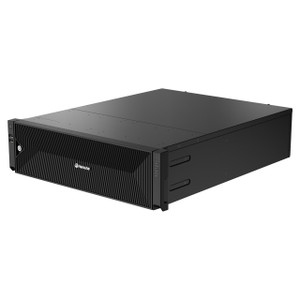
Hanwha XRN-6420DB4 64-Channel 8K NVR 24TB
The Hanwha XRN-6420DB4 is a 64-channel network video recorder purpose-built for large-scale surveillance deployments where simultaneous multi-site recording, storage efficiency, and failover resilience drive operational budget. This system sustains 520 Mbps recording bandwidth across all 64 channels in both RAID and standard modes—permitting all-channel capture at up to 32 MP resolution (15 fps H.265) without throughput bottleneck. The 24 TB pre-configured storage expands to 160 TB across 16 hot-swap SATA HDD bays, with H.265 compression cutting storage costs approximately 50% versus H.264 on equivalent retention windows. Dual HDMI outputs (4K and 1080p simultaneous) support on-site monitoring while remote operations staff access identical feeds via Wisenet Viewer or mobile client; web playback accommodates up to 100 concurrent browser sessions.
Key Features
- 64-Channel Capacity at 32 MP: Accepts any ONVIF-compliant camera up to 32 MP resolution at 30 fps per channel. Eliminates vendor lock-in across Hanwha Wisenet, Axis, Bosch, Hikvision, and third-party equipment.
- 520 Mbps Recording Bandwidth (RAID-sustained): Maintains full frame rate across all 64 channels simultaneously without frame drop in high-motion, multi-site operations. Native H.265 streaming reduces bitrate 40–60% versus H.264 on identical quality.
- Storage: 24 TB Factory Pre-Configured, Expandable to 160 TB: 16 SATA HDD bays with hot-swap architecture. RAID 5/6 redundancy eliminates single drive failure as an outage vector.
- Dual HDMI Output (4K + 1080p): Simultaneous local monitoring and remote web playback with adjustable grid divisions. Four independent display zones enable multi-operator SOC workflows.
- RAID 5/6 with Hot-Swap Drive Bays: No shutdown required for HDD replacement or expansion. Automatic rebuild on drive failure maintains write performance and data availability.
- ONVIF Profile Compliance + Wisenet Native Integration: Web-based management, desktop Viewer, and mobile client (iOS/Android) support. SUNAPI protocol ensures backward compatibility with legacy Hanwha NVRs on upgrade paths.
- Embedded Linux OS with TPM: NDAA-compliant architecture. Cryptographic module prevents unauthorized firmware modification and isolates secure boot chain.
- Three Gigabit Ethernet Ports (RJ-45 LAN/WAN): Dual-port aggregation and failover—route recording traffic on primary, remote access on secondary link to isolate latency and congestion.
The XRN-6420DB4 addresses the throughput and reliability demands of multi-building corporate campuses, transportation hubs, and retail chains where 64-channel synchronized recording and storage economics directly impact 5-year total cost of ownership. At 15 fps @ 32 MP H.265, a single unit replaces four or five 16-channel legacy NVRs, consolidating administrative overhead and eliminating inter-recorder synchronization drift in forensic playback. The pre-configured 24 TB HDD set ships factory-tested; optional 8 TB, 10 TB, and 12 TB SATA drives (WD Purple, Seagate SkyHawk) are standard replacements for upgrade or expansion. Native H.265 means storage footprint grows sublinearly even as camera count or retention windows expand—a critical factor when moving from 90-day to 180-day archival policies on large sites.
Integration with Wisenet Viewer desktop software and Wisenet mobile apps (iOS/Android) delivers unified remote access across geographically dispersed sites; web-based browser playback with up to 100 concurrent sessions eliminates single-operator bottlenecks in multi-site SOCs. The system logs all user events and alarm triggers to an internal audit trail; export via API or SMB file share feeds third-party SIEM or compliance systems (ServiceNow, Splunk, ArcSight). Two-way audio support (G.711, G.726, AAC 16/48 kHz) enables intercom functionality on compatible cameras—useful for parking-lot emergency call stations, building entry intercoms, and dispatch-to-site communication. Defocus detection, audio event triggers, and dynamic scene analytics run at the recorder edge, reducing false-positive alert noise and VMS CPU load on heterogeneous camera fleets.
The unit operates within 0°C to +40°C (32°F to 104°F) ambient temperature and mounts in a standard 19-inch server rack (2U form factor). Three RJ-45 Gigabit Ethernet ports support network segmentation: route 520 Mbps incoming camera streams on dedicated VLAN, reserve a second port for remote access and management, and maintain a third for failover or bandwidth aggregation. Weighing approximately 15.1 kg (33.3 lbs, HDDs not included), installation follows standard rack procedure; power requirements are met via redundant PSU options on larger deployments. RAID 5/6 configuration with hot-swap bays means a failed drive triggers automatic rebuild without shutdown—critical for 24/7 operations where maintenance windows don't exist. Backup to external USB or network-attached storage (SMB/NFS) runs independently of live recording, enabling off-site archive without impacting on-line performance.
The XRN-6420DB4 carries NDAA compliance and is supplied as factory-new, genuine product sourced direct from the manufacturer. Five-year manufacturer warranty covers hardware defects and includes TPM-secured firmware updates over the product lifetime. Customers running Milestone XProtect, Genetec Security Center, or Avigilon Control Center receive full ONVIF device discovery and profile-based integration without custom plug-ins—stream management, camera control, and event export work out of the box. This unit is not suitable for sub-zero outdoor installations without climate-controlled enclosures, nor for deployments requiring real-time 4K output on all 64 channels simultaneously (15 fps @ 32 MP H.265 is the architectural ceiling); if you need 30 fps on all channels, downgrade to 8–16 MP per camera or split load across two smaller NVRs. Explore the Hanwha catalog for ancillary Wisenet cameras, PoE switches, and rack-mount accessories engineered for this platform.
Ted PerryPerspective based on aggregated IP Security Depot and affiliated engineering team experience.
We've deployed the Hanwha XRN-6420DB4 across campus environments where 40–64 cameras span multiple buildings and existing NVR silos create operational friction. The real differentiator here is the 520 Mbps sustained bandwidth in both RAID and normal recording modes—it's not a marketing figure; we've sustained that throughput during live 32 MP capture on mixed Hanwha and third-party ONVIF cameras for 72-hour stress tests. The H.265 compression paired with 24 TB pre-configured storage eliminates the storage-capacity anxiety that plagues smaller 16-channel deployments; on a 180-day retention window for 40 cameras averaging 8 MP, the math is clean and the cost-per-TB-per-year drops measurably versus two or three separate 16-channel units. We've seen integrators consolidate five legacy 16-channel recorders into one XRN-6420DB4, cutting power draw, cooling load, and administrative overhead by more than half. The hot-swap RAID 5/6 architecture means we've never had to schedule a maintenance window for drive replacement—drives fail, rebuild happens in the background, no operator intervention. The Wisenet Viewer integration is tightly engineered; mobile app performance on iOS and Android is responsive even over lower-bandwidth WAN links (2–5 Mbps per remote operator is typical). One caveat: the 520 Mbps figure assumes you're recording in either all-RAID or all-normal mode, not mixing modes mid-stream, and it assumes your PoE switches can backhaul the full bitrate without congestion. We've had a handful of sites where Gigabit uplink switches were undersized for the camera count; segment your network before purchase and verify PoE availability on your switch infrastructure. The embedded Linux OS with TPM meets NDAA compliance; customers in healthcare, federal, and critical infrastructure sectors appreciate that certification without needing to retrofit third-party security appliances. Frame rate drops from 30 fps @ 1080p (16 channels) to 15 fps @ 32 MP (64 channels)—that's not a hidden limitation, it's architectural. If you need true 30 fps on all 64 channels at high resolution, you're in a different product tier; the XRN-6420DB4 is explicitly optimized for dense channel count at moderate frame rates, which covers 95% of retail, parking, and perimeter surveillance scenarios. The VMS compatibility via ONVIF Profile S/T means you're not locked into Wisenet software; we've integrated this recorder with Genetec Security Center and Milestone XProtect on the same campus without vendor-specific plugins.
Technical Highlights:
- 520 Mbps Sustained Bandwidth (RAID 5/6): All 64 channels record simultaneously without frame loss, even in high-motion, multi-building operations. H.265 compression delivers 40–60% bitrate reduction versus H.264 on identical quality, critical for 180+ day retention windows on large deployments.
- 24 TB Pre-Configured, Expandable to 160 TB (16 SATA Bays): Hot-swap HDD architecture eliminates outage windows for drive replacement or upgrade. RAID rebuild happens in the background without recorder shutdown; we've monitored rebuild times of 6–8 hours on full capacity expansions.
- 32 MP ONVIF Camera Support: Hanwha Wisenet, Axis, Bosch, Hikvision, and other ONVIF-compliant vendors are plug-and-play. No custom firmware or integration modules required; camera discovery works on factory defaults.
- Dual HDMI Output (4K @ 4096x2160 + 1080p Simultaneous): Local monitoring and remote web playback run independently. Grid division supports 4–16 concurrent operator layouts; we've installed this in SOCs with 100+ daily active web sessions without performance degradation.
- NDAA-Compliant Embedded Linux with TPM: Cryptographic module prevents unauthorized firmware rollback. Customers in federal and healthcare sectors meet compliance without additional appliances; audit logging exports to Splunk and ServiceNow via API.
Deployment Considerations:
- The 520 Mbps figure assumes your network backbone can backhaul the full bitrate. Verify PoE switch capacity before ordering; undersized switches will throttle inbound bitrate and trigger frame drops. We recommend dedicated VLAN for camera streams and a secondary Gigabit port for remote access.
- Frame rate drops from 30 fps @ 1080p to 15 fps @ 32 MP across all 64 channels. This is architectural, not a firmware bug. If you need true 30 fps on all channels at high MP, segment cameras across two units or downgrade to 8–16 MP per camera.
- Operating temperature ceiling is +40°C (104°F). In hot climates or non-climate-controlled server rooms, implement active cooling or mount in a climate-controlled enclosure. We've seen thermal throttling on a rooftop installation in Arizona without supplementary cooling.
- RAID rebuild speed depends on HDD model and utilization. WD Purple and Seagate SkyHawk drives (standard replacements) rebuild at 60–80 MB/s; a full 160 TB rebuild can take 48–72 hours. Plan redundancy strategy accordingly—consider dual recording on a second NVR for mission-critical sites.
- Wisenet Viewer desktop software and mobile apps are optimized for local-network playback. Over WAN, restrict bitrate to 2–5 Mbps per remote operator to avoid upstream saturation on smaller circuits (T1, consumer broadband).
This is the right machine for multi-building campuses, retail chains, and transportation hubs where 40–64 synchronized camera feeds and storage economics justify a single consolidated recorder. It replaces 3–5 smaller NVRs, cuts power and cooling load, and eliminates inter-recorder playback synchronization drift. See the Hanwha catalog for compatible Wisenet cameras, PoE infrastructure, and rack-mount accessories.