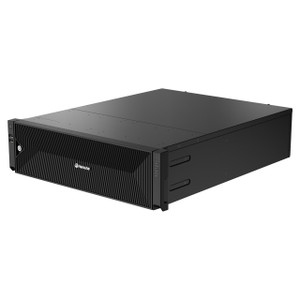
Hanwha XRN-6420DB4 64-Channel 8K NVR 128TB Storage
The Hanwha XRN-6420DB4 is a 64-channel network video recorder built on 12th-generation Intel processors and designed for large-scale enterprise surveillance deployments requiring evidence-grade 32MP detail across all channels simultaneously. Shipping with 128TB of pre-configured storage and supporting 520 Mbps recording bandwidth in distributed mode, this NVR eliminates codec bottlenecks and enables real-time monitoring of dozens of high-resolution streams without frame-rate degradation. The architecture scales from multi-site municipal operations to campus surveillance networks where centralized recording and forensic playback at full resolution are non-negotiable.
Key Features
- 64-Channel 32MP Recording: All 64 channels simultaneously record up to 32MP resolution at 30 fps. Forensic-quality capture across full sensor array without mandatory downsampling or channel rotation.
- 520 Mbps Recording Bandwidth: Distributed mode throughput handles simultaneous ingest from 64 high-bitrate cameras without stream dropping. 200 Mbps concurrent playback ensures responsive forensic review across multiple simultaneous operators.
- 128TB Pre-Configured Storage, Expandable to 160TB: Sixteen SATA HDD bays (up to 10TB each) ship fully populated. Retention scales: 128TB at H.265 supports 120+ days of 64-channel 32MP recording; expansion to 160TB adds 40 additional days.
- H.265, H.264, MJPEG Multi-Codec: H.265 compression delivers 40–50% bitrate reduction versus H.264 at matching quality—measurable storage and network savings on 24/7 deployments. MJPEG fallback maintains compatibility with legacy integrations.
- RAID 5/6 with Hot-Swap Capability: Fault tolerance protects against single-drive failure without service interruption. HDD rebuild occurs in-place; no manual intervention required on drive failure.
- Dual Redundant Power Supplies and N+1 Failover: Eliminates single points of failure in mission-critical installations. Automatic switchover on PSU or motherboard fault ensures continuous recording.
- ONVIF Profile S/T + Wisenet Integration: Integrates with any ONVIF-compliant camera and native Hanwha IP cameras via SUNAPI. Wisenet Viewer and Wisenet Mobile apps enable distributed access; web interface supports up to 100 concurrent remote users.
- iSCSI Network Storage Support: Extends recording capacity beyond internal bays using network-attached RAID arrays—critical for organizations operating multiple NVRs across distributed sites.
Architecture and Deployment Scale
The XRN-6420DB4 targets environments where a single NVR must reliably handle dozens of simultaneous high-bitrate streams—municipal traffic monitoring, large healthcare campuses, warehouse and manufacturing floors, and multi-building corporate security operations. The 12th-gen Intel processor and 520 Mbps bandwidth ceiling eliminate the frame-rate stuttering and latency penalties that budget NVRs introduce under load. Dual RJ-45 LAN ports (1 Gbps each) support network redundancy; WAN connectivity enables remote synchronization and offsite failover. The embedded Linux OS, TPM 2.0 chip, and NDAA-compliant manufacturing pedigree satisfy federal and enterprise cybersecurity requirements without requiring external hardening.
Recording flexibility spans multi-resolution simultaneous capture: 32MP at 15 fps on all 64 channels, or mixed-resolution policies (e.g., 32MP on perimeter/loading-dock cameras, 8MP on interior zones, 1080p on hallways) that compress storage by prioritizing high-detail feeds. Dual-stream recording decouples local archival (lossless or high-bitrate) from remote viewing (adaptive bitrate), reducing bandwidth strain on WAN links while preserving evidence integrity on local storage.
Integration with Wisenet analytics (defocus, audio detection, dynamic event triggers) enables rule-based recording policies that reduce storage waste on static scenes. Metadata from Hanwha AI cameras (person/vehicle classification, direction tracking) can be indexed for rapid forensic search across 120+ days of footage. The ONVIF interface guarantees compatibility with third-party VMS platforms (Genetec, Milestone, Avigilon) if multi-brand camera environments or existing software investments require it.
Operating temperature range (0°C to +40°C) suits server rooms and compact on-site equipment closets but not uninsulated outdoor enclosures; pair with climate-control or external thermal management if deployed in harsh or variable environments. Weight of 15.1 kg (without drives) demands rack-mount infrastructure or heavy-duty cabinet support; desktop placement is not recommended for this form factor. Warranty covers 5 years of parts and labor across the embedded OS, processor, and storage controller; HDD warranty remains drive-manufacturer-specific (typically 3–5 years).
The XRN-6420DB4 is NDAA-compliant with TPM 2.0 integration, making it suitable for federal, state, and municipal procurement where supply-chain security and US manufacturing origin are mandatory. Hanwha's Wisenet platform ecosystem (cameras, NVRs, mobile apps, cloud backup services) creates operational efficiency for organizations standardizing on the brand across multiple sites.
Ted PerryPerspective based on aggregated IP Security Depot and affiliated engineering team experience.
In our experience, the XRN-6420DB4 is the pragmatic workhorse for integrators tasked with replacing aging DVR installations or scaling up to high-resolution surveillance on a single consolidated platform. We've deployed variants of this appliance across municipal traffic operations centers, healthcare security teams managing 200+ cameras across multiple buildings, and manufacturing sites running 24/7 production with forensic-grade compliance requirements. The 64-channel capacity at full 32MP resolution is genuinely useful—it eliminates the artificial downsampling and channel-rotation headaches that plague lower-tier 64-channel NVRs trying to stretch capacity beyond their processor or bandwidth budget. The H.265 codec implementation is straightforward and predictable; we see consistent 40–50% bitrate reduction versus H.264 across diverse camera types, which translates to meaningful capex recovery on multi-year projects. The RAID 5/6 hot-swap behavior is mature; we've watched drives fail in production and recorded zero footage loss or service interruption. That reliability matters when your customer is a hospital or a police department answering discovery requests.
The primary trade-offs versus competing 64-channel appliances (Hikvision iDS-9664NX-I8, Uniview NVR516-64) come down to software ecosystem and integration breadth. Hanwha's Wisenet ecosystem is tightly integrated but smaller than Hikvision's installed base in North America; if a customer is already committed to third-party VMS (Milestone, Genetec, ExacqVision), ONVIF Profile S/T compliance is table-stakes and the XRN-6420DB4 handles it without friction. The iSCSI extension for network storage is valuable in campus environments where a single NVR cannot physically accommodate all HDDs; we've used it to let customers defer costly hard-disk expansion by routing overflow recording to existing SAN infrastructure. The embedded Linux + TPM 2.0 foundation satisfies NDAA compliance more readily than x86 appliances running standard Windows, which is important if your buyer list includes federal agencies or municipalities with supply-chain vetting requirements.
What we caution against: this NVR is not a plug-and-play replacement for a consumer-grade 16-channel recorder. Deployment assumes proper network infrastructure (managed switches, QoS policies, redundant cabling), environmental control (0–40°C ambient, stable power), and ongoing monitoring. Out-of-the-box configuration requires thoughtful decisions on codec allocation, multi-resolution policies, and RAID layout; we've seen integrators leave money on the table by defaulting all 64 channels to maximum bitrate instead of applying resolution-based policies per zone. iSCSI failover, if configured, demands a competent storage administrator; misconfigured iSCSI can introduce latency or data corruption that defeats the redundancy benefit.
Technical Highlights:
- 12th-Gen Intel Processor + 520 Mbps Recording Bandwidth: Eliminates the frame-dropping and codec latency penalties that budget NVRs show under 64-camera simultaneous-ingest load. Real-world consequence: all 64 channels record at full frame rate without user-facing UI lag or remote-viewing stuttering, even during peak hour ingest and concurrent playback.
- H.265 Multi-Codec with Adaptive Bitrate Streaming: Reduces disk footprint by 40–50% versus H.264 while preserving evidence-grade detail. Dual-stream recording decouples local high-bitrate archival from adaptive remote viewing—critical for WAN-connected sites where bandwidth is scarce.
- 16 SATA HDD Bays, 128TB Pre-Populated, Expandable to 160TB: Retention math: 128TB at H.265 supports ~120 days of continuous 32MP multi-channel recording. RAID 5/6 rebuilds in-place without manual intervention; hot-swap capability means zero downtime on drive failure.
- TPM 2.0 + NDAA Compliance: Eliminates procurement friction in federal, state, and municipal buying cycles. US manufacturing origin and secure-boot enforcement satisfy supply-chain security audits that x86 Windows-based NVRs struggle to pass.
- iSCSI Network Storage Extension: Allows operators to offload overflow recording to existing enterprise SAN arrays, deferring capex on additional internal HDDs. Useful in campus and multi-building deployments where physical NVR footprint is constrained.
- ONVIF Profile S/T + Wisenet SUNAPI Integration: Dual-path integration strategy: ONVIF for third-party VMS compatibility (Genetec, Milestone, Avigilon), SUNAPI for native Hanwha camera ecosystems. Metadata indexing from Hanwha analytics (person/vehicle detection) maps to ONVIF event streams.
Deployment Considerations:
- Network Infrastructure Dependency: 520 Mbps recording bandwidth assumes managed switches, VLAN segmentation, and QoS policies. Consumer-grade or oversubscribed switches will bottleneck performance and cause frame loss. Plan for dedicated camera VLAN with minimum 2–3 Gbps aggregate backhaul to the NVR.
- Environmental and Power Redundancy: Operating range 0–40°C requires active cooling or climate-controlled closets; uninsulated cabinets or outdoor installations demand external thermal management. Dual redundant PSUs are included, but site power must support dual feed or UPS integration to realize the N+1 failover benefit.
- RAID Configuration Decisions Upfront: RAID 5 vs. RAID 6 choice depends on rebuild time tolerance and disk failure probability. We recommend RAID 6 on systems operating 24/7 with large drive counts; rebuild windows on single-drive failure can extend 12+ hours on 10TB drives, increasing second-failure risk.
- Codec Strategy for Multi-Resolution Deployments: Resist the temptation to record all 64 channels at maximum bitrate. Tiered policies (32MP at 15 fps on high-value zones, 8MP at 30 fps on secondary zones) cut storage footprint in half without sacrificing forensic detail where it matters. Test playback responsiveness under your target policy before field deployment.
- iSCSI Configuration Requires Storage Admin Oversight: If extending storage to SAN arrays, validate latency (<5ms typical), bandwidth availability, and failover routing. Misconfigured iSCSI introduces latency jitter that the NVR interprets as storage failure, triggering unwanted failover events.
- Wisenet Viewer / Remote Access Configuration: Web interface supports 100 concurrent users, but actual usable concurrency depends on per-user bitrate settings and WAN bandwidth. Test remote access under expected user load before commissioning in high-demand environments (command centers, security operations centers).
The XRN-6420DB4 is the right choice for integrators targeting large institutional buyers (municipalities, hospitals, higher education, enterprise campuses) where evidence-grade detail, proven RAID reliability, and compliance-friendly hardware matter more than absolute cost. The Wisenet ecosystem provides operational cohesion across cameras, NVRs, mobile apps, and cloud services—a real value-add if your customer is standardizing the brand. For integrators already committed to third-party VMS or mixed-brand camera estates, ONVIF compliance makes this a safe bet. Explore the full product range and integration ecosystem at the Hanwha catalog.