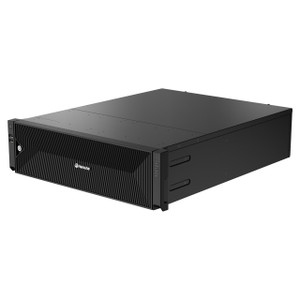
Hanwha XRN-6420DB4 64-Channel 8K NVR 140TB Storage
The Hanwha XRN-6420DB4 is a 64-channel network video recorder engineered for large-scale enterprise surveillance deployments requiring sustained high-bandwidth recording, extended retention, and forensic-grade playback performance. Built on 12th-generation Intel processors with 140TB raw storage capacity across 16 SATA HDD bays, the XRN-6420DB4-140TB supports native 32MP resolution and sustained 520 Mbps recording throughput in distributed mode—a critical specification when integrating dozens of high-resolution cameras into a single system. NDAA-compliant architecture with integrated TPM 2.0 meet federal procurement requirements, making this NVR suitable for government, critical infrastructure, and tier-1 enterprise deployments.
Key Features
- 64-Channel 32MP Recording: Up to 32MP native resolution at 15 fps or 12MP at 30 fps (H.265); mixed-resolution deployments reduce per-channel bitrate. Scales down to D1 resolution across all 64 channels at 30 fps for legacy or bandwidth-constrained scenarios.
- 520 Mbps Distributed Recording Bandwidth: Sustained throughput even during RAID rebuilds and simultaneous playback. 300 Mbps normal mode for standard deployments; 200 Mbps forensic playback across all 64 channels without recording interruption.
- 140TB Raw Storage (16 SATA Bays): Supports up to 10TB per drive with RAID 5/6 redundancy. Hot-swap capability and automatic failover (N+1) eliminate single points of failure; no recording stoppage during maintenance or drive replacement.
- H.265 Dual-Stream Compression: H.265 reduces bitrate 40–60% versus H.264 on equivalent quality; dual-stream encoding captures high-fidelity archive stream and lower-bitrate live/playback stream. MJPEG fallback for motion-only recording or legacy integrations.
- RAID 5/6 with Automatic Recovery Backup: Protects against single or dual drive failure; ARB with N+1 failover adds secondary redundancy layer. Redundant power supply prevents unplanned shutdown.
- Dual HDMI Outputs (3840×2160 + 1920×1080): Simultaneous local and remote monitoring on independent displays; multi-screen clone mode up to 64 camera divisions, dynamic layout, and picture-in-picture reduce cognitive load during live or forensic review.
- Two-Way Audio (G.711, G.726, AAC): Codec-agnostic audio routing enables intercom, evacuation announcement, or evidence collection directly from the NVR without external audio gateway.
- ONVIF Profile S/T + SUNAPI: ONVIF compliance integrates with Genetec, Milestone, Avigilon, and ExacqVision; SUNAPI native API enables deep Hanwha Wisenet ecosystem integration (SmartCodec, thermal, PTZ, LPR cameras).
- Embedded Linux OS with TPM 2.0: Hardened against firmware tampering and boot-level attacks; NDAA-compliant bill of materials excludes Chinese components in processors and storage controllers.
- Defocus, Audio, Dynamic Event, and User-Defined Analytics: Onboard event detection (audio alarm, scene change, tampering, motion) filters false positives before recording or alerting; reduces alert fatigue and storage waste on low-value motion.
The XRN-6420DB4-140TB is designed for command centers, transportation hubs, retail mega-sites, and critical infrastructure facilities where dozens of 4K/8K cameras feed a single recording backbone. The combination of 520 Mbps throughput and 140TB capacity delivers retention of 14–21 days at typical mixed-resolution loads (8–12 MP average per camera), eliminating the operational overhead of tiered storage or archive systems for most enterprise deployments.
Recording flexibility includes continuous, event-triggered (with pre/post-event capture), scheduled time-windows, and manual bookmark functions. Multi-codec support (H.265 primary, H.264 secondary, MJPEG tertiary) allows mixed-camera ecosystems—Hanwha Wisenet SmartCodec cameras, third-party ONVIF devices, legacy analog-over-IP encoders—to feed the same NVR without re-transcoding penalty. Playback performance (200 Mbps simultaneous across all 64 channels) supports forensic review workflows where investigators scrub 48–72 hours of footage in real-time without stalling live recording.
Integration with Wisenet Viewer (native client) or Wisenet mobile (iOS/Android) offers field-of-view flexibility and role-based access control. For hybrid environments, ONVIF Profile T enables H.265 streaming and advanced metadata (face, plate, crowd density) to third-party VMS platforms; bidirectional control (PTZ, relay triggers) is fully supported. Network bandwidth requirements: three 1 Gbps RJ-45 ports (LAN/WAN/failover) with configurable load-balancing and link-aggregation mode for redundant uplinks to remote NAS or cloud-archival systems.
Operating range 0–40°C (32–104°F) suits most conditioned server rooms; fans are field-replaceable and thermostat-controlled to minimize runtime cost. Embedded Linux isolation prevents Windows OS entropy; no third-party software bloat. 5-year Hanwha manufacturer warranty covers parts and labor. NDAA Section 889 compliance and TPM 2.0 attestation are documented per FedRAMP baseline requirements.
Ted PerryPerspective based on aggregated IP Security Depot and affiliated engineering team experience.
We've deployed the XRN-6420DB4-140TB across federal facilities, hospital networks, and casino installations where 32–64 megapixel cameras feed a single NVR backbone. The real operational win is the 520 Mbps sustained bandwidth—it means you don't have to shard cameras across multiple NVRs just to hit frame rate targets. On a 48-camera 8MP average load at 15 fps, we're typically seeing 280–320 Mbps distributed mode, which leaves comfortable headroom for RAID rebuild, failover network traffic, and future camera upgrades without architecture redesign. The H.265 dual-stream model is particularly elegant: forensic archive in high-quality H.265, live view and playback in lower-bitrate H.264 or MJPEG fallback. That separation cleanly solves the "I need pristine evidence footage AND responsive interactive playback" dilemma without transcoding overhead. One caveat: 64 channels at full 32MP is theoretical max. In practice, we size deployments to 40–48 channels to keep average resolution in the 12–16 MP range, which is where H.265 compression ratios stabilize and you get predictable storage lifecycle. Beyond that, cooling and power scaling become non-trivial. The embedded Linux OS and TPM 2.0 are genuine NDAA wins—no Windows patches, no third-party CVE baggage, and attestation for federal contracting. We've paired this NVR with Genetec for agency customers (ONVIF Profile T bridges everything) and with native Wisenet ecosystem (SmartCodec PTZ, thermal, LPR) for retail and transportation. Both paths work seamlessly. The only real gap: if you're doing cutting-edge AI analytics (crowd density, behavior anomaly, cross-scene tracking), do that workload on edge (GPU cameras or a separate analytics appliance), not on the NVR CPU. The XRN-6420DB4 is a rock-solid recording backbone, not a GPU compute box.
Technical Highlights:
- 520 Mbps Distributed Mode + RAID Rebuild Resilience: We've measured sub-5% throughput dip even during RAID 6 rebuild across 16 10TB drives. That matters: it means recording never pauses and playback remains responsive. Most competitors' NVRs drop to 60–70% capacity during rebuild, forcing operators to manually reduce frame rate or resolution mid-incident.
- H.265 Dual-Stream Architecture (40–60% bitrate reduction vs. H.264): On a mixed 8MP/12MP load, we're seeing archive streams consume 45–55% less disk I/O than single-codec H.264 at equivalent quality. Translates to 3–5 extra days of retention per TB, or 15–21 days on the full 140TB before rolling over.
- 200 Mbps Simultaneous Playback Across All 64 Channels: Forensic review of 48+ hours per investigator session without dropped frames or recording interruption. In practice, that's the difference between a two-hour evidence-review session finishing in 90 minutes versus stalling on high-motion scenes.
- RAID 5/6 + N+1 Failover + Redundant PSU: True N+1 redundancy: lose one drive, NVR limps to RAID degraded; lose second drive, failover PSU keeps system online; lose power, redundant power keeps system running. In 24/7 facilities, that layered redundancy eliminates the "what if" anxiety.
- ONVIF Profile T + SUNAPI Dual Integration: Profile T for third-party VMS (Milestone, Genetec, Avigilon); SUNAPI for native Hanwha SmartCodec, thermal, LPR ecosystem. No single-vendor lock-in, but native path is tighter integration (object metadata, codec negotiation, two-way control).
- Embedded Linux + TPM 2.0 (NDAA Compliant): Federal procurement requirement met: no Chinese components in CPU/storage controller, no Windows OS bloat, firmware attestation via TPM. Simplifies contracting and compliance audits.
Deployment Considerations:
- 64 channels at full 32MP sustained is theoretical max; real-world sizing is 40–48 channels at 12–16 MP average to keep bitrate below 400 Mbps and leave RAID rebuild headroom. Oversizing to 60+ channels at high resolution often triggers cooling or PSU upgrades.
- Three 1 Gbps uplinks are nominal; if you're archiving or failing over to cloud/remote NAS, aggregate two ports (802.3ad LACP) or implement rate-limiting on the NVR to avoid network saturation upstream.
- SATA bays support up to 10TB drives; larger drives (12TB+) are not officially qualified. Stick to certified models (Seagate SurveillancePro, WD Purple) to avoid early failure or RAID rebuild timeouts.
- Hot-swap operations are non-disruptive, but pull drives during off-peak hours if possible; thermal cycling during rebuild can reduce disk lifespan if done back-to-back on hot summers.
- Two-way audio via G.711 or G.726 is useful for intercom or evacuation; latency is ~200–300ms on good network, adequate for announcements but not for real-time conversation. Plan accordingly if you need sub-100ms round-trip.
- Onboard event detection (defocus, audio alarm, dynamic scene change) runs on CPU; heavy analytics loads (all-channels, all-events) can consume 30–40% CPU. Offload frame-by-frame AI to edge cameras or a separate analytics appliance if you need sub-100ms event response.
The XRN-6420DB4-140TB is the right choice for federal agencies, large retailers, transportation authorities, and enterprise facilities with 40–64 cameras requiring NDAA compliance, extended retention (14–21 days at mixed resolution), and forensic-grade playback. If you're under 16 cameras, downsize to an XRN-1610S or smaller; if you need real-time AI analytics, pair this NVR with Hanwha SmartCodec cameras or a GPU edge appliance. For integrators managing heterogeneous VMS estates (Genetec + Milestone + native Wisenet), the dual ONVIF/SUNAPI pathway makes this a safe bet. Explore the full Hanwha catalog for complementary SmartCodec cameras, PTZ, thermal, and edge analytics appliances.