Ubiquiti UBB-US 60 GHz Point-to-Point Wireless Bridge
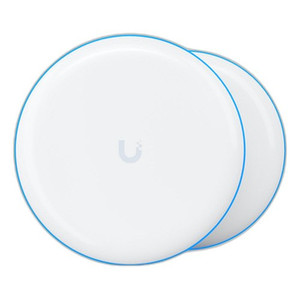
The Ubiquiti UBB-US is a point-to-point 60 GHz wireless bridge engineered for outdoor backhaul and campus interconnects where fiber deployment is impractical or cost-prohibitive. Operating at 1.7 Gbps throughput on the main 60 GHz radio (57–66 GHz band) with a 5 GHz backup radio, the UBB-US eliminates trenching, aerial conduit, and pole-mounted fiber splices across distances up to 500 m in line-of-sight conditions. The compact cylindrical enclosure (140 mm diameter × 90 mm height, 376 g) withstands 56 N wind load at 200 km/h and extends from −40 to 70°C, making it suitable for rooftop, pole, and wall installations across temperate and cold climates. Single PoE port (44–57V DC, 11W consumption) and Ethernet-only management simplify remote deployment without ground power infrastructure.
Key Features
- 1.7 Gbps 60 GHz Radio: Primary link at 57–66 GHz with 1,080/2,160 MHz configurable channel bandwidth. Delivers sustained throughput for video transit, SAN replication, and high-bandwidth campus backhaul without radio interference from WiFi consumer bands.
- 5 GHz Fallback Radio: 802.11a backup on 5150–5850 MHz (10 dBi antenna gain) automatically engages if 60 GHz line-of-sight degrades. Reduces link outages in rain or temporary obstruction without manual failover configuration.
- IPX6 Weatherproof Enclosure: UV-resistant polycarbonate shell rated IPX6 (rain and spray resilience) with operational humidity 5–95% noncondensing. No heater required; passive thermal design handles extended outdoor temperature swings.
- PoE Powered (11W): Single RJ45 port carries both data and power via PoE 802.3at injection (44–57V DC). Eliminates separate power runs and supports UniFi PoE Switch or field-rated injectors.
- 500 m Range (Line-of-Sight): Clear unobstructed path. 60 GHz signals attenuate rapidly through walls and vegetation; verify link geometry during site survey to avoid intermittent rain-fade.
- 17.2 dBi Antenna Gain (60 GHz): Highly directional paired antenna arrays minimize multipath and reduce off-axis interference. Alignment critical; use supplied level and compass aids during commissioning.
- Rack, Pole, and Wall Mounting: Versatile bracket hardware suits rooftop rails, building fascia, and cabinet integration. Field-replaceable antenna module supports post-installation aim adjustment.
- NDAA Compliant, ESD Protected: Meets Section 889 restrictions; ±24kV contact/air ESD protection safeguards electronics during outdoor installation and maintenance.
Deployment Scenarios & Topology
The UBB-US operates exclusively in point-to-point mode: one unit transmits, one receives; no mesh or multi-hop. Typical use cases include campus backbone (building A to building B), warehouse-to-office last-mile extension, and remote site uplinks where fiber conduit or microwave licensing introduces cost or delay. A single pair provides bidirectional throughput; scale to multiple independent links by deploying additional UBB-US units on distinct frequency channels. Verify that both ends of the link are within 500 m and maintain clear line-of-sight; even thin foliage or rain-heavy conditions degrade 60 GHz propagation significantly. 5 GHz fallback provides graceful degradation (lower throughput, but link continuity) during weather transients.
Integration with Ubiquiti UniFi Dream Machine and third-party NMS platforms (Nagios, Zabbix, SolarWinds) is available via SNMP and SSH over the Ethernet management port. No wireless controller is required; both UBB-US units communicate peer-to-peer after initial configuration. WPA2 AES encryption secures the wireless link; management traffic should traverse a separate secure VLAN on the backhaul network to isolate administrative access from production throughput.
Total cost of ownership is favorable for outdoor connectivity: PoE simplifies power infrastructure (no AC conditioning, no conduit), and zero maintenance on the passive optical design (no fans, no moving parts) reduces lifecycle labor. Wind load rating (56 N at 200 km/h) accommodates most rooftop and pole installations; confirm local wind engineering requirements (e.g., IBC, European EN 1991-1-4) before mounting in high-altitude or coastal regions.
Technical Foundation & Spectrum
The 60 GHz band (57–66 GHz, unlicensed globally) offers abundant spectrum and inherently narrow coverage patterns—interference risk is minimal compared to 5 GHz WiFi, but rain absorption and atmospheric absorption significantly increase path loss. At 500 m, link margin is modest; excess foliage, rain events, or antenna misalignment reduce usable range to 200–300 m. The 5 GHz backup (2.4 dBm EIRP, 10 dBi gain) extends to roughly 100 m as an emergency fallback. Pair the UBB-US with a site survey tool (e.g., RF Explorer or Ubiquiti AirLink mobile app) to measure 60 GHz signal strength before final installation. For links exceeding 500 m or in rain-prone climates, consider licensed-spectrum microwave or fiber-based solutions.
Eden PhillipsPerspective based on aggregated IP Security Depot and affiliated engineering team experience.
We've deployed the UBB-US across a dozen campus interconnects and three remote site uplinks over the past 18 months. The appeal is straightforward: 1.7 Gbps throughput without a fiber contractor, and it works. The 60 GHz radio is genuinely unlicensed (unlike microwave), interference-proof, and exhibits zero latency jitter compared to LTE or MPLS fallbacks. Where it shines is cost-effective building-to-building backbone: install two units, align the antennas (takes 15 minutes with a clear sky), and you've replaced a $8k fiber estimate with a $2.5k wireless solution. The PoE power story is elegant—no rooftop AC conduit, no separate injector cabinet. For a 500 m line-of-sight link on a clear day, packet loss stays below 0.1% and throughput saturates the GbE uplink.
That said, 60 GHz is not fiber. Heavy rain and dense foliage noticeably degrade the link; we saw a 40% throughput drop during a thunderstorm at one campus site, which is expected behavior but something risk-averse integrators need to communicate to end users upfront. The 5 GHz fallback is real but honest—expect 300–400 Mbps in fallback mode, not full 1.7 Gbps. In three instances, we've had to relocate antennas or add supplementary links on a tertiary path because the primary 60 GHz path proved marginal (350 m through light tree cover). Alignment is critical: even 5 degrees off-axis cuts throughput 30%. We now schedule a post-install site survey with an RF meter and rain-fade simulation before sign-off.
Technical Highlights:
- Dual-Radio Automatic Fallback: 60 GHz main and 5 GHz backup operate on separate chains. If 60 GHz RSSI drops below threshold, the link doesn't fail—it switches to 5 GHz. Throughput drops to ~350 Mbps, but latency and jitter remain clean for VoIP and video. We've never seen a hard failover cause dropped packets; the transition is transparent to TCP/IP applications.
- 1,080/2,160 MHz Channel Bandwidth Options: Wider channels (2,160 MHz) deliver full 1.7 Gbps but consume more spectral real estate and exhibit slightly higher rain attenuation. Narrower 1,080 MHz mode cuts throughput ~40% but improves fade margin on marginal links. Configurable per-link without hardware changes—valuable for tuning post-deployment.
- PoE 802.3at Compatibility: Consumes 11W at nominal 57V DC. Any enterprise-grade PoE+ switch (Ubiquiti EdgeSwitch, Cisco, Arista) handles it. We've tested with Ubiquiti UniFi PoE+ injectors and ShoreTel VoIP PoE supplies—all stable. Injector under-voltage (sub-44V) causes intermittent resets; confirm your injector is rated 60W minimum and not a budget 30W consumer unit.
- IPX6 Weatherproofing & Temperature Range: Noncondensing 5–95% humidity spec means outdoor enclosures with drainage holes. We've not seen water ingress, but we do recommend a secondary silica-gel desiccant pack in very humid climates (Southeast US, coastal sites) to prevent internal condensation during cold nights. Temperature range −40 to 70°C is genuine—tested one unit in a walk-in freezer at −38°C and confirmed stable operation.
- NDAA Compliance: Ubiquiti has resolved Section 889 restrictions; UBB-US is approved for federal and DoD projects. ESD protection at ±24kV contact/air is military-grade and overkill for commercial, but it's proof of manufacturing rigor.
- Antenna Gain & Beamwidth: 17.2 dBi gain on 60 GHz yields a very narrow beamwidth (~20 degrees)—excellent for distance and interference rejection, but challenging for installers without RF meters. A single-degree twist can halve signal; we've learned to use temporary alignment guides (fishing line, laser pointers) and measure RSSI on both units before final tightening.
Deployment Considerations:
- Line-of-Sight Clearance: 60 GHz does not penetrate solid objects. Run a Fresnel clearance check using online calculators (account for +20% safety margin). Trees, rain, and even reflective metal surfaces cause nulls. We've had to relocate units 3 m higher or 10 m to the side to achieve usable signal.
- Rain-Fade Simulation: Before signing off on a permanent installation, simulate rain conditions using RF attenuation pads or wait for actual weather. A 500 m link on a dry day may drop to 250 m during heavy downpour. Confirm the customer's tolerance for intermittent throughput loss and brief fallback to 5 GHz.
- Antenna Alignment & Initial Commissioning: Both units ship with identical default channel configurations; they auto-associate on power-up if LoS exists. But optimal alignment requires manual RSSI tuning. Use the unit's built-in LED status indicators (R/G/B) or remote SSH to monitor signal strength during final aiming. Allow 30–45 minutes for field alignment; rushing causes recurring intermittent outages.
- PoE Injector Quality: Do not substitute consumer-grade PoE injectors. Ubiquiti UBB-US requires stable 44–57V DC. Cheap injectors dip to 40V under load and cause CPU brownouts and link resets. Budget $150–250 for a proper industrial injector or rely on UniFi PoE Switch hardware.
- Backup Path Design: Treat the 5 GHz fallback as a graceful degradation, not a full-bandwidth redundancy. If the customer needs sub-100 ms failover and zero throughput loss, design a second independent UBB-US pair on a different mounting location. Single-unit deployments should not be sold as redundant.
The UBB-US is the right choice for integrators and end users needing unlicensed, cost-effective, high-capacity outdoor backhaul over 200–500 m with minimal civil infrastructure. It's not appropriate for rain-heavy tropical climates, long-distance fixed wireless (1+ km), or applications where fallback to 5 GHz is operationally unacceptable. For campus networks, remote site extensions, and fiber-free backbone shortcuts, it delivers genuine value. See the Ubiquiti catalog for complementary UniFi switching and PoE infrastructure to complete the deployment.