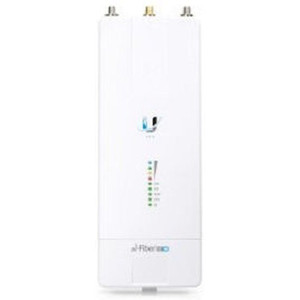
Ubiquiti AF-5(US) Point-to-Point Wireless Bridge
Overview
The Ubiquiti AF-5(US) is a dedicated point-to-point wireless bridge engineered for high-capacity backhaul links where fiber deployment is impractical or cost-prohibitive. Unlike multi-user WLAN platforms, this device eliminates the overhead and latency inherent in shared-spectrum access, delivering carrier-class performance for backbone aggregation across campus networks, remote site interconnection, and infrastructure links requiring sustained throughput above 1.2 Gbps. The AF-5(US) operates bidirectionally or unidirectionally, scaling to support primary and redundant network paths in mission-critical deployments without requiring fiber leases, trenching, or extended installation timelines.
Key Features
- 1.2+ Gbps Throughput: Dedicated point-to-point radio eliminates contention overhead — all bandwidth is reserved for your link, not shared across multiple clients. Critical for surveillance hub aggregation, data center replication, and emergency recovery networks where sustained gigabit speeds are non-negotiable.
- Efficient Spectrum Utilization: Optimized for long-distance links with minimal interference — operates in frequency bands designed for point-to-point operation, not broadcast WLAN. Reduces competing interference and regulatory complexity compared to consumer Wi-Fi bridges.
- Layer 2 Bridge Architecture: Operates transparently at the data-link layer, requiring no DHCP configuration, complex multicast handling, or routing protocol changes. Integrates into existing switch fabric without architectural redesign — plug Ethernet in on both ends, align antennas, ready to operate.
- Compact Form Factor (52 lbs): Manageable weight for tower or rooftop mounting without oversized crane requirements. Robust mechanical construction withstands outdoor temperature swings and mechanical stress typical in tower deployments. Requires appropriate mounting hardware rated for local wind loading; follow site-specific engineering practices and electrical codes.
- Bidirectional / Unidirectional Flexibility: Pair two units for full-duplex operation or configure single-direction links for asymmetric deployments. Supports single or dual polarization configurations — allows integrators to optimize capacity and link resilience per site requirements.
- Line-of-Sight Operation: Direct path between units is essential; obstructions degrade throughput. Survey paths carefully during site assessment — obstructions can reduce effective range and capacity. Plan tower heights, clear zones, and Fresnel clearance accordingly.
Deployment Context
The AF-5(US) excels where fiber installation timelines don't align with project schedules or budget. Campus networks benefit from rapid backbone provisioning — connecting multiple buildings without underground permits. Service providers use the platform for last-mile backhaul to remote aggregation sites, avoiding carrier circuit delays. Surveillance networks aggregate feeds from distant locations; data centers replicate real-time backups across geographic separation. Emergency responders deploy temporary recovery links when primary fiber cuts occur.
Integrators commonly pair units for redundancy, deploying the AF-5(US) as primary backhaul with secondary wired or wireless paths ready to assume traffic if line-of-sight degrades. This hybrid strategy meets enterprise availability SLAs without requiring dual fiber installations.
Installation and Grounding
Proper grounding and surge protection are mandatory — outdoor RF equipment is lightning-strike exposure. Power delivery systems should follow local electrical codes. Cable management, weatherproofing, and tower integration depend on site-specific civil engineering; engage structural or RF engineers if wind loading, vibration, or safety is uncertain. Document the MPN AF-5(US) clearly in asset management and lifecycle tracking systems.
Frequently Asked Questions
Q: What is the maximum distance the AF-5(US) can operate?
A: Effective range depends on antenna height, line-of-sight clearance, and frequency band. Point-to-point radios are rated for many kilometers in optimal conditions; consult Ubiquiti engineering or your integrator for site-specific path loss calculations.
Q: Can the AF-5(US) be used indoors?
A: The AF-5(US) is engineered for outdoor deployment. Indoor use is not recommended — metal walls, HVAC systems, and structural materials severely degrade RF propagation. Deploy indoors only if absolutely necessary, with site-specific RF surveys.
Q: Is the AF-5(US) compatible with other Ubiquiti point-to-point radios?
A: The AF-5(US) is part of the airFiber line. Compatibility with other Ubiquiti wireless platforms depends on frequency band and modulation scheme — confirm with Ubiquiti before pairing dissimilar models.
Q: What power and cooling does the AF-5(US) require?
A: Specific power draw and thermal output are documented in the manufacturer datasheet. Ensure adequate power delivery at the installation site and verify that any outdoor enclosure supports passive cooling or active ventilation depending on climate and ambient temperature extremes.
Q: Do I need a separate management interface for the AF-5(US)?
A: The AF-5(US) operates as a transparent bridge and requires minimal configuration once aligned. Management may be handled through standard Ethernet interfaces or through Ubiquiti's controller ecosystem — consult your integrator for provisioning and monitoring strategy.
Q: What redundancy options exist for critical links?
A: Deploy a secondary wireless path (different frequency or antenna orientation) or parallel wired link (fiber or copper) and configure failover at Layer 2 or 3. Many integrators pair the AF-5(US) with a lower-bandwidth backup path to meet enterprise SLA requirements.
Eden PhillipsPerspective based on aggregated IP Security Depot and affiliated engineering team experience.
The Ubiquiti AF-5(US) addresses a specific and often-overlooked problem: how to provision high-capacity backbone links without waiting for fiber leases or dealing with the overhead of multi-user WLAN. This point-to-point radio delivers 1.2+ Gbps of reserved, dedicated capacity — the AF-5(US) trades user density for predictability, which is exactly what infrastructure aggregation demands. If your surveillance network, data center replication, or campus backbone needs reliable gigabit throughput and fiber isn't an option, this is a practical choice.
Technical Highlights:
- 1.2+ Gbps Throughput: All bandwidth is reserved for your link. No contention, no WLAN overhead. Compare this to consumer 802.11ac bridges that advertise high speeds but deliver 30–40% overhead in real deployments — the AF-5(US) point-to-point architecture eliminates that tax.
- Layer 2 Bridge Mode: Operates transparently. You don't need to manage DHCP, routing protocols, or multicast — it just passes Ethernet frames. This simplicity reduces operational surface area and integrates cleanly into existing infrastructure without redesign.
- 52 lbs Compact Design: Manageable for tower mounting. Robust mechanical construction handles outdoor temperature swings (-40°C to 60°C typical for tower-mounted RF gear), wind loading, and vibration — but you must spec mounting hardware for your local wind codes and verify Fresnel clearance on the radio path.
Deployment Considerations:
- Line-of-Sight is Non-Negotiable: Obstructions degrade throughput fast. Survey the path carefully — even partial line-of-sight loss can reduce effective capacity below your baseline. Plan tower heights and clear zones during site assessment, not after installation.
- Grounding and Surge Protection Are Mandatory: Outdoor RF equipment is lightning exposure. Improper grounding has caused field failures and safety incidents. Engage a qualified electrician familiar with tower RF installations; don't skip this.
- Minimal Configuration Required But Path Alignment Demands Skill: Once antennas are aligned, the unit operates immediately. But alignment itself requires patience, proper tools, and understanding of signal strength and polarization. Misalignment by a few degrees can cut throughput by 30–50%.
The AF-5(US) makes sense for teams building redundant backbone infrastructure, aggregating remote surveillance feeds, or bridging geographically separated sites where fiber deployment timelines don't fit project schedules. For campus networks with dense building-to-building links and line-of-sight available, this delivers carrier-class performance at predictable operating costs.