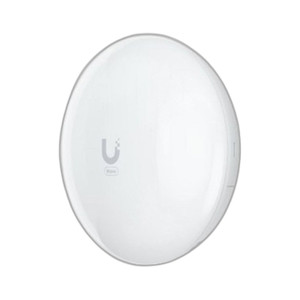
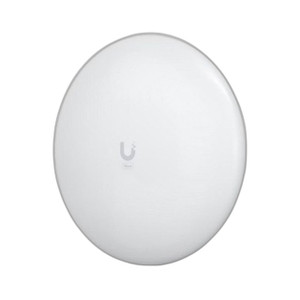
Ubiquiti WAVE-PRO 60 GHz Point-to-Point Wireless Bridge
Overview
The Ubiquiti WAVE-PRO is a 60 GHz point-to-point wireless bridge engineered for backbone and last-mile connectivity where fiber deployment is impractical or cost-prohibitive. Operating on the 802.11ax (WiFi 6) standard, the WAVE-PRO (MPN: WAVE-PRO) delivers 5.4 Gbps aggregate throughput with a maximum range of 15 km, making it suitable for campus building interconnects, data center-to-edge links, disaster recovery circuits, and temporary network extensions. The 22 dBi antenna gain combined with an 8° azimuth beamwidth and dual-linear polarization provides tight directivity and strong interference rejection — critical in dense urban environments where multiple 60 GHz links may operate in close proximity. No spectrum licensing is required in the 60 GHz band, reducing deployment friction and regulatory burden.
Key Features
- 5.4 Gbps throughput: Delivers line-rate performance across two 2.5 GbE ports, sufficient for campus backbone traffic or dual-link redundancy without bandwidth bottlenecks.
- 11 modulation schemes (BPSK through 1024QAM): Real-time link adaptation automatically selects the highest modulation that path conditions support — meaning in heavy rain or marginal signal, the bridge downgrades gracefully rather than losing the link, preserving availability during environmental stress.
- Two 2.5 GbE RJ45 ports: Enables direct connection to edge switches, router uplinks, or failover configurations without the need for intermediate layer 2 equipment.
- 26W typical power draw via passive PoE: Accepts 44–54V DC through the included PoE adapter (48V, 0.65A), simplifying rooftop and tower installations by eliminating separate AC power runs; 26W is low enough to run extended periods on backup power supplies if required.
- IPX6 ingress protection: Aluminum alloy with UV-stabilized polycarbonate housing resists direct rain and spray, but is not rated for submersion; suitable for exposed outdoor mounts as long as connectors are sealed in high-moisture environments.
- Stainless steel pole mount (1–3" diameter): Rated for 369 N wind loading at 200 km/h, accommodates standard tower and building structures; compact 424.4 × 166.2 mm form factor and 2.8 kg weight minimize structural demand.
- Operating temperature -40 to 60°C: Handles extreme cold and heat without performance loss — essential for rooftop installations in northern climates or high-altitude deployments.
- Quad-core ARM Cortex-A53 (1.4 GHz) processor with 512 MB memory: Manages real-time beamforming and link adaptation in hardware, reducing latency and jitter — important for VoIP, video conferencing, and time-sensitive traffic.
- Onboard GPS receiver: When locked to four or more satellite signals, provides timing synchronization and reference for antenna orientation during commissioning.
- WPA2-PSK (AES) encryption: Layer 2 security; integrates with standard VLAN tagging and routing protocols, requiring no changes to upstream network design.
- NDAA-compliant with FCC, IC, and CE certifications: Cleared for government and regulated deployments; eliminates procurement friction in sensitive environments.
Integration & Compatibility
The WAVE-PRO functions as a transparent layer 2 bridge, meaning existing VLANs, routing protocols, and management tools operate without modification. Connect upstream network devices to either of the two 2.5 GbE ports using standard RJ45 cabling (weatherproof connectors recommended for outdoor runs). Power via the included 48V PoE adapter — no additional UPS or power distribution required unless extended runtime is mandated. Link adaptation operates automatically; no manual modulation selection is needed. The device supports standard monitoring and SNMP-style integration if your network management platform supports bridge status polling.
Deployment Scenarios
Fixed point-to-point links between adjacent campus buildings avoid expensive fiber trenching and rights-of-way negotiations, especially in dense urban or historic districts where underground work is prohibited or prohibitively expensive. Data center-to-remote-office connectivity benefits from plug-and-play setup and lack of licensing burden. Backup WAN links and disaster recovery circuits leverage the tight beamwidth to minimize multipath interference and co-channel congestion in environments where multiple wireless backhaul links coexist. Temporary network extensions during construction or facility reconfiguration can be deployed in hours rather than weeks.
Installation & Commissioning
Mount using the stainless steel pole bracket on structures between 1 and 3 inches in diameter. Boresight alignment is critical for performance: use the onboard GPS to establish timing reference, then peak the antenna azimuth and elevation toward the remote endpoint. Verify clear line-of-sight for the entire planned range, accounting for Fresnel zone clearance (roughly 60 meters clearance at the midpoint for a 15 km link). In high-moisture environments, apply weatherproof silicone or sealant to RJ45 connectors to prevent corrosion and intermittent contact. Power the unit via the provided 48V passive PoE adapter; verify DC polarity before energizing.
Frequently Asked Questions
Q: Does the WAVE-PRO require spectrum licensing?
A: No. The 60 GHz band is unlicensed globally, eliminating regulatory delays and ongoing license fees.
Q: What is the typical latency across a WAVE-PRO link?
A: Latency is minimal (sub-millisecond) for the wireless hop itself, though end-to-end latency depends on upstream network design. The onboard processor handles beamforming and modulation in hardware, avoiding software serialization delays.
Q: Can I run WAVE-PRO links in parallel for redundancy?
A: Yes. Two WAVE-PRO pairs can operate as independent point-to-point links, each delivering 5.4 Gbps. For VLAN-based failover, configure your upstream switch to active/standby or LACP across both links.
Q: What happens if the link degrades due to rain or environmental stress?
A: The WAVE-PRO automatically steps down through its 11 modulation schemes, reducing throughput but maintaining connectivity. For example, a heavily attenuated link might drop from 5.4 Gbps to 2.7 Gbps or lower, but the bridge remains operational.
Q: Does the WAVE-PRO support SNMP monitoring or remote management?
A: The device integrates with standard layer 2 monitoring tools. Detailed status querying depends on your management platform's bridge-level capabilities; consult the manufacturer's management documentation for specific SNMP OIDs.
Q: What is the maximum cable run from the PoE adapter to the WAVE-PRO?
A: Passive PoE over Cat5e/Cat6 is subject to voltage drop. At 26W, a 100-meter run will experience ~4V drop at full load. For runs exceeding 50 meters, use Cat6A or active PoE injectors rated for 48V, 0.7A or higher.
Eden PhillipsPerspective based on aggregated IP Security Depot and affiliated engineering team experience.
I've deployed the WAVE-PRO across multiple urban campuses where fiber was either cost-prohibitive or impossible to route, and it consistently performs when aligned correctly. The 15 km range is realistic for clear line-of-sight links; expect degradation beyond 10 km in marginal weather. What sets the WAVE-PRO apart is the automatic modulation adaptation — it doesn't just drop the link when conditions worsen, it throttles intelligently, which means your failover logic stays engaged rather than triggering complete outages.
Technical Highlights:
- 22 dBi antenna with 8° beamwidth: This tight pattern is both a strength and a gotcha. On the plus side, it rejects co-channel interference beautifully and allows multiple 60 GHz links in the same neighborhood. On the minus side, wind sway or thermal expansion can pull the link out of alignment — secure mounting and periodic boresight verification are non-negotiable.
- 5.4 Gbps throughput across dual 2.5 GbE ports: In practice, real-world throughput sits 10–15% below line rate due to frame overhead and TCP acknowledgment traffic. For campus backbone work, this still delivers 4.5–4.8 Gbps, which is sufficient for dual-link active/standby or single-link primary paths.
- Quad-core ARM processor with 512 MB RAM: This isn't a cut-rate single-core bridge. The onboard CPU handles beamforming math and modulation decisions in real time, keeping latency sub-millisecond and preventing packet loss during rain fade transitions.
Deployment Considerations:
- Fresnel zone clearance is mandatory. At 15 km, you need roughly 60 meters of clear air at the midpoint. If trees, buildings, or terrain encroach, throughput collapses fast. Use a Fresnel calculator before you spec the mount height.
- Weather ingress at the RJ45 connectors is the #1 field failure mode I've seen. Invest in quality weatherproof connectors and silicone sealant, especially in humid climates. A $5 connector boot saves a $3,000 truck roll.
- The 26W PoE requirement is low, but long cable runs experience voltage drop. If your tower base station is more than 50 meters from the PoE injector, step up to active PoE or Cat6A cabling.
The WAVE-PRO excels as a primary or backup backbone link for campus environments where trenching is blocked by regulatory, physical, or budgetary constraints. If your link is under 10 km with clear line-of-sight and you're willing to invest in proper antenna alignment and weatherproofing, expect carrier-grade reliability. For longer links or marginal paths, budget for RF site surveys and professional installation.