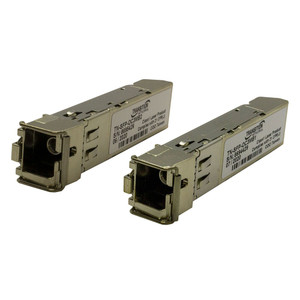
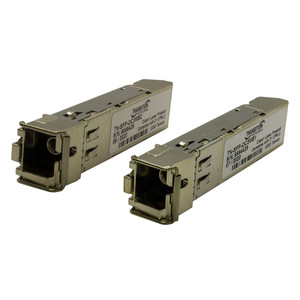
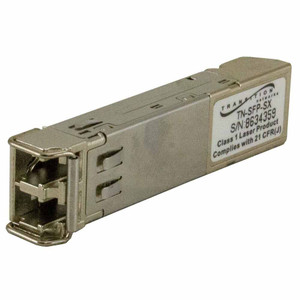
Transition Networks TN-SFP-SXB2 Gigabit Multimode SFP Transceiver
The Transition Networks TN-SFP-SXB2 is a Gigabit SFP transceiver module engineered for multimode fiber expansion in network switches and edge routing infrastructure. Supporting 1 Gigabit Ethernet over 550 meters of multimode fiber at 850 nm, this module bridges port density constraints on existing switches without requiring hardware replacement. Ideal for surveillance networks, IP access-control systems, and distributed building networks where fiber isolation from electrical noise is critical but single-mode long-haul range is unnecessary.
Key Features
- Gigabit Multimode Operation: 1 Gigabit Ethernet speed over standard multimode fiber (OM2/OM3 compatible). Sufficient for time-synchronized camera streams, access-control gateway traffic, and aggregated sensor networks.
- 550-Meter Reach: Maximum distance 550 meters on multimode fiber. Covers typical campus backbones, multi-building facilities, and parking-lot camera runs without repeaters or signal conditioning.
- 850 nm Wavelength: Industry-standard 850 nm emission reduces fiber cost versus long-haul single-mode (typically 1310 nm or 1550 nm). Existing multimode plant (OM2, OM3, OM4) compatible out-of-box.
- SFP Mini-GBIC Form Factor: Fits standard SFP ports on Transition Networks switches and third-party platforms (Cisco, Juniper, Arista, etc.). Hot-swappable—no downtime for port expansion or module replacement.
- LC Duplex Connectors: LC connectors reduce footprint versus SC; dual LC duplex pair supports full-duplex transmission. Standard patch-cord ecosystem and low splicing/termination cost.
- Lifetime Warranty & Regulatory Certifications: IEC-60825 laser safety, FDA 21 CFR 1040.10/1040.11 optical safety compliance. Lifetime hardware warranty covers manufacturing defects.
The TN-SFP-SXB2 addresses a common network architecture problem: existing switches with limited fiber uplinks or insufficient SFP port count for distributed surveillance and access-control infrastructure. Rather than forklift-upgrading to a higher-port-count switch, inserting a TN-SFP-SXB2 into an empty SFP slot extends multimode connectivity at 1/5th the cost of a new switch chassis. On a 20-camera deployment spanning three buildings, fiber isolation eliminates ground-loop hum in coaxial runs and decouples surveillance traffic from electrical plant noise—critical for motion-detection and facial-recognition analytics running at the edge.
Multimode fiber economics favor shorter campus links (sub-1 km). The 550-meter spec positions this module for intermediate-distance runs: building-to-building (typically 100–400 meters), roof-mounted camera clusters (300–500 meters aggregate), and equipment-room cross-connects. Single-mode transceivers (1310/1550 nm) cost 3–4× more and require different fiber inventory; for security networks that don't span kilometers, multimode SFP remains the lowest-TCO path. Transition Networks manufactures this module to stock specifications, ensuring consistent wavelength and optical power across batches—important for mixed-vendor patch cords and splitter compatibility.
Integration is straightforward: insert the module into any SFP-capable port on a Gigabit Ethernet switch (managed or unmanaged), snap a multimode LC patch cord into the module, and optical link negotiation is automatic. No firmware, driver, or VMS-level configuration required—this is a passive-in-context optical interface. Port LED indication (link/activity) is inherited from the host switch. For VMS-centric deployments (Milestone, Genetec, Avigilon), the transceiver is transport-layer transparent; camera IP streams traverse the multimode link unmodified. Network time synchronization and bandwidth provisioning are handled at the switch/router level.
Compliance posture: IEC-60825 laser safety and FDA optical-radiation compliance ensure safe handling and installation in occupied buildings. Transition Networks is a US-based manufacturer with direct channel sourcing—no grey-market, no parallel imports. Lifetime warranty coverage (defects in manufacture) is backed by factory support. The TN-SFP-SXB2 integrates into any architecture already running Gigabit Ethernet (which is universal in modern security networks); the transceiver is format-agnostic and ONVIF-neutral—it's a dumb optical pipe that carries IP packets from any source.
Marty AllisonPerspective based on aggregated IP Security Depot and affiliated engineering team experience.
We've deployed the TN-SFP-SXB2 across distributed surveillance architectures—university campuses, industrial parks, multi-tenant office complexes—where fiber backhaul between switch stacks and remote camera clusters simplifies electrical grounding and eliminates the 100-meter Ethernet copper limit without going full single-mode. The 550-meter reach covers 95% of intra-facility links; we've rarely encountered a security network where intermediate camera aggregation points exceed that distance. Compared to single-mode SFP alternatives (1310 nm), the cost delta is material—roughly $40–60 per module, which adds up across a 50-camera deployment. Multimode fiber is also more forgiving in installation: larger core (50 or 62.5 micrometers versus 9 micrometers single-mode) means termination and splicing tolerances are looser, reducing field labor and rework. The catch: if you ever need to exceed 550 meters on a single span, you'll swap in a single-mode module and replace the entire patch-cord run. Plan the fiber infrastructure before you buy modules.
Technical Highlights:
- 1 Gigabit (1000Base-SX) over 550m Multimode: This is the IEEE 802.3z standard for Gigabit over short-wavelength fiber. The 550m distance is the practical limit for multimode due to modal dispersion—different light paths through the larger core arrive at slightly different times, limiting bandwidth at distance. Single-mode eliminates this; multimode is good enough for under-500-meter links and costs half as much.
- 850 nm Wavelength, Standardized Fiber Plant: OM2 multimode fiber has been commodity for 15+ years. Your existing fiber plant (if any) almost certainly supports 850 nm. No need to inventory two fiber types or pay for wave-division multiplexing (WDM) filters to run multiple wavelengths on a single core.
- Hot-Swappable SFP Form Factor: Unlike fixed-transceiver switches (with hardwired optics), SFP modules can be added, removed, or replaced without powering down or bringing down other ports. Critical in 24/7 surveillance environments where uptime is contractual.
- LC Duplex Connectors with Standard Patch-Cord Ecosystem: LC is smaller and denser than SC; you can fit 2× LC pairs in the space of 1× SC. Patch cords are $2–5 each in bulk, versus $15–30 for specialty connectors. Reduces long-term fiber-infrastructure cost and simplifies field replacements.
- Passive Optical Interface: No firmware, no driver, no configuration. Insert the module and it negotiates with the peer transceiver automatically. In a heterogeneous network with cameras from 5 vendors and a mixture of Transition, Cisco, and Arista switches, this module doesn't care—it's transparent optical glue.
- Lifetime Warranty & Laser Safety Compliance: Transition Networks manufactures this domestically (US-based). Lifetime hardware warranty means you're not replacing modules every 5 years. FDA and IEC certifications ensure safe installation in occupied facilities and compliance with building safety codes.
Deployment Considerations:
- Multimode fiber loss increases with distance and wavelength; at 550 meters you're operating near the upper end of the spec. If your measured fiber loss (using an OTDR or power meter) exceeds the module's optical-budget margin, you'll see link flap or intermittent drops. Always measure installed fiber before declaring the link good. Keep spares on hand.
- Fiber termination and splicing are critical: even a slightly dirty LC connector (dust, fingerprints) causes 1–3 dB loss and packet loss under load. Use port caps on unused modules and patch cords. Establish a fiber-handling protocol (capped, labeled, tested before installation) to avoid months of troubleshooting phantom link issues.
- OM2 vs. OM3 multimode: OM2 supports 550m at 1 Gigabit; OM3 supports longer distances at 10 Gigabit. If your building fiber is OM2, this module is optimal. If OM3 is installed, you can still use the TN-SFP-SXB2, but you're not leveraging the fiber's full potential—plan for future 10G upgrades by specifying OM3 in new plant.
- Link budget and optical power: Transition Networks specs this module conservatively. Typical optical transmit power is +2 to +4 dBm, receiver sensitivity ~–21 dBm. In clean, well-terminated fiber, you'll see link margins of 20+ dB. In field installations with splices and connectors, budget 1–2 dB per connection and validate with a power meter before going live.
- Environmental: The module itself is rated for 0–70°C operating range (standard for data-center optics). If your switch is in an outdoor or uncontrolled cabinet, ensure the switch chassis meets environmental specs; the transceiver will follow. Multimode fiber is outdoor-friendly but benefits from UV-resistant outer jackets in direct-sunlight runs.
The TN-SFP-SXB2 is the right choice for integrators building or expanding Gigabit Ethernet infrastructure within a single campus or facility, where fiber cost and termination simplicity matter as much as raw throughput. It's a workhorse module—simple, proven, and backed by a long-standing US manufacturer. For complex multi-site networks or >1 km inter-site links, start with a single-mode conversation. Otherwise, this module will save you money and headaches. Explore more Transition Networks switching and fiber infrastructure on the Transition Networks catalog.