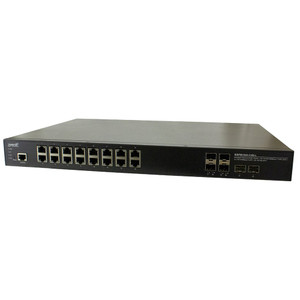
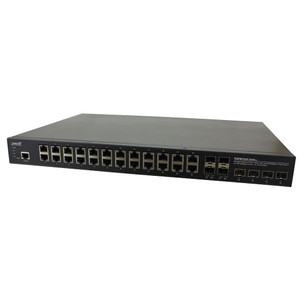
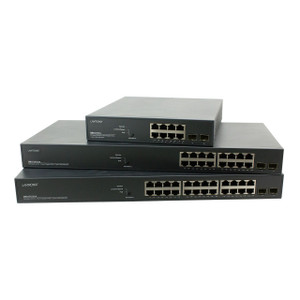
Transition Networks EO2PSE4052-111 32-Port Gigabit PoE+ Fiber Switch
Overview
The Transition Networks EO2PSE4052-111 is a 32-port Gigabit unmanaged switch purpose-built for field deployment in fiber-backbone networks. It combines local powered port expansion with single-mode fiber connectivity, eliminating the need to run separate power distribution to remote equipment cabinets or outdoor enclosures. The DIN-rail form factor fits standard 19-inch panel setups, making it a practical choice for distributed antenna systems, warehouse automation hubs, and security infrastructure where fiber runs are already in place but powered Gigabit ports are needed at the endpoint.
Key Features
- 32 Gigabit PoE+ ports: All 32 ports deliver IEEE 802.3at+ power, so any PoE-compatible device—IP camera, wireless access point, industrial sensor, or powered switch—draws power from the same infrastructure without external PSUs. This cuts installation cost and cable clutter at the remote site.
- Single-mode fiber uplink: Extends connectivity across longer distances (10+ km feasible with proper optics) without signal degradation, critical when your core network is already fiber-based. Avoids the need for copper runs across campus or between buildings.
- Unmanaged design: Zero configuration required. Plug in, power on, and it forwards frames. No VLAN setup, no firmware updates, no web interface—attractive for sites where IT overhead is minimal or where field technicians lack networking expertise.
- DIN-rail mounting: 35mm profile fits directly into industrial control cabinets, telecom distribution frames, and outdoor weatherproof enclosures. Saves space compared to desktop switches and aligns with IEC 61076 standard panel conventions.
- Compact power footprint: Unmanaged architecture means lower idle draw compared to managed models, reducing cooling requirements in enclosed remote cabinets.
- Gigabit backplane: Full line-rate switching across all 32 ports—no bottlenecks if multiple cameras or sensors transmit simultaneously. Typical in surveillance and industrial automation where burst traffic from sensors can spike.
Integration & Deployment Context
This model fits two primary scenarios. First, network switch installations where your backbone is already fiber (common in large campuses, manufacturing plants, or carrier-grade deployments) but your edge devices—surveillance cameras, access control readers, IoT nodes—require both power and network connectivity. The EO2PSE4052-111 consolidates that at the remote end, reducing the number of cable runs to the field cabinet.
Second, it integrates well into power infrastructure planning for distributed systems. Since all 32 ports deliver PoE+, you avoid mixed scenarios where some devices use PoE and others require 24VDC. Simplifies inventory and reduces integration risk on medium-to-large rollouts.
The unmanaged nature means it does not filter traffic, tag VLANs, or enforce quality-of-service rules—acceptable for flat-network topologies but not for segmented enterprise LANs. If you need VLAN isolation or managed switching, consider a managed alternative in the Transition Networks portfolio.
When to Choose a Different Model
If your network topology requires VLAN tagging, link aggregation, or per-port traffic shaping, the unmanaged EO2PSE4052-111 will not deliver those controls. Likewise, if your remote site lacks fiber already and you cannot justify a fiber run, a standard copper Gigabit PoE+ switch (likely more compact and cheaper) may be more practical. Finally, if you need SNMP monitoring or syslog alerting from the switch itself, step up to a managed variant.
Frequently Asked Questions
Q: Does the EO2PSE4052-111 work with standard single-mode fiber optic modules?
A: Yes. It accepts standard LC, SC, or ST single-mode transceiver modules (SFP). Verify compatibility with your module vendor and confirm the distance and wavelength ratings match your fiber run.
Q: How much PoE+ power does each port deliver?
A: Each of the 32 ports delivers full IEEE 802.3at+ (PoE+) power, rated up to 30W per port. This covers most IP cameras (including PTZ units), wireless access points, and industrial PoE devices. Confirm your specific device's power draw against the switch's per-port budget.
Q: Can I stack or daisy-chain multiple EO2PSE4052-111 units?
A: Each unit stands alone as an unmanaged switch. You can deploy multiple units in the same cabinet or location, each with its own fiber uplink, but they do not stack or cluster as a single logical switch. Each operates independently.
Q: Is the EO2PSE4052-111 suitable for outdoor cabinet deployment?
A: The switch is designed for indoor field cabinets and distribution frames. If deploying in an outdoor enclosure, ensure the enclosure itself provides adequate environmental protection (temperature, humidity, dust ingress). The switch does not include weatherproofing of its own.
Q: What's the typical power consumption?
A: As an unmanaged switch with no moving parts, idle power draw is minimal. When all 32 ports are active and delivering PoE+ to devices, total system power consumption scales with the attached load. Refer to the datasheet for the power supply specifications required to support your deployment scenario.
Q: Does this switch support SNMP or any management protocol?
A: No. The EO2PSE4052-111 is unmanaged and does not expose SNMP, Telnet, SSH, or HTTP interfaces. There is no way to monitor or configure it remotely. It operates as a true plug-and-play bridge.
Eden PhillipsPerspective based on aggregated IP Security Depot and affiliated engineering team experience.
The Transition Networks EO2PSE4052-111 (often searched as EO2PSE4052 111) solves a specific infrastructure problem: you have fiber runs to remote sites, but you need to power devices at the endpoint without adding a second power feed. The 32 Gigabit PoE+ ports mean you consolidate power and network into one fiber connection—a real cost and logistics win on distributed deployments like multi-building campuses or warehouse zones fed by a fiber backbone.
Technical Highlights:
- 32 ports, all PoE+: IEEE 802.3at+ on every port means no mixed architectures. Any PoE device you connect draws power from the switch; no need to jumper between PoE and 24VDC busses or manage separate supply circuits at the edge.
- Single-mode fiber uplink: Extends your network reach 10+ km without copper degradation, critical for industrial sites or campus deployments where fiber is already the backbone. Simplifies cabling and avoids the cost of additional copper runs.
- Unmanaged, DIN-rail mount: Zero configuration, minimal footprint in a standard 19-inch panel. Deploy, power on, forget about it. Field technicians do not need networking knowledge to install this.
Deployment Considerations:
- No management features: This is flat-network gear. If you need VLAN isolation, link aggregation, or per-port traffic shaping, you'll outgrow the EO2PSE4052-111. Plan for that upfront in your design.
- PoE budget scales with load: While each port can deliver 30W, the total available power is constrained by the PSU you provision. Running 32 devices at max power requires a substantial power supply and cooling in the cabinet. Do the math on your actual device count and wattage per device before committing to full-port deployment.
Position this for fiber-fed remote hubs in surveillance networks, warehouse automation zones, and industrial control sites where you have fiber already in place and need to simplify power distribution. It is not a managed backbone switch, and it's not for sites still running all copper—but for the niche it fills, it eliminates a separate power infrastructure problem.