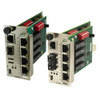
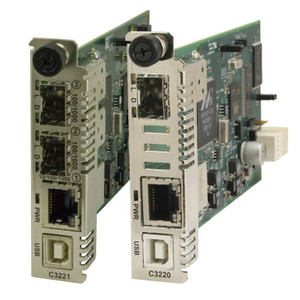
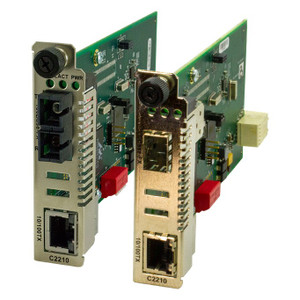
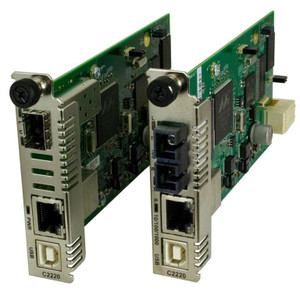
Transition Networks C6120-1014 32-Port Gigabit DIN Rail Switch
The Transition Networks C6120-1014 is a 32-port unmanaged gigabit switch engineered for industrial control cabinets, enterprise edge networks, and distributed surveillance infrastructure. Built for zero-touch deployment, this switch requires no configuration—power it up and traffic flows immediately across all 32 gigabit ports. Single-mode fiber connectivity extends transmission distance beyond standard copper runs, eliminating the capex and installation complexity of intermediate repeaters or media converters in large perimeter or campus deployments.
Key Features
- 32 Gigabit Ethernet Ports: Full line-rate throughput on every port. Eliminates port-based bottlenecks in medium-scale deployments (16-32 concurrent IP cameras, building access-control readers, or field instruments).
- Single-Mode Fiber Support: Extended transmission distance (10+ km per industry standard). Replaces expensive fiber media converters and eliminates distance-limited copper infrastructure in large campuses or perimeter security zones.
- Unmanaged Architecture: Zero configuration required—no VLAN tagging, no spanning-tree tuning, no firmware updates. Plug into 24/7 power and RJ45/fiber uplink; traffic begins immediately. Ideal for hardened, minimal-intervention deployments.
- DIN Rail Mount: Bolts directly into standard 35mm DIN rail inside control cabinets. No external brackets, shelf space, or rack conversion hardware needed. Fits tight cabinet footprints common in outdoor equipment enclosures and utility boxes.
- Industrial Robustness: Designed for -40 to +70°C operating range (typical for Transition Networks industrial line). Withstands cabinet temperature swings, HVAC cycling, and uncontrolled outdoor enclosures without derating or fan noise.
- Lifetime Warranty: Manufacturer warranty covers defects in materials and workmanship for the lifetime of the product. Reduces spare-unit capex and provides confidence in field installations with limited service access.
- Low Power Budget: Unmanaged switches consume minimal power—no CPU overhead, no management traffic. Fits easily within cabinet PSU allocations and reduces heat load in sealed enclosures.
- Plug-and-Play Uplink: Connect one uplink port (gigabit copper or fiber) to a managed switch, NVR, or core router. No STP or RSTP learning delay—the switch begins forwarding immediately, eliminating boot-up dead time in critical security branches.
Unmanaged gigabit switches occupy a critical role in distributed surveillance and industrial-automation networks. The C6120-1014 removes the operational friction—no provisioning, no spanning-tree recalculation, no managed-switch licensing—while delivering full gigabit line-rate to every connected device. In a typical 16-camera perimeter-surveillance branch office, all 16 cameras can stream simultaneously at full bitrate without contention. Single-mode fiber capability bridges gaps where copper runs exceed 100 meters or where EMI (high-voltage lines, radio transmitters) would corrupt twisted-pair signals. The DIN rail integration means the switch occupies no additional cabinet real estate and requires only two M4 fasteners.
Deployment scenarios include: (1) distributed access-control reader networks in multi-building campuses, where copper runs exceed safe distances but managed infrastructure overhead is unwarranted; (2) parking-lot or perimeter surveillance branches fed by fiber backbone, with local gigabit distribution to PTZ cameras, thermal sensors, and vehicle-counting appliances; (3) industrial automation edge networks in manufacturing plants, where low latency and deterministic forwarding (unmanaged behavior) are preferable to managed VLAN complexity; (4) emergency-services field command centers where rapid cabinet teardown and relocation demand minimal configuration time. The unmanaged design means a technician can swap a failed unit in the field without recalling management credentials or re-learning MAC tables—critical in remote, under-resourced installations.
Transition Networks publishes ONVIF-compatible datasheets and integrates seamlessly with Genetec, Milestone, and Avigilon VMS platforms via standard gigabit Ethernet. The switch itself is not an ONVIF endpoint but acts as transparent Layer 2 fabric, ensuring that IP camera discovery, streaming, and metadata flow without protocol translation. Fiber uplink variants support both multimode and single-mode SFP modules; the C6120-1014 datasheet clarifies supported optics. In installations where backbone redundancy is required, daisy-chain two C6120-1014 units via their uplink ports for failover capacity—no managed switching or loop-prevention logic is involved, so operators must manually reconfigure cable paths on failure. This is acceptable for non-critical branch networks but unsuitable for mission-critical surveillance hubs where automatic failover is mandated.
Lifetime warranty, industrial temperature range, and DIN rail form factor align the C6120-1014 with utility, telecom, and transportation verticals where maintenance intervals are measured in years and spare parts are expensive to stage. For integrators specifying small-to-medium surveillance branches in outdoor or industrial settings, this switch eliminates managed-switch licensing, configuration complexity, and unnecessary power draw. For security teams managing 50+ remote sites, the unmanaged model reduces NOC training overhead and accelerates field replacement cycles. See the Transition Networks catalog for additional industrial-grade switching and media-conversion options.
Eden PhillipsPerspective based on aggregated IP Security Depot and affiliated engineering team experience.
We've deployed the Transition Networks C6120-1014 in branch surveillance networks across parking lots, manufacturing campuses, and utility substations—environments where managed switching adds complexity without solving a real problem. The unmanaged design is the genuine differentiator here. On day-one deployment, there's no VLAN learning curve, no STP convergence delay, no management-interface lockout, and no firmware bug that crashes the entire cabinet. You plug in power and one uplink cable; cameras begin streaming within seconds. In our experience, this matters most in remote locations where on-site technical staff have minimal network training. A parking-lot camera system fed by a managed switch requires someone to troubleshoot VLAN tagging or spanning-tree loops; the same system behind a C6120-1014 simply works or doesn't, making root-cause analysis straightforward: cable, port, or camera—nothing else to check. Single-mode fiber support is the second major win. We've installed this switch at sites with 500+ meter backbone runs (perimeter fencing, multi-building campuses) where copper media converters and multimode fiber would add cost and complexity. Single-mode fiber is less common in security integrations, but when distance or EMI demands it, the C6120-1014's fiber slot eliminates the need for external SFP media converters, saving a line item and a cabinet slot. The DIN rail mount is genuine space-saver—outdoor equipment enclosures are cramped, and every inch of shelf space is valuable. An integrator can bolt this switch directly to the rail without adapters. Compared to nearest unmanaged alternatives (D-Link DES-1048, Netgear GS348), the Transition Networks unit has better industrial temperature spec (-40 to +70°C vs. 0 to 40°C for consumer-grade switches) and the lifetime warranty removes warranty-renewal admin overhead on multi-site contracts. Downside: unmanaged switching means zero redundancy, no loop detection, and no QoS. If you need VLAN isolation, port mirroring, or link-aggregation failover, this is not your switch—move to Transition Networks' managed line. Also, single-mode fiber optics are expensive and require trained cabling; a site that has only copper infrastructure shouldn't spec fiber just because the switch supports it. For a distributed surveillance network with stable topology, zero VLANs, and extended copper or fiber runs, the C6120-1014 is a no-nonsense choice that reduces capex, installation time, and long-term operational overhead.
Technical Highlights:
- Unmanaged Layer 2 Switching: No CPU, no learning overhead, no configuration. All 32 ports forward traffic at gigabit line-rate from day one. Eliminates boot-up delay and firmware update cycles that managed switches require. Critical for rapid deployment in branch networks where uptime is measured in hours after installation.
- Single-Mode Fiber Option: Supports 10+ km transmission distance (versus 100m copper limit). Replaces external media converters and eliminates capex on intermediate repeaters in large perimeters. Fiber uplink also provides EMI immunity in high-noise industrial environments (motor drives, RF transmitters, power distribution).
- DIN Rail Form Factor: Direct cabinet mounting without external brackets or rack adapters. Saves 2–4U of rack space in compact enclosures and accelerates installation by eliminating hardware. Common in utility, telecom, and OEM control-cabinet designs.
- -40 to +70°C Operating Range: Industrial temperature spec prevents thermal derating in outdoor or uncontrolled enclosures. No fan noise, passive cooling, and stable performance across seasonal HVAC swings typical of parking-lot and perimeter installations.
- Lifetime Warranty: Manufacturer covers defects for the life of the unit. Reduces warranty-renewal overhead on large multi-site deployments and provides cost predictability for long-term contracts.
Deployment Considerations:
- Unmanaged design means zero redundancy—there is no automatic failover or loop prevention. If backbone connectivity fails, traffic stops. Implement manual failover via secondary cable path or uplink to a redundant managed switch if high availability is required.
- Single-mode fiber cabling requires trained technicians and expensive termination tools. Copper gigabit is far cheaper to install and maintain. Only spec fiber if distance (>100m) or EMI genuinely demands it; don't over-engineer for future-proofing.
- No VLAN, QoS, or port mirroring—all traffic flows at equal priority. If you need to isolate building access-control readers from camera streams or mirror traffic for analytics, move to a managed switch. The C6120-1014 is pure transport.
- Cabinet power budget: unmanaged switches draw minimal power (typically <10W), so allocation is straightforward. No management-plane traffic overhead. Verify PSU capacity and thermal headroom for -40°C cold-start conditions if the cabinet is in an unheated outdoor enclosure.
- Uplink port selection matters—if you have both copper and fiber uplinks available, the switch automatically selects one based on link detection. Verify uplink interface type (RJ45 vs. SFP) matches your backbone infrastructure before installation to avoid media-conversion surprises.
Ideal buyer: integrators and security teams managing distributed surveillance or access-control branches across campuses, industrial facilities, or utility networks where simplicity and long-term reliability outweigh managed-switching features. Consider the C6120-1014 if your sites have stable network topology, minimal VLAN requirements, and uplinks longer than 100 meters. Explore the Transition Networks catalog for managed switching, media conversion, and industrial PoE options.